

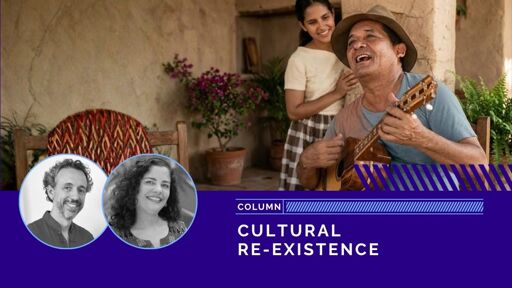
Venezuelan popular artist Luis Mariano Rivera was born on August 19, 1906. His music is a tribute to life and a commitment to his community’s identity and cultural sovereignty. Rivera’s works remind us that when a people sow their land and tell their stories, they become resistant to oppression and invincible against foreign domination.
Canchunchó Florido is a tribute to Luis Mariano Rivera’s home village. Peformed by Gualberto Barreto.
A brief and affectionate profile
In the fertile and sunny lands of eastern Venezuela, specifically in the lush village of Canchunchú in Bermúdez Municipality, Sucre State, Luis Mariano Rivera was born on August 19, 1906, 120 years ago. His life was shaped by the rural realities of this area, which combined the abundance of nature with the profound inequalities of a latifundista-dominated agrarian economy.
His childhood was marked by early orphanhood and farm labor. Far from leading to resentment or resignation, this experience shaped in Rivera a loving and vital sensibility that allowed him to dismantle traditional notions of property and patriarchal-landowner hierarchy, enabling him to identify with the land, plants, and animals that surrounded him. This connection to the land enriched his imagination, and his extended family ultimately came to encompass the entire territory.
Rivera’s creative work blossomed after he turned 48. A self-taught musician, poet, and playwright, he composed his first verses using the Venezuelan four-stringed cuatro guitar as his primary instrument. His artistic output became an act of defiance that placed elements dismissed by the dominant culture at the center of Venezuelan poetry: local biodiversity, manual labor, trees, fruits, and wildlife.
Through his popular theater plays and musical compositions, Rivera portrayed a cosmogony in which nature is not merely a resource to be exploited, but a subject with rights to be loved and respected.
Although he never joined any political party nor sought public office, his approach to life and art constitutes a profound political statement. In a Caribbean and Venezuelan context where the neocolonial oil rentier model displaced agricultural production and fueled the exodus from the countryside to the city, Rivera’s insistence on staying in Canchunchú and singing about rural life was a clear act of resistance.
His politics were rooted in pacifism, fraternity, and love for the land. In the face of the metastasizing commodification of life, he prioritized the ethics of care, respect for natural cycles, and community solidarity. Various artists of national and international renown, including Alí Primera, Lilia Vera, Cecilia Todd, Soledad Bravo, Gualberto Ibarreto, and Morella Muñoz, performed his songs, transforming his local message into a banner of continental identity. Alí Primera, in particular, saw Rivera as a beacon of popular dignity, celebrating his ability to transform everyday rural life into revolutionary and loving poetry.
Luis Mariano Rivera passed away on March 15, 2002, in Carúpano, Sucre State, at the age of 95, after nearly a century devoted to cultivating the poetry of life, simplicity, and affection. His legacy is recognized as a symbol of the musical identity that flows directly from the harmonious relationship with the land and the wisdom of the people.
La Guácara [The Snail] is a tribute to nature and the delicate nature of life. Interpreted by Gualberto Ibarreto.
Sound, memory, and collective identity
In many of the ancestral cultures of Abya Yala, sound is part of the creation myth of the women and men who originally inhabited these territories. For all of humanity, sounds have played an important role in the formation of identities. Languages and music stem from this very relationship and our need to connect, to name ourselves, and to determine our own destinies.
Every landscape has its own sonority. In other words, a set of sounds that form its geohistory. This includes our ways of speaking and our music, but also the sounds of the wind, the rain, the sea, the river, birds, insects. In short, all the sounds of life expressing itself, as well as the sounds of human inventions that are now part of our daily lives.
Within this spectrum, there are human beings who manage to connect the sounds of past, present, and future memories to bequeath a sonic identity that transcends the purely artistic realm, becoming the very landscape narrated in their poetry. Luis Mariano Rivera is an example of this transcendental audacity to place oneself beyond time with a unique music.
At the age of 48, driven by the desire to express himself without relying on others to write his letters and thoughts, he taught himself to read and write. Already in his mature years, he began composing verses, parrandas, merengues, and eastern joropos through which he paid tribute to the flora, fauna, and everyday life of his village.
Rivera’s remarkable sensitivity stems from his direct observation of the countryside. His lyrics preserve idioms, sayings, and oral expressions from eastern Venezuela that would otherwise have been lost. Long before the rise of globalized environmental movements, his songs already championed the balance between humans, wildlife, and flora from a local, community-based, and decolonizing perspective. Rivera’s legacy transcends mere musical composition; he represents a defense of communal life and a living example of how it is possible to reclaim one’s own history to create sounds that cement collective identity.
For him, Canchunchú was not merely a geographical reference point, but the center of the world. By singing about his village and embracing rural daily life as a symbol of belonging with a claim to universality, he created an affective geohistory that recognized the dignity of life as equivalent to that of the cherry, the guácara [snail], and the mango. He showed to his community that their own reality is worthy of being celebrated and sung about. As such, his work did not stem from ego. It was born out of the village’s celebrations and gatherings, and like collective knowledge, it has no other purpose than enjoyment and the strengthening of collective unity.
Singing honestly about one’s own village, honoring the vernacular of one’s community without resorting to artificial language, taught us a sense of pride in our ways of feeling, understanding, and reasoning.
Rivera’s music, paraphrasing Alí Primera, grounds us in our own land, with the profound simplicity of one who surrenders to the magnitude of the surrounding beauty. His deep connection to his native Canchunchú never served as chauvinistic isolation or picturesque folklorism. Rather, it was a gateway to the human condition prior to the violent irruption of Western capitalist modernity, with its imposition of individuality, the commodification of nature, and linear progress, at the expense of communal memory. Rivera’s work operates in the opposite direction: it reconnects with an organic body of knowledge that does not require academia to be legitimate, because it is engraved in the lived collective experience.
It is no secret to anyone that traditional community music, as well as rural poetry, serves as a means of transmitting memory. It is not mere entertainment. Rhythmic patterns, melodic turns, and poetic meter interact with the biological, agricultural, and communal cycles that humankind has cultivated for millennia.
Rivera did not theorize about nature: he embodied it. His philosophy sprang from working the land, from sweat, and from the sounds of the countryside. It is the knowledge transmitted through the body and emotion, that “communal way of life” that predates modernity and remains a reservoir from which to conceive alternatives to capitalism, fascism, imperialism, and Zionism.
True universality does not consist in erasing differences under a single mold with domineering hegemonic pretensions, but rather in reaching our very roots. When we reaffirm the dignity of our communities, we validate the “peripheries” as the center of our own worldviews without the need for external recognition.
Rivera demonstrates that the periphery is a center in and of itself by stripping away the pretensions of colonial modernity. His music taps into the common core of humanity: the wonder of being alive, communal solidarity, and respect for the sacred meaning of life. And this is not a nostalgic gaze toward the past, but rather a reservoir of meaning and hope for the present. It reminds us that beneath the veneer of modernity, the human species remains hardwired to come together, celebrate, and sustain communities.
Finally, Rivera’s production is above all an expression of love. Love toward the full life experience. But when a poet sings about love, it is usually limited to romantic love, or heartbreak in the absence of corresponding feelings. Nevertheless, Rivera did count on a “spiritual companion,” to use his own words: Maximina Marsella, known as La Negra Marsella and whom he affectionately called “la negra,” in what is a very common expression in Venezuela. She was presented as the only woman capable of understanding his silences and his late passion for words. He dedicated many love verses to her, expressing how they shared feelings and devotion for the small things in life and the land.
El Mango is a song dedicated to Venezuela’s ubiquitous tropical fruit as a symbol of shared sovereignty and food sovereignty. Interpreted by Andrea Paola.
Writing our own history and cultural sovereignty
The act by which a dispossessed individual reclaims control over the written word is, in essence, an act of sociopolitical liberation. For Luis Mariano Rivera, the decision to learn to read and write on his own as an adult was not merely a matter of functional education or an attempt to conform to bourgeois standards. It represented taking control of his own narrative and a fundamental reaffirmation of his personal and communal sovereignty. In a system dominated by the colonialism of knowledge, where official writing has historically functioned as a mechanism of subordination and administrative control, mastering the alphabet from the campesino perspective means dismantling the monopoly on truth. Rivera lucidly understood that mastering the written code granted him the historical ability to cease being a passive subject, an object of study in folklorism, and become the chronicler and philosopher of his own time. He ceased to be narrated by others and assumed authorship of his territorial memory.
This literacy and poetic endeavor took place against a profoundly adverse historical backdrop. Throughout the twentieth century, Venezuela underwent a traumatic transformation driven by the emergence of the neocolonial oil enclave. Urban modernization advanced aggressively through its ideological and economic strategy of marginalizing the countryside, dismantling traditional community structures, and promoting rural depopulation in favor of slums in the major cities.
The extraction of hydrocarbons by transnational corporations tied to the geopolitical interests of US and European imperialism came alongside an overwhelming wave of cultural propaganda. This ideological penetration sought to impose the American consumerist lifestyle, eroding peasant identity and dismissing local agriculture as synonymous with backwardness and savagery. Venezuela, which was barely emerging from the devastating aftermath of the war of independence and successive nineteenth-century insurrections, revolutions, and civil wars stoked by local elites and foreign capital, saw its food sovereignty and historical memory shaken.
Amid this landscape of alienation, where the country was rapidly transforming into a consumerist, import-dependent enclave, Rivera’s insistence on remaining in his Canchunchú valley and singing about the communal way of life was not a nostalgic or folkloric retreat, but rather a deeply political and assertive affirmation of cultural re-existence.
He sang with such transparent and loving clarity that his powerful message took root in the national collective imagination, ethically reframing the traditions, sufferings, joys, and experiences of campesinos in eastern Venezuela. Against the aesthetics of waste and the logic of neocolonial dispossession, he countered with the ethics of care and the sacredness of everyday life. His compositions served as a mechanism for preserving historical memory: he warned against the collective amnesia regarding the communal way of life driven by the discourse of developmental modernity; he championed food sovereignty in the face of dependence on the globalizing market; he dignified rural labor in the face of urban prejudice, revealing the profound ecological philosophy inherent in popular knowledge. But, moreover, his profound poetic work demonstrates that true national sovereignty is more than just the defense of natural resources or borders. It requires the preservation of the collective soul, the dignity of the living word, and the self-determination of the people’s power.
Luis Mariano Rivera’s life journey teaches us that decolonization is not achieved solely through theoretical confrontation or bellicose rhetoric, but above all through an organic connection to the land and the community. By recognizing himself through his own voice, he prevented imperialist corporations and the oil industry’s maelstrom from erasing the humanity of his surroundings. His music endures as an indestructible testament to cultural sovereignty: living proof that a people who remember their roots, cultivate their land, and tell their own stories become resilient in the face of modern oppressions and invincible against any attempt at external domination.
Cerecita [Little Cherry] is a song about the miracle of life and a subtle critique of the urban disdain for the simple beauty of rural life. Interpreted by Maria José Delgado and Fabiola José.
Fabiola José is a Venezuelan singer. She has performed in countries across South America, Africa, Europe, and Asia. Her singles and albums are available on all digital platforms. She hosted and produced “Cantante y Sonante” for Radio Nacional de Venezuela. In 2018–2019, she created a series of videos for social media, published on her YouTube channel #HechoEnCasa. She holds a bachelor’s degree in Music from IUDEM, Caracas (2005); specialized under Maestro Tom Krause in Spain (2007); and an M.A. in Arts and Cultures of the South from UNEARTE, Venezuela (2020).
Fidel Barbarito is a Venezuelan musician and researcher, with a bachelor’s and master’s degrees in music and history, respectively. He teaches in the undergraduate and graduate programs at the National Experimental University of the Arts (UNEARTE). Together with Fabiola José, he promotes several musical projects aimed at disseminating traditional repertoires, integrating them with contemporary compositions inspired by these sounds.Joropo llanero. Parranda de reexistenciais one of his published essays.
The views expressed in this article are the authors’ own and do not necessarily reflect those of the Venezuelanalysis editorial staff.
The post Luis Mariano Rivera and the Battle for Cultural Sovereignty appeared first on Venezuelanalysis.
From Venezuelanalysis via This RSS Feed.