

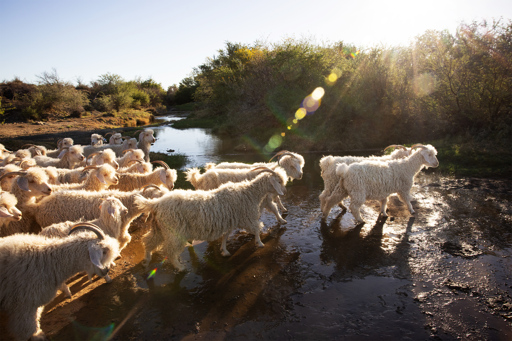
This is the first article in Mongabay’s three-part investigation of spekboom-led ecosystem restoration in South Africa. It is part of an award-winning collaboration between independent science writer Leonie Joubert, the Stellenbosch University School for Climate Studies, and the Henry Nxumalo Foundation which supports investigative journalism in Africa. GQEBERHA, South Africa — The spekboom is to goats what ice cream is to a toddler, say the locals in this little nook of South Africa’s Eastern Cape province. This explains why roughly 90% of the Albany thicket plant biome has been stripped by generations of livestock farming, mostly mohair-producing goats. Where there once was impenetrable bush, many farmlands now look like a desert. This particular plot of cultivated spekboom (Portulacaria afra) — literally, bacon tree in Afrikaans — carries the weight of expectation, though. “These are the old ones,” says Nick Hamp-Adams, gesturing to a dense line of bushes, each a spray of boughs that erupts from the ground like fireworks. After half a century, they stand a little higher than a tall person’s head. Their plush, water-laden leaves create a pointillist hedge that’s hard to see through. Where the lower branches dip to the ground, some send out roots, which allows the plant to spread and further carpet the soil. “The farmer planted them because mud [kept] flooding his barn,” says Hamp-Adams, an environmental policy graduate and general manager at Return to Thicket, a small restoration initiative in this emerging sector. From those humble beginnings in 1976 — a farmer needing…This article was originally published on Mongabay
From Conservation news via This RSS Feed.