

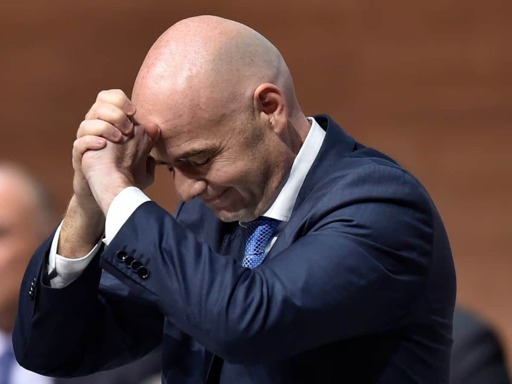

Infantino — The guarantees provided by FIFA did not end the crisis with its UEFA, but they did succeed in temporarily freezing its most critical chapters.
After weeks of tension and threats that European national teams would withdraw from Fifa competitions, the UEFA announced in a statement that it is suspending the boycott. This follows written commitments confirming the withdrawal of a project that had sparked widespread anger within European football — a proposal to sell shares in the rights to future World Cup editions to external investors.
The announcement came after the Uefa meeting in Monaco on the sidelines of the draw for the 2026-2027 European club competitions. While this move appears at first glance to be a settlement, in reality, it shifts the confrontation to a more sensitive level: who rules Fifa, and how are its decisions made?
Infantino — Retreat on the billion-dollar project
Uefa confirmed that the “FIFA Forward Enterprise” project, which was linked to the investment plan for World Cup rights, has been withdrawn finally and irrevocably. Fifa has provided written guarantees confirming that it will not be re-introduced in the future under any different name, structure, or format.
The plan pushed the relationship between the two largest unions in world football to the brink of an unprecedented confrontation after Uefa threatened the withdrawal of European national teams from Fifa competitions during the next season—a move that would have caused a significant sports and institutional crisis.
After receiving the required guarantees on July 30, the UEFA announced the temporary suspension of its threat, following consultation with member national associations. The decision includes competitions such as the Fifa U-20 Women’s World Cup, the Fifa U-17 World Cup, and the Fifa U-17 Women’s World Cup.
However, the word “temporarily” remains the most important part of the decision, as Uefa has reserved its right to re-evaluate its position should the crisis return to the forefront.
From the world cup deal to resetting FIFA
The confrontation is no longer linked solely to the withdrawn investment project. UEFA believes the deeper issue relates to how the international federation is managed and the concentration of power in the hands of its president, Gianni Infantino.
In its strongest political statement to date, the UEFA announced that football officials on the continent have authorized the Uefa president and his administration to use all available institutional, political, and legal avenues to achieve “fundamental reform” in Fifa’s management and to reimpose appropriate restrictions on the powers of the international federation president.
Uefa also demanded an independent external review of the “FIFA Forward Enterprise” project, rejecting the idea that Fifa should investigate its own project — a clear indication of the deep trust deficit between the two institutions.
The European Union also raised a fundamental question regarding the justifications for turning to external investors at a time when Fifa possesses financial reserves of billions of dollars. They argue that these funds belong to the member national associations and that a portion could be used to finance development programs while maintaining the financial stability of the international federation.
Infantino: The next target in the confrontation?
The most sensitive part of the Uefa statement was not the project that was withdrawn, but rather the upcoming elections for the Fifa presidency.
The UEFA announced that if Infantino decides to run for a new term, it will cooperate with partner continental confederations to ensure the presentation of a “credible alternative” to the national associations—one committed to integrity, accountability, and institutional reform.
In practice, this message means that UEFA has not merely forced Fifa to retreat from the investment project; it is hinting at the possibility of a political battle in the upcoming elections should Infantino decide to remain in his position.
Thus, the crisis is transforming from a dispute over selling World Cup shares into a wider conflict over the structure of world football management and the future of its leadership.
Competitions and governance are not for sale
Despite suspending the boycott, Uefa was keen to emphasize that its position remains unchanged in essence: Fifa competitions are not for sale, and world football governance is not for sale.
This reflects that the current de-escalation does not represent a final peace agreement between the two parties, but rather a truce conditioned on written guarantees.
If FIFA adheres to its pledges, the World Cup investment crisis may recede. However, if there are attempts to re-introduce the project in a different form, or if the dispute regarding the concentration of power within the international federation continues, the confrontation may return with greater intensity.
In conclusion, UEFA succeeded in temporarily halting the boycott, but it has maintained political and institutional pressure on Infantino, opening one of the most sensitive battles in the history of the relationship between the European and international football federations.
Featured image via the Canary
By Alaa Shamali
From Canary via This RSS Feed.