

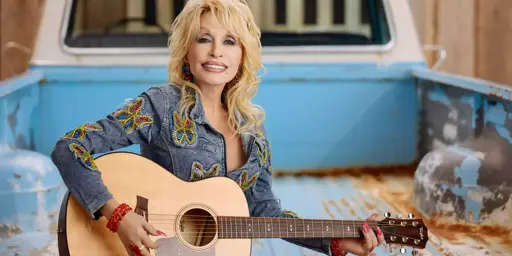

Dolly Parton: Jan. 19, 1946 – Aug. 25, 2026
By JOHN LESLIE
In recent decades, while country music has been homogenized and made safe for suburbanite consumption, Dolly Parton stood out. In a genre that’s rife with phony tough guys and bro country fantasies about “girls,” trucks, and beer, Dolly’s contribution to country is unparalleled.
One of my first thoughts when I heard she was gone from this world was a lyric from the Ray Wylie Hubbard song, Conversation with the Devil, “What you won’t find up in Heaven are Christian Coalition right-wing conservatives, country program directors, and Nashville record executives.”
Dolly Parton died of cancer on Aug. 25. She was preceded in death by her husband of 59 years, Carl Dean, in March 2025.
Dolly started writing songs in high school with her uncle and mentor, Bill Owens, himself a country music songwriter and performer. When Dolly was 10 years old, Owens arranged her first live radio performance on the “Cas Walker Farm and Home Hour” in Knoxville, Tenn. Shortly after her graduation, Dolly and Owens moved to Nashville and began writing songs for other country performers.
Her earliest writing successes in Nashville were songs co-written with Owens: “Put It Off Until Tomorrow” (1966), recorded by Bill Phillips (with Dolly on background vocals); “Fuel to the Flame” (1967), recorded by Skeeter Davis; and “I’m in No Condition” (1967), recorded by Hank Williams Jr. Dolly’s first studio album, Hello, I’m Dolly, was released in 1967, charting two singles, “Dumb Blonde” and “Something Fishy”. Dolly herself estimated that “I’ve written at least 5000 songs. I probably got five good ones.”
At the age of 21, Dolly joined the cast of the Porter Wagoner television variety show, with the duo singing a duet every week. Dolly Parton and Porter Wagoner released 13 studio albums together, putting out 21 singles, 10 of which reached the top 10 on the Billboard Hot Country Singles. Dolly embarked on her solo career in 1974, leaving the Porter Wagoner Show in order to have more control over her career. Dolly was an astute business person, founding her own publishing company when she was 20 and retaining control of more than 3000 songs in her catalog. Her solo output included some classic hits: “Jolene”, “I Will Always Love You” (written for Porter Wagoner), “Coat of Many Colors”, and “9 to 5.” Whitney Houston’s cover of “I Will Always Love You,” recorded for the soundtrack of “The Bodyguard” was a worldwide hit, reaching #1 on the pop, R&B, and adult contemporary charts for five weeks. Dolly invested nearly $10 million in royalties from the song in a Black neighborhood in Nashville.
“9 to 5,” written for her acting debut in the movie of the same name, co-starring Jane Fonda and Lily Tomlin, was a huge crossover hit, reaching #1 on the Billboard Hot 100 on Feb. 21, 1981. The themes of the film highlighted the struggles of working women against sexual harassment and disrespect by bosses, and for equal pay. In all, Dolly appeared in 13 films and numerous television shows. A made for TV movie, “Dolly Parton’s Coat of Many Colors,” chronicled Dolly’s early childhood and the struggles of her family.
I recall a box of rags that someone
gave us
And how my mama put the rags
to use…
She made my coat of many colors
That I was so proud of
Over the years, Dolly worked with other artists. Her duet with Kenny Rogers in 1983 on the song, “Islands in the Stream,” became a huge hit and was followed by another No. 1 hit, “Real Love,” in 1985. Dolly also did two albums, Trio and Trio 2, with Emmylou Harris and Linda Ronstadt, both of which went platinum. Additionally, Dolly recorded her song, “Here I Am,” with pop singer Sia for the soundtrack of the Netflix movie, “Dumplin’.”
Dolly’s final studio album was Rockstar (2023), which teamed her up with rock musicians like Rob Halford of Judas Priest, Ann Wilson of Heart, Paul McCartney and Ringo Starr (Beatles), and Peter Fampton. Rockstar was Dolly’s most successful album of her career, going to #1 on both the rock/alternative and country charts. The single, “World on Fire,” may be Dolly’s most explicit political statement of her career; “Don’t get me started on politics, Now how are we to live in a world like this, Greedy politicians, present and past, They wouldn’t know the truth if it bit ‘em in the ass.” Amen.
Dolly was born in poverty. Her father, Robert Lee Parton Sr., couldn’t read or write and worked as a farmer, sharecropper, and construction worker. Her mother, Avie Lee Parton, was a stay-at-home mom, caring for 12 kids. The family lived in a one-room cabin in the Smoky Mountains of eastern Tennessee. The doctor who delivered Dolly was paid with a sack of cornmeal. Dolly’s mother came from a musical family and had deeply held religious beliefs. While the family attended church on Sundays, her father, reportedly a non-believer, waited in the car outside during services.
Dolly’s upbringing no doubt influenced her attitude and generosity towards others. She strongly believed in the notion that we should love our neighbors and not judge others. While she avoided overt “political” stances, she took positions in solidarity with LGBTQ people, coming out in favor of marriage equality well before it was legalized nationally. She challenged Christians, “I keep saying, ‘Well, if you’re the fine Christian you think you are, why are you judging people? That’s God’s job. We’re not God. We’re not judges,'” she explained. “We’re supposed to love one another. We’re supposed to not judge and we’re not supposed to take vengeance on other people. That’s God’s job.” Dolly also opposed transphobic bathroom bills and anti-transgender legislation—emphasizing respect, personal freedom, and acceptance. Her support was generally reciprocated by the LGBTQ community, which largely embraces her as a Queer icon.
Dolly was also an advocate for childhood literacy in a period in which literacy rates are declining. She founded Dolly Parton’s Imagination Library, which distributes free books to children under five across the U.S. and abroad. Dolly stressed the personal importance of her literacy advocacy, writing, “Before he passed away, my Daddy told me the Imagination Library was probably the most important thing I had ever done. I can’t tell you how much that meant to me because I created the Imagination Library as a tribute to my Daddy. He was the smartest man I have ever known but I know in my heart his inability to read probably kept him from fulfilling all of his dreams.” The program has distributed more than 300 million books and serves more than 3 million children.
In a world where the music industry is all about appearances and illusion, Dolly was the real thing—Real Country. She never forgot where she came from or the struggles of her family and folks like them. She carved out a spot in an industry where women are supposed to live up to certain expectations and smashed all of the expectations. She was kind and empathetic in a time when some on the so-called Christian right are trying to make empathy a dirty word. She stood up for LGBTQ rights, defended trans kids and drag queens, and tried to help kids learn to read. Dolly Parton will be missed; we will always love you.
Photo: Dolly in 2025. (David McClister / Southern Living)
The post Dolly Parton, Real Country first appeared on Workers’ Voice/La Voz de los Trabajadores.
From Workers’ Voice/La Voz de los Trabajadores via This RSS Feed.