

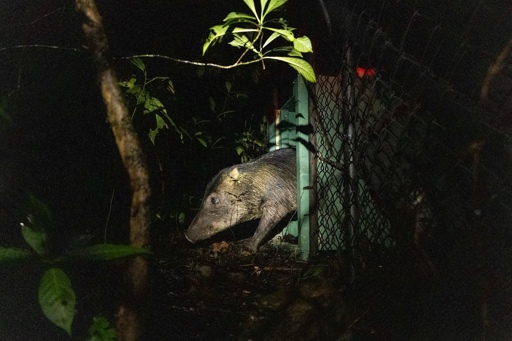
It’s after midnight, and veterinarian Dennise Ortiz Angulo is in the middle of Golfo Dulce, surrounded by shooting stars, bioluminescent water, and 13 boar-like beasts. “That moment, it felt like the movie Life of Pi,” Ortiz told Mongabay. After years of preparation, hours of fast-paced decision-making, and a tedious truck drive, Ortiz, 13 white-lipped peccaries (Tayassu pecari), and a few other humans were midway through a voyage from Costa Rica’s Osa Peninsula to Piedras Blancas National Park. The peccaries had finally settled, and Ortiz had a moment to catch her breath and take in the scene: stars, glowing water, and a boat full of gently breathing threatened mammals. This group had been carefully captured on the Osa Peninsula, where the species still ranges in strong numbers. White-lipped peccaries also used to be found in Piedras Blancas until hunters wiped them out roughly 18 years ago. The plan: reintroduce the peccary to a forest across the water, an ecosystem the animals themselves had helped build. After crossing the Golfo Dulce on boat, white-lipped peccaries are unloaded at the shores of Piedras Blancas National Park. Photo courtesy of Ian Rock. Peccaries are a force. You often smell them before you see them, a musky, garlicky scent that clings to the forest after the herd has passed. They travel in tight, noisy groups that, in Costa Rica, can number 70 to 100 animals, and elsewhere in their range, up to 300. On the night the herd reached Piedras Blancas, the animals began to…This article was originally published on Mongabay
From Conservation news via This RSS Feed.