

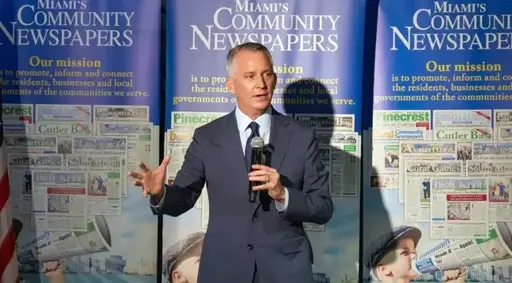
Caracas (OrinocoTribune.com)—Florida Democratic gubernatorial candidate David Jolly has claimed that Washington approved Acting President Delcy Rodríguez as President Nicolás Maduro’s successor in order to subsequently begin profiting from Venezuelan oil, rather than a regime change operation as he would have preferred.
His remarks last Thursday, August 20, echo narratives promoted by a number of differing political sectors since the brutal invasion of Venezuela by the US empire on January 3, which resulted in more than 100 people murdered and the kidnapping of President Maduro and First Lady and National Assembly Deputy Cilia Flores. Many right-wing figures have complained that US ruler Donald Trump failed to establish effective control over Venezuela, while left-wing critics have described Rodríguez as a traitor and claimed that Chavismo was defeated or subordinated to Washington.
Despite this, a number of Chavista analysts dispute both interpretations, arguing that they ignore Venezuela’s coercive circumstances following the US bombing, the killing of more than 100 people, Washington’s seizure of Venezuelan oil revenue, lack or real international support, and continuing threats of renewed military aggression.
Regime change as a bipartisan objective
Jolly made the comments during an interview published by EFE after winning Florida’s Democratic gubernatorial primary. Although he left the Republican Party in 2018 over his opposition to Trump, the former congressman expressed support for regime change in Cuba and rejected socialism and the center-right Democratic Socialists of America (DSA).
“I reject socialism. I reject the DSA. I am a capitalist,” Jolly told EFE. “If Cuba is part of your heritage, I believe the Cuban regime must fall.” Jolly then said he fears Trump could move too quickly against Cuba without preparing for what would follow, citing Washington’s kidnapping of President Maduro as a precedent.
“There is no Delcy Rodríguez in Cuba,” he said, referring to Venezuela’s acting president as a leader tolerated—but not installed or genuinely backed—by Trump. “If we look at what happened in Venezuela,” Jolly continued, “we saw the regime change, but then we gave our blessing to his successor, Delcy, and we simply started profiting from the oil. I’m not sure that has changed anything.”
Jolly expressed hope that Secretary of State Marco Rubio—one of the principal promoters of Washington’s aggression against Cuba and Venezuela—would successfully advise Trump. His statements indicated that his disagreement concerns the planning and execution of regime change rather than Washington’s asserted imperialist right to impose it.
Treason, defeat, or imperial coercion
Jolly did not mention that Rodríguez was sworn in as acting president on January 5 following a Venezuelan Supreme Court ruling issued after President Maduro’s abduction. She was not appointed by Washington, and has repeatedly affirmed that President Maduro remains Venezuela’s legitimate and constitutional leader.
Rodríguez has also continuously pledged to secure the liberation of Maduro and Flores, while Venezuela’s Chavista leadership, political institutions, social programs, communes, and popular organizations remain active.
Previous reporting by the Orinoco Tribune has documented Trump’s open boasts that Washington is taking Venezuelan oil as the “spoils” of its military aggression. Chavista analysts and activists have characterized the resulting arrangement—under which Washington controls significant oil sales and revenue—as imperial extortion imposed through military and economic coercion, rather than evidence of Rodríguez’s potential voluntary submission.
During a recent Orinoco Tribune interview, Venezuelan journalist Andreína Chávez Alava and sociologist María Páez Victor rejected allegations of treason. They argued that assessments declaring Chavismo defeated generally disregard US military superiority, the threat of further bombing, Washington’s control of oil income, and the continued captivity of the presidential couple.
Chávez Alava reported that Venezuela’s Chavista popular base continues to lend its support Rodríguez while criticizing decisions it considers objectionable at the same time. She described this position as critical unity: defending the Bolivarian process against imperial aggression without abandoning internal debate.
The interviewees also argued that Washington retained the Chavista state because its regime-change operation failed to produce a viable replacement. Venezuela’s far-right opposition, they said, lacks the organized popular base required to govern the country and provide the stability demanded by US colonial oil interests.
From this perspective, Washington exercises severe economic and military coercion over Venezuela but has not eliminated Chavismo or secured complete political control. This—according to analysts—helps explain why some US right-wing sectors complain that Trump failed to achieve genuine regime change, even as critics on the left describe the same outcome as proof of Chavista surrender.
Florida’s anti-socialist campaign
Jolly will face Trump-backed Republican Congressman Byron Donalds in November. Despite running as a Democrat and proposing measures related to housing, healthcare, education, immigration, and artificial intelligence data centers, Jolly distanced himself from DSA after member Angie Nixon won the Democratic nomination for the US Senate.
His statements on Venezuela and Cuba demonstrate the broad support for regime-change policies within the political establishment of the US settler colony, despite surface-level disagreements over Trump’s controversial methods and results.
Special for Orinoco Tribune by staff
OT/JRE/AU
From Orinoco Tribune via This RSS Feed.