

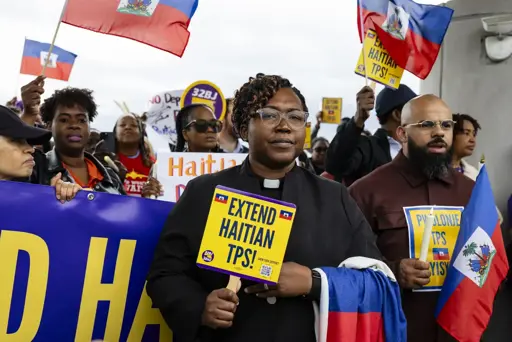
Instead of soaking up the last days of summer at the parks or the beaches, huge numbers of Haitian students and families across New York City are staying home. Mothers and fathers are staying home from work, worried about a potential ICE raid. Children are wondering if it’s safe for them to go to school when classes begin in a few weeks.
This fear is the latest consequence of the Trump administration’s broader campaign against immigrants. The administration has ended Temporary Protected Status (TPS) for Haitian TPS holders, following a series of similar decisions affecting people from Ethiopia, Cameroon, South Sudan, Somalia, Syria, and other countries. The policy allows certain groups from countries with unsafe conditions to live and work legally in the United States for a period of time.
While legal groups and civil rights organizations fought the termination of TPS the courts by filing amicus briefs and class-action lawsuits, the Supreme Court ultimately upheld the decision, leaving hundreds of thousands of immigrant workers and youth without protection from deportation.Deportation flights have already begun, and hundreds of thousands more people are at risk of being removed from the country where they have built their lives.
For those who have been deported to Haiti, the consequences can be devastating. People are being sent to conditions marked by widespread violence and limited access to healthcare — conditions that U.S. imperialism itself has played a direct role in creating. The human cost of this deportation machine is not abstract. We have already seen its consequences, illustrated by the case of a Missouri man who was deported to Guatemala and later found murdered alongside his wife.
For those who remain in the United States, the end of TPS means living with the constant threat of detention and deportation, losing access to the marginal stability that legal status provides. Employment, education, healthcare, housing and other basic necessities are put at greater risk. This is precisely the type of insecurity that Donald Trump seeks to create: a system that enshrines unequal rights and deepens divisions in the working class, benefitting the bosses and the union-busters and making the working class easier to exploit.
The Haitian community is an integral and vibrant part of New York City. More than 200,000 Haitians live in the metropolitan area, including thousands of TPS holders. Across the country, there are over 300,000 Haitian TPS holders and thousands of Syrian TPS holders.
These are public school students and educators, home health aides, nurses, construction workers, and countless other irreplaceable members of society. They care for the most vulnerable members of our communities; they build and maintain homes, roads, schools, and hospitals; they contribute unquantifiable social and cultural richness to the community.
And now, after building their lives here, they are being thrown under the bus.
An Attack on the Entire Working Class
The end of TPS is a direct attack on the immigrant and Black working class in the United States — but it’s also an attack on the entire working class. When one section of workers is denied basic rights and forced to live under the constant threat of detention or deportation, bosses gain another tool to intimidate and exploit workers.
A worker who fears losing their legal status is less able to report wage theft, unsafe working conditions, harassment, or other abuses — or to organize with their coworkers. This makes us all weaker and more vulnerable. The more the bosses can divide us by immigration status, the easier it becomes to undermine our wages, working conditions, and our ability to collectively organize. Beyond abstract solidarity, this is a strategic fight for the entire working class.
That’s why the labor movement must take up this fight.
Temporary protected status was always just that — temporary, and therefore fragile in the face of right-wing attacks. The answer cannot simply be to restore TPS and return workers to the same precarious legal status that left them vulnerable in the first place. Our movement needs to fight for permanent status and full legal and democratic rights for all immigrants.
While Democratic Party politicians will issue statements denouncing these attacks by Trump, especially as the November elections approach, we shouldn’t mistake rhetoric for a winning strategy. In fact, the Democratic Party is complicit in creating the conditions for these attacks. Democratic administrations have participated in the criminalization of immigrants, including the Biden administration’s attacks on Haitian migrants at the border. They have continued to fund ICE and support the U.S. imperialism that has contributed to destabilization in Haiti, Syria, and beyond.
Imperialism is the broader context in which much of global migration takes place: powerful countries economically plunder and indebt poorer countries, interfere in their governments, and drive political, economic, and environmental instability — forcing people to seek safety and opportunity elsewhere. Then, when those people arrive at the border, they are met with militarization, detention, deportation, and policies that relegate immigrants to second- or third-class status. From U.S. intervention in Haiti and Central America to the European Union’s treatment of migrants arriving through the Mediterranean illustrated by the recent crisis in Ceuta, the pattern is predictable: imperialist powers help create the conditions that drive migration, then punish the people who are forced to migrate.
The Democratic Party is no ally in this fight — the workers’ movement must build its own independent power.
But so far, the labor movement has largely condemned these attacks on TPS in words, but not in deeds.
Some unions have issued statements, including the AFL-CIO’s condemnation of the Supreme Court decision. Others have issued “know your rights” information for their members, such as SEIU Healthcare 1199NW. Resources and information can be important, particularly for workers who are facing an immediate threat — but this is a far cry from the potential of the labor movement to mobilize to stop the deportations.
One of the strongest examples so far has come from Teamsters Local 804, which represents UPS and Amazon workers in Brooklyn, passed a resolution defending Haitian and Syrian immigrants against Trump’s attacks on TPS. But resolutions, while necessary, cannot be where the struggle ends.
From Statements to Collective Action
If the labor movement is serious about defending immigrant workers, we need to move beyond statements to collective action, coordinating our response, mobilizing in the streets, and using our power to put our resolutions into practice.
To do that, we need to organize democratic assemblies that bring workers together within and across unions and sectors — including non-unionized, precarious workers as well as the broader community. At these assemblies, workers could debate strategies and democratically decide what actions to take. Rather than the top-down status quo that leaves workers voiceless, the rank and file should have a direct role in determining how our unions respond — through demonstrations, workplace actions, and other ways to disrupt business as usual.
This should include discussion around moving beyond the demand to simply restore TPS, but for permanent legal status and full rights for all immigrants — because the fight for immigrants’ rights and workers’ rights are one and the same.
This is especially important for educators’ unions like the UFT. The union has passed resolutions encouraging members to form committees to defend immigrants, but little material, support or resources beyond one-time trainings have been provided to ensure that these committees can actually build power. If union leadership is serious about defending immigrant students, families, and workers, it must also provide resources, time, and support necessary to turn these commitments into organized action.
This also requires a real, organized and democratic discussion about the need for labor to organize independently of the parties of capitalism — a topic that is increasingly debated in the labor movement and the Left. If we want to build an independent working-class movement capable of fighting for immigrant rights regardless of which party is in power, we cannot allow ourselves to continue to be restrained by the Democratic Party that seeks capitalist stability.
We cannot rely on the courts to save us, Democratic politicians to lead us, nor the bureaucratic union leaderships to fight this battle on our behalf. If an injury to one is truly an injury to all, then the labor movement must turn its statements into action, its resolutions into mobilization, and its solidarity into power.
This Friday, August 28 at 4 PM in Foley Square, we will mobilize alongside our neighbors and class siblings to denounce these attacks and fight for full rights for immigrants, organized by Haitian Women for Haitian Refugees. Join us!
The post The Labor Movement Must Fight for TPS Recipients Facing Deportation appeared first on Left Voice.
From Left Voice via This RSS Feed.