

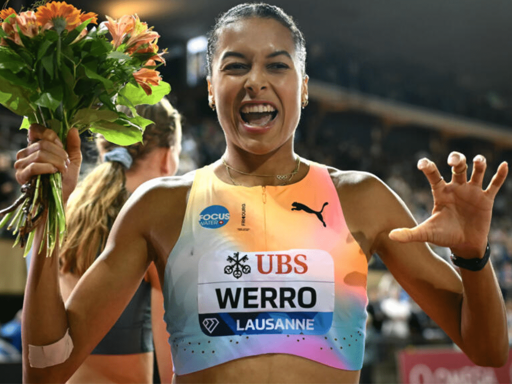

European 800m champion Audrey Werro says she is ready to keep pushing towards one of the sport’s most immovable targets. She continues her rapid rise through the event’s all‑time rankings. The 22‑year‑old Swiss athlete has emerged as the most credible challenger yet to Jarmila Kratochvilova’s world record of 1:53.28. This record was set in 1983 and has remained untouched for 43 years.
Kratochvilova’s time has long been viewed as one of the sport’s most controversial marks. She ran during a period in which Czechoslovakia operated a systematic doping programme, though she never failed a test and has always denied any wrongdoing. The record has survived generations of challengers, tactical shifts, technological changes and the evolution of middle‑distance racing. Nevertheless, Werro’s surge this season has placed her within striking distance.
In June, Werro ran 1:53.80 in Paris, becoming the third‑fastest woman in history and moving to within half a second of Kratochvilova’s benchmark. It was a performance that reshaped expectations around her trajectory and placed her firmly among the event’s elite.
“Things have happened really fast,” Werro said on the eve of Thursday evening’s Diamond League meeting in Zurich. “I was not prepared for a world record this year. I just want to focus on running fast and winning some races and I think with this mentality the world record will fall one day. But I don’t know when.”
A ‘genuine world‑record threat’
Werro’s progression has been steady rather than explosive. A multiple title‑winner at youth level, she has lowered her personal best in each of the last eight seasons. She is building a profile defined by durability, discipline and continual refinement. This year, she has produced three of the 10 fastest times in history. This level of consistency has transformed her from promising prospect to genuine world‑record threat.
Her development has coincided with a shift in her lifestyle and training environment, in her own words:
The biggest difference this year was that I finished university one year ago.
Now I’m just focused on athletics and I just have more time for the competition, the training, the recovery, everything.
That additional time has allowed her to sharpen both her physical and mental approach, saying:
I have worked a lot more in the mentality part over the past two years and you are seeing the result now.
The psychological shift has been evident in her racing style. She is now composed early, assertive late, and increasingly confident in championship settings.
Werro’s trademark celebration is mimicking outstretched claws. This has become a familiar sight at the end of her races. The gesture is a nod to her father, who encouraged her to channel the spirit of a lion after judging her too timid in childhood competitions. It has become part of her identity. Now it is a symbol of the aggression and belief she brings to the two‑lap event.
Hodgkinson absent
Thursday’s race in Zurich will be missing one of Werro’s most familiar rivals. Britain’s Olympic champion Keely Hodgkinson has withdrawn from the meet. She is opting to rest ahead of the Diamond League final in Brussels on 4–5 September. Hodgkinson was beaten by Werro at the European Championships in Birmingham earlier this month. At that event, the Swiss star claimed her continental title with a decisive late move.
In Hodgkinson’s absence, the spotlight shifts to Femke Broeders‑Bol, the Dutch athlete who has transitioned to the 800m this season. She won the 400m hurdles world title in Tokyo in 2025. Broeders‑Bol has adapted with remarkable speed. She is blending her trademark strength with an improving tactical feel for the event.
The 26‑year‑old finished just eight hundredths of a second behind Werro in Lausanne last week. She also claimed European bronze in Birmingham. Her rise has added another layer of intrigue to an event already rich with emerging talent.
“I didn’t expect to be this fast already — to run a national record already — so it has been very nice to surprise myself with my level,” Broeders‑Bol said. Her presence in Zurich ensures Werro will not have a straightforward evening. This is true even without Hodgkinson on the start line.
Britain’s hopes rest with Hunter‑Bell
With Hodgkinson out, Britain’s sole representative in the race will be Georgia Hunter‑Bell. She won world 800m silver last year and has added national and Commonwealth titles this season. Hunter‑Bell has become one of the most reliable championship performers in the event. She combines strong positioning with a powerful final 200m.
She will line up aiming to test herself against Werro and Broeders‑Bol. It will be one of the final major races before the Diamond League finale. For Hunter‑Bell, the Zurich meet offers a chance to sharpen race rhythm. In addition, it is a chance to assess her standing against two athletes who have shaped the narrative of the season.
Werro’s pursuit of history
Werro’s rise has inevitably revived discussion around Kratochvilova’s record. A mark that has hovered over the event for decades, shaping perceptions of what is possible. The Swiss athlete has been careful not to frame her season around chasing the number, instead focusing on the process that has brought her to this point.
Her Paris run demonstrated that she is now operating in a realm few athletes have reached. The margins are small, the demands immense, and the scrutiny intense. Even so, Werro has shown a calmness that suggests she is not burdened by the weight of expectation.
Her approach remains grounded: run fast, win races, improve steadily. The record, she believes, will fall if she continues to build on those foundations. Whether that moment arrives this season, next year or further down the line remains uncertain. But for the first time in years, the event has an athlete consistently operating within touching distance of the most stubborn mark in women’s middle‑distance running.
Werro enters Zurich as the favourite, the form athlete, and the most compelling storyline in the two‑lap event. Her season has already reshaped the landscape. Another fast run on Thursday would only strengthen the sense that history is no longer out of reach.
Featured image via the Canary
By Faz Ali
From Canary via This RSS Feed.