

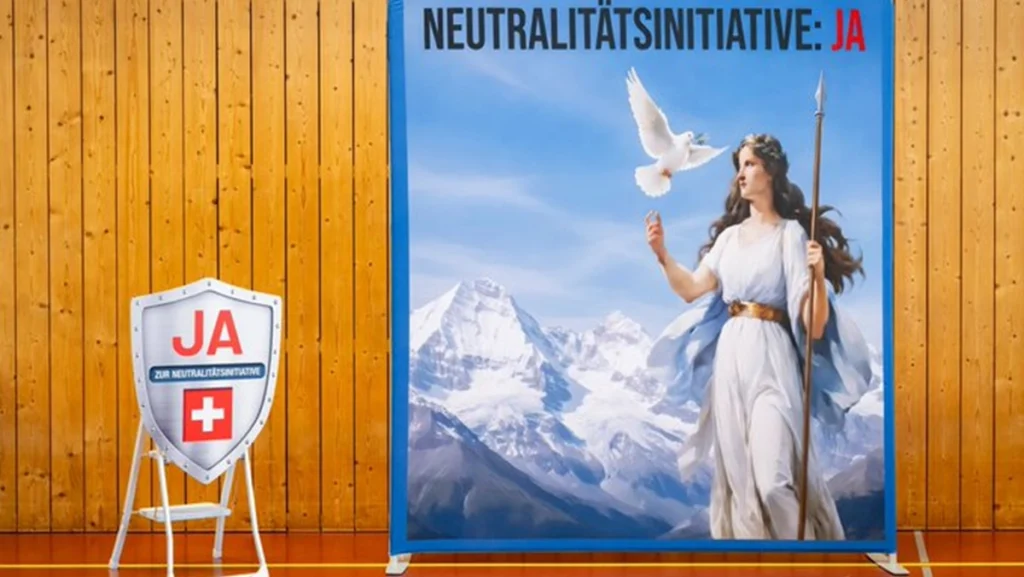
A referendum would enshrine permanent armed neutrality and prohibit military alliances and sanctions against belligerent states.
Swiss voters will soon decide in a referendum on an issue vital to the future of the country’s foreign and defense policy: whether to accept or reject adding a stricter interpretation of neutrality than the current one to the Constitution.
RELATED:
Russia Approves Tax Relief For Businesses Hit By Ukrainian Drone Attacks
The referendum will be held on September 27, although the vast majority of voters will cast their vote by mail, and only a few will go to the polling stations, which that day are only open in the morning.
The campaign ahead of the vote is being closely followed from Russia, as the measures Switzerland has taken toward that country over its special military operation in Ukraine have prompted populist right-wing groups to launch the initiative.
Specifically, the proposal calls for the Constitution — where the principle of neutrality has been enshrined since 1848 — to establish permanent armed neutrality, explicitly prohibit joining military alliances, limit military cooperation, and prohibit the adoption of sanctions against belligerent states, except those approved by the United Nations.
Since the beginning of the Ukrainian war in 2022, Switzerland has aligned itself with the packages of sanctions issued by the European Union (EU) against Russia, and currently 2,790 people or entities linked to the conflict are subject to asset freezes in Swiss territory.
In addition, last year Switzerland signed the convention establishing the International Claims Commission for Ukraine, which entails its participation in a structure whose goal is to establish Russia’s financial responsibility for the damage caused to Ukraine. The Swiss government justified the move as a contribution to accountability and lasting peace.
Another element cited by referendum organizers as supposed evidence that Swiss neutrality is breaking down is that Switzerland has participated since 1996 in the Partnership for Peace program, which allows countries that are not NATO members to maintain bilateral cooperation with the alliance through exercises and training activities.
For Russia, all of this demonstrates that Switzerland can no longer offer its “good offices” because it has ceased to be a neutral place. For that reason, Russia has refused to accept Switzerland as a host for peace negotiations or high-level diplomatic meetings involving Russia, as used to happen before the Ukrainian conflict.
In mid-2024, Switzerland organized a conference on the reconstruction of Ukraine to which Russia was not invited. Afterward, Russian President Vladimir Putin’s spokesman said Switzerland “has considerably lost its neutrality” in the Ukrainian conflict.
Recently, Russian Ambassador to Switzerland Sergei Garmonin said that “Swiss neutrality is a thing of the past” because “it is not impartial and its foreign policy is hostile toward Russia,” while Russian Foreign Ministry spokeswoman Maria Zakharova criticized the Swiss government for opposing the neutrality initiative.
face au rapprochement du gouvernement suisse de l’ OTAN et de l’ UE . Le mouvement Souveraineté Suisse se bat afin de réaffirmer la neutralité et l’indépendance de la Suisse.
il a réussi à avoir, un référendum sur la neutralité pour le le 27 09 2026.
Exemple à suivre ! pic.twitter.com/PozRlmQySZ— PARIS 09 GAULLISTE (@DLFParis09) August 26, 2026
The text reads, “In response to the Swiss government’s rapprochement with NATO and the EU, the Swiss sovereignty movement is fighting to reaffirm Switzerland’s neutrality and independence. It has succeeded in getting a referendum on neutrality scheduled for Sept. 27, 2026. An example to follow!”
The Swiss Government Favors “No”
The Swiss Parliament and the federal government, which form the country’s main political forces and operate collectively, are recommending that citizens write “NO” on their ballots.
Their argument is that neutrality, as it is currently enshrined in the Constitution, gives authorities the room for maneuver needed to defend Switzerland’s interests in a world where security is constantly deteriorating.
The executive and legislative branches go further in their argument, maintaining that if approved, the initiative “would reduce the country’s ability to preserve its security and independence” and “complicate security cooperation.”
“Switzerland cannot afford to wait until it is attacked before beginning to cooperate, as the initiative provides. The consequences for Switzerland’s security would be serious,” the two branches of government argue.
On the opposing side, supporters of the initiative are demanding “absolute neutrality” that cannot be subject to interpretation by public institutions depending on external political circumstances. They say this would prevent the small Central European country from being unwillingly dragged into a war.
From their point of view, approving the text would also “protect” Switzerland from closer ties with NATO and prevent it from aligning with either side in a conflict by ruling out the possibility of sanctions being imposed on a belligerent state.
teleSUR/ JF
Source: EFE
From teleSUR English via This RSS Feed.