

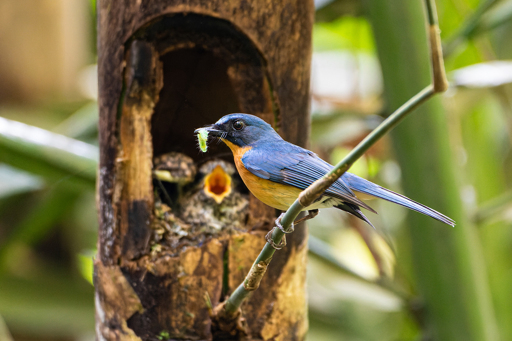
PURWOREJO, Indonesia — As a young man, Parman hunted songbirds here in the Menoreh Hills, a landscape of karst valleys near the Indonesian city of Yogyakarta. The area is now a UNESCO Biosphere Reserve, but back then Parman would raid nests for rare birds, taking fledglings before they had learned to fly, then raising them himself until they were old enough to sell. “Most buyers came from outside the area, especially Yogyakarta and Magelang,” Parman told Mongabay Indonesia in June, referring to the two nearest cities to his home in Donorejo village. “They’d ask local people to catch them, and we’d sell them — for a pretty good price.” The colorful Javan blue flycatcher (Cyornis banyumas), for example, used to be a common sight and sound here in the Menoreh Hills. But the species is now critically endangered, a sad reflection of the depth of Indonesia’s songbird trade. Today, many more of these birds are held in cages than live freely in forests. “Remarkably, the population in captivity likely numbers in the tens of thousands, while the wild population is now suspected to number fewer than 1,000, and maybe much lower,” notes the most recent assessment of the Javan blue flycatcher, published in 2022 by the IUCN, the global wildlife conservation authority. “It became really difficult to find birds here,” Parman said. “So that’s why we stopped, and chose to focus on raising goats instead.” But after Parman and his peers stopped hunting for the songbird trade, they found outsiders…This article was originally published on Mongabay
From Conservation news via This RSS Feed.