

Bullets:
Two Chinese companies in two months successfully recovered their orbital booster rockets.
Reusable rockets mean far more frequent launches, at lower cost.
China had already made enormous strides in space, with quantum advances in satellite navigation, remote sensing, laser communications, and imagery.
The US Space Command is urgently attempting to build out new satellite constellations, and satellites with offensive capabilities.
But the supply chains for satellite manufacturing run through China’s rare earths industries, and aerospace contractors already face severe shortages and long production backlogs.
Inside China / Business is a reader-supported publication. To receive new posts and support my work, consider becoming a free or paid subscriber.
Report:
Good morning.
The most important driver of who wins the space race will be how many payloads can be lifted into orbit. And that is likely to be a function of supply chains that can build the satellites and rockets, and how often those rockets can be used. So we should imagine two races going on: one, in reusable rockets, and the other in the manufacturing chains of satellites.
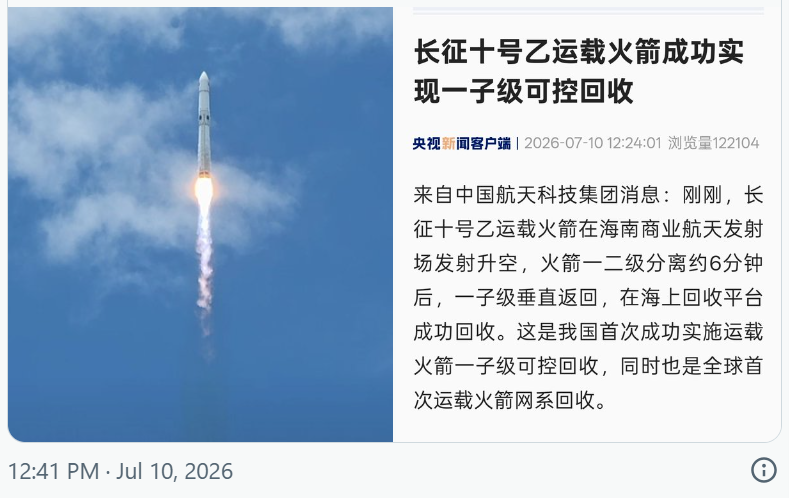
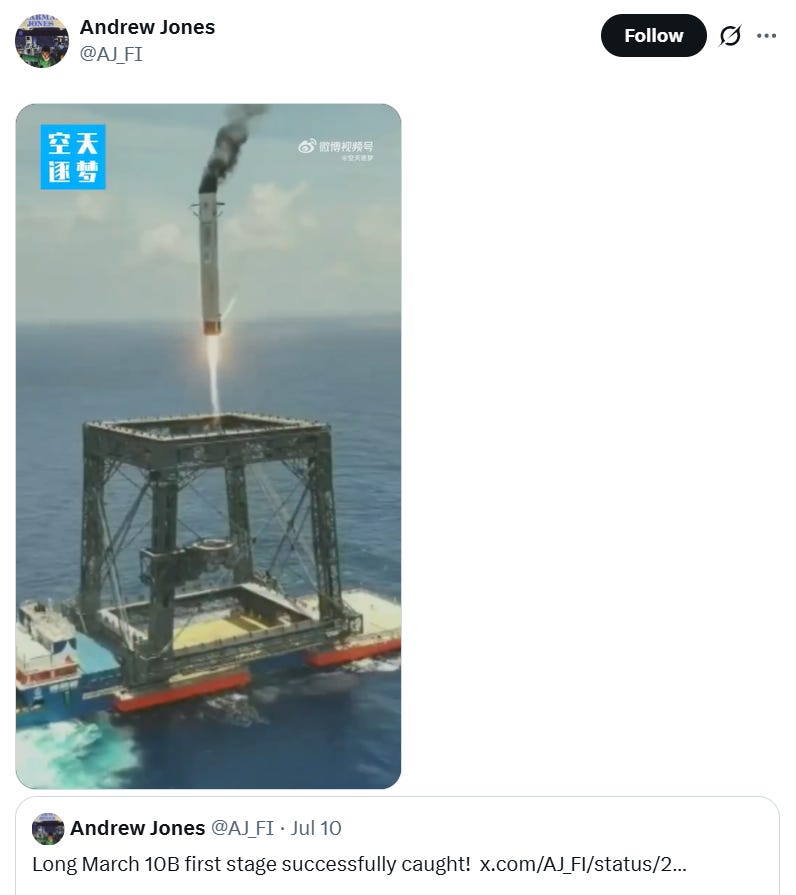
China just became the second country to score big advances in reusable rockets. CASC is a Chinese state-owned company, and now is in the same league as SpaceX and Blue Origin, in recovery of its orbital booster rocket. Their system deployed a sea platform with a net. CASC plans to build low-earth orbit satellite constellations. The net capture means that their rocket can be designed differently, and lighter, because it will not require landing legs.
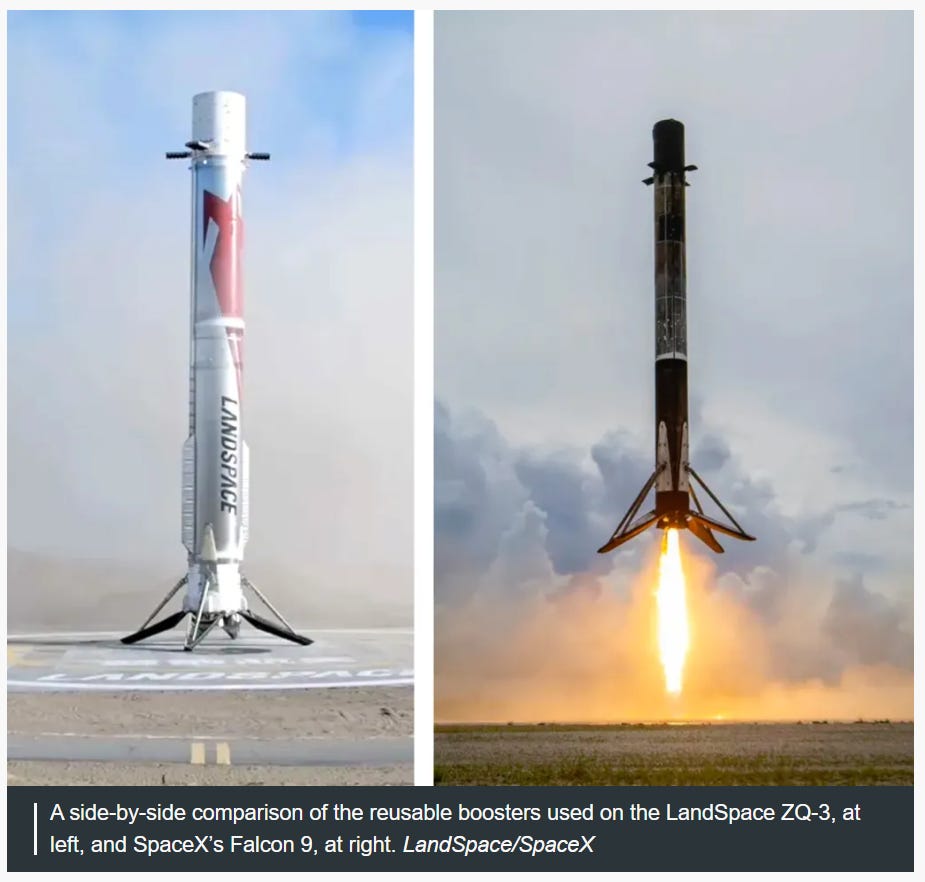
That was in July. Then this month, another Chinese company, LandSpace, launched and recovered its rocket, and also was compared to SpaceX and Blue Origin. LandSpace’s ZQ-3 is compared here to SpaceX’s Falcon 9 rocket. LandSpace’s is less expensive to build, and the stainless-steel design is more durable on reentry. The Falcon 9 carries a larger payload, and is designed for more launches over time:
It’s a major hurdle that both companies have cleared, and allows for lower-cost launches. And that has obvious implications for the strategic and military sectors. More satellites translate immediately into improved capabilities to identify, follow, and engage targets on the ground. Two Chinese companies, two different approaches to reusability and recovery, will right away impact China’s future capabilities to put more satellites up, and more often.
China had already made big strides in space, anyway, before CASC and LandSpace made the news over the summer. China is “catching up fast”, and is already ahead in key metrics. Their Beidou satellite navigation system is a direct competitor to GPS, and has already proven decisive in the Persian Gulf War, after the Iranians switched over to Beidou from GPS.
Remote sensing is the use of satellites to capture data from the Earth, and industry insiders believe the Chinese are already ahead there. Take those together and Washington’s ability to project power are “undermined”, and China’s satellite imagery could be used by adversaries to target friendly forces.
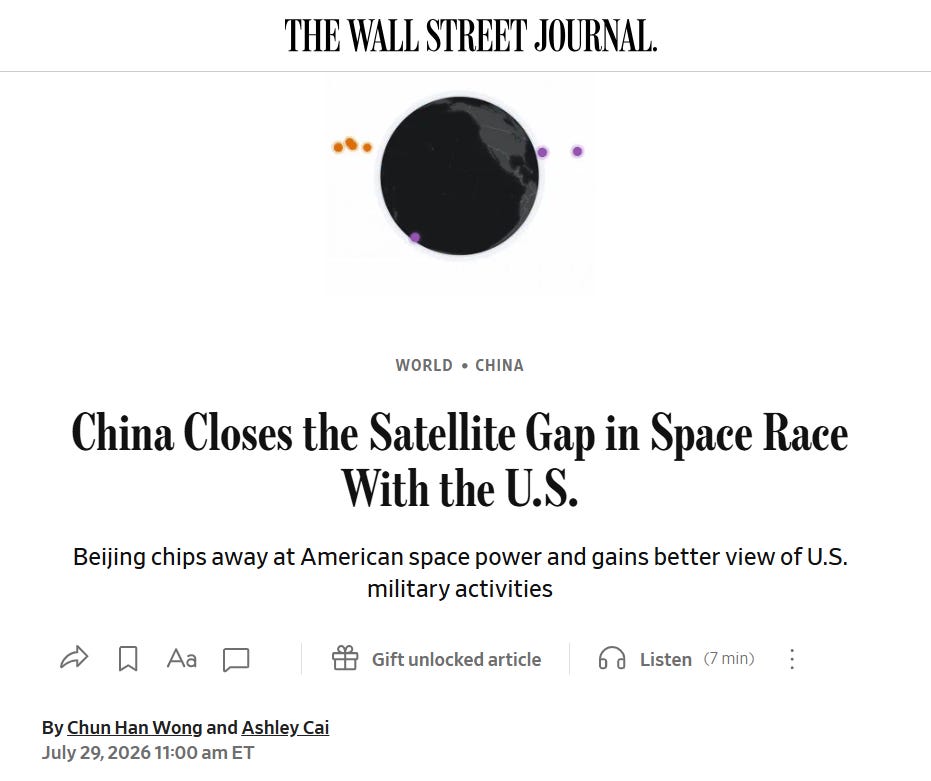
Wall Street Journal, 9 May: High-resolution imagery from Chinese satellites is spreading online, and “China now can do a lot of what the US can do.” China has dramatically increased the number and type of military-capable satellites. In Navigation and Positioning, more than the rest of the world combined. Big numerical advantages in Signals Intelligence satellites, and in radar imaging. In remote sensing China leads the world in research, for sensors and for satellite positioning.
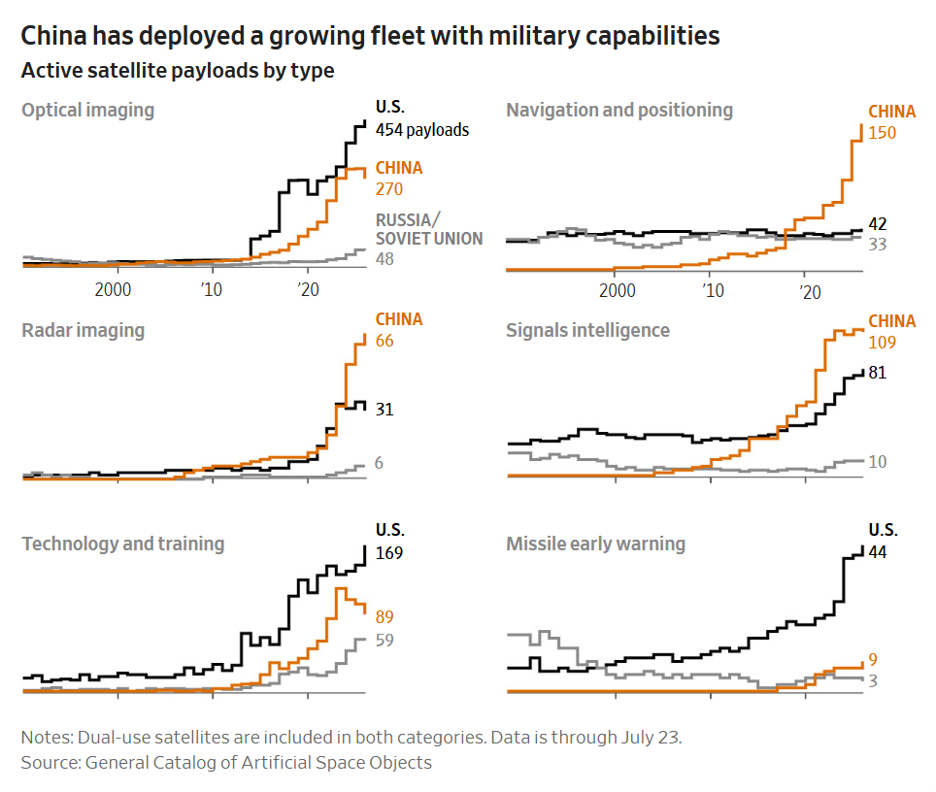
They rank first in five out of the eleven key technologies in remote sensing, while the US systems led in four. Today there are over 510 Chinese military satellites, which is an increase of over five times in just a decade.
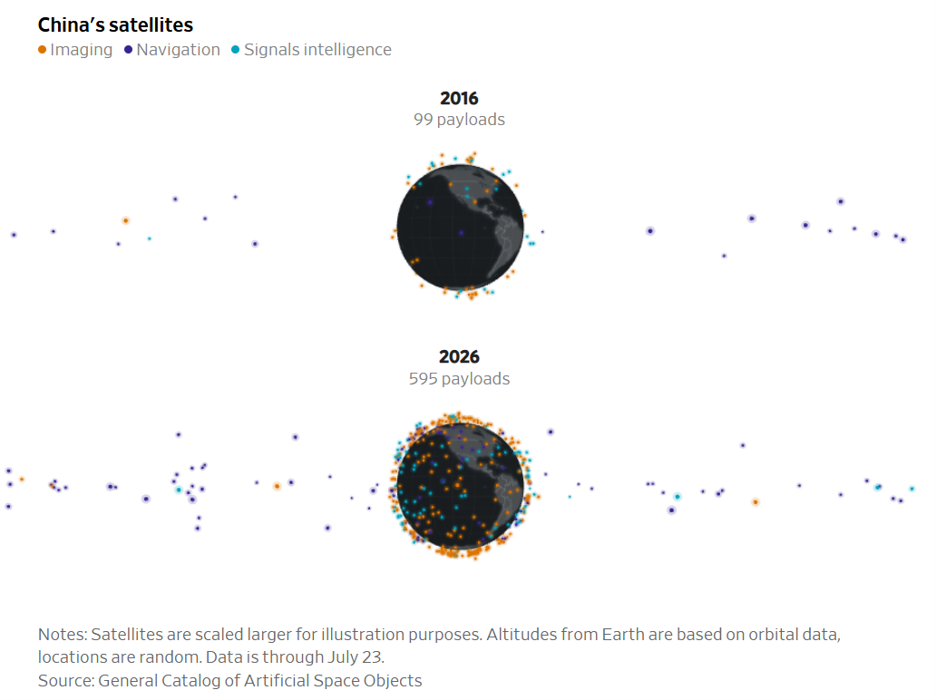
Those newest-generation satellites allow for far higher resolution than was possible with previous models, and can identify and track US assets, even so-called “stealthy” aircraft which aren’t supposed to be tracked at all.
MizarVision is a small Chinese company, a startup. For months the company was posting satellite imagery on social media, including the movements of American bombers and aircraft carriers. It was one of the companies sanctioned by the State Department, in May, and in June the company published satellite photos of the Abraham Lincoln operating in the Gulf of Oman:
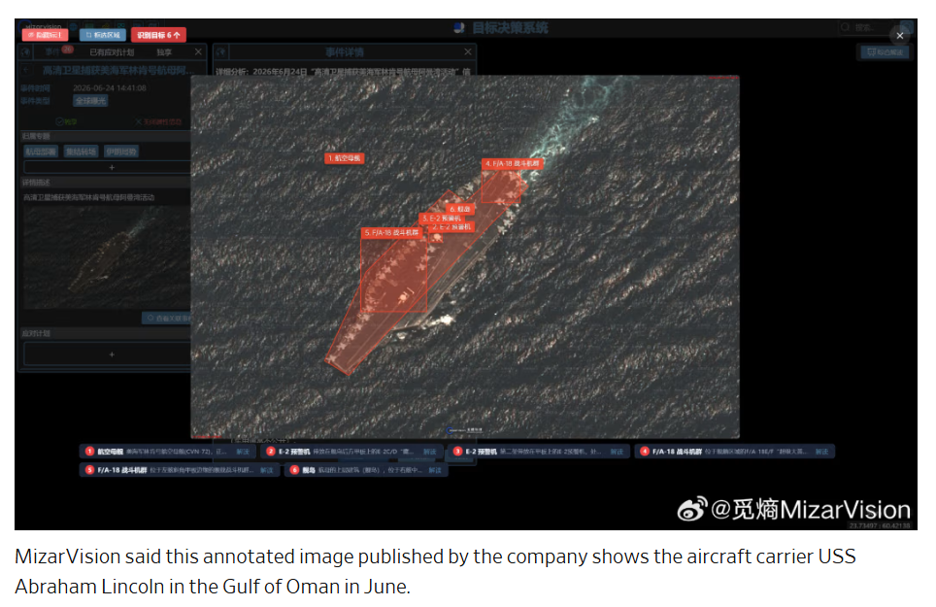
Repeating for emphasis: MizarVision is a startup AI company in China, and so it begs the question of how good the tools must be for the bigger state companies, or those used by the Chinese military itself.
We’ll repeat this part too, that China’s quantum improvements in remote sensing, and in Beidou, and for high-resolution imagery and [satellite laser communications](http://400-gigabit-per-second/ intersatellite comms reduce the need for ground stations https://spectrum.ieee.org/satellite-internet-china-crosslink)—took place before LandSpace and CASC got reusable rockets figured out. The US Space Force is worried what China may be up to in “counterspace capabilities” that might disable American satellites. And the Space Force hopes that these advances in Chinese space technology results in a funding bonanza. We’re reminded of the joke from the Cold War, that the true enemy of the United States Air Force is not the Soviet Union; it’s the US Navy.
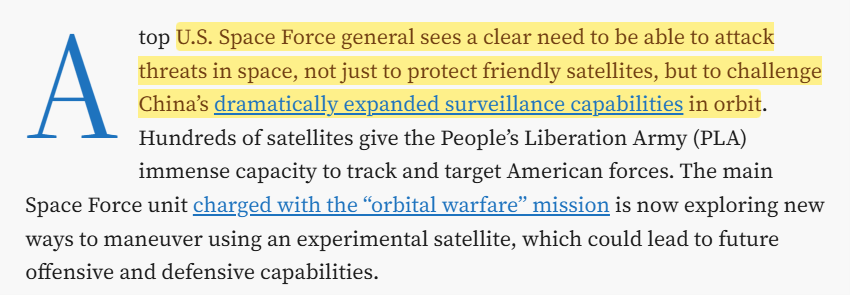
The Space Force needs a lot more money and resources if they’re going to “attack threats in space, not just to protect friendly satellites, but to challenge China”. Space Force wants new constellations of satellites, with lots of smaller ones that would confuse adversaries, the thinking goes. The commander of the US Space Force believes that China has the “second-best remote sensing” systems, capable of tracking US Navy assets in the Pacific, including major surface ships and aircraft.
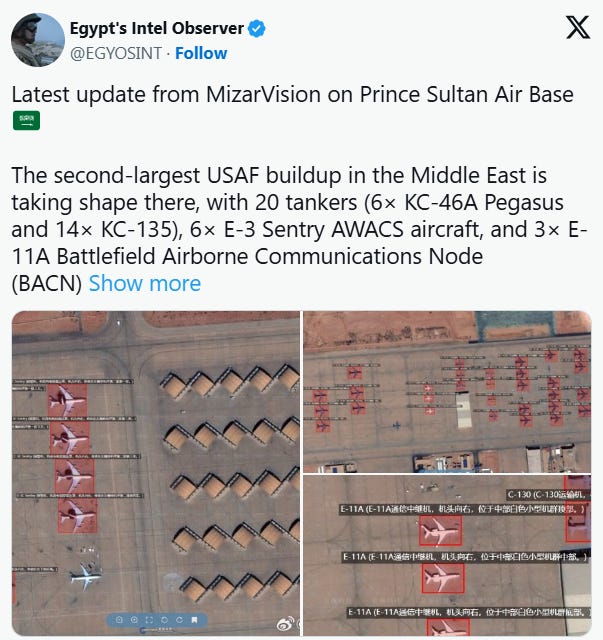
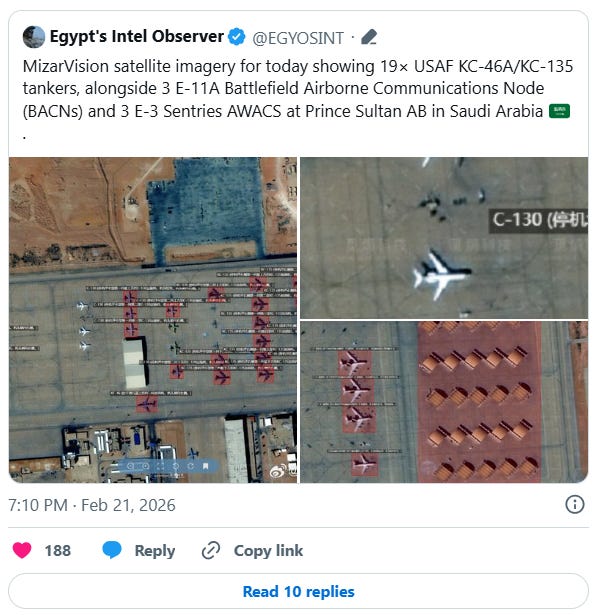
That report was dated February 26th. On 21 February, MizarVision shared imagery of US Air Force planes on Prince Sultan Air Base in Saudi Arabia. Prince Sultan was a staging area for tankers and AWACS aircraft, for the war on Iran that would kick off a week later. In late March, that air base was hit by Iran.
On 18 July, the Iranians hit it again. Numerous aircraft were destroyed or badly damaged, with twelve Americans wounded.
There were other consequences, of that second strike on the Prince Sultan Air Base. House of Saud here is saying here that the July attack put an end to whatever immunity the Saudis thought they still had, and it exposed deep problems with air defense missile systems in the Gulf. Hundreds of millions of dollars’ worth of aircraft destroyed, on the tarmac, and the Kingdom is running out of interceptor missiles. PAC-3 missiles cost $4 million each, and they’re engaging Iranian drones that cost $40,000 each. Those interceptor missiles cost a hundred times what they’re trying to shoot down:
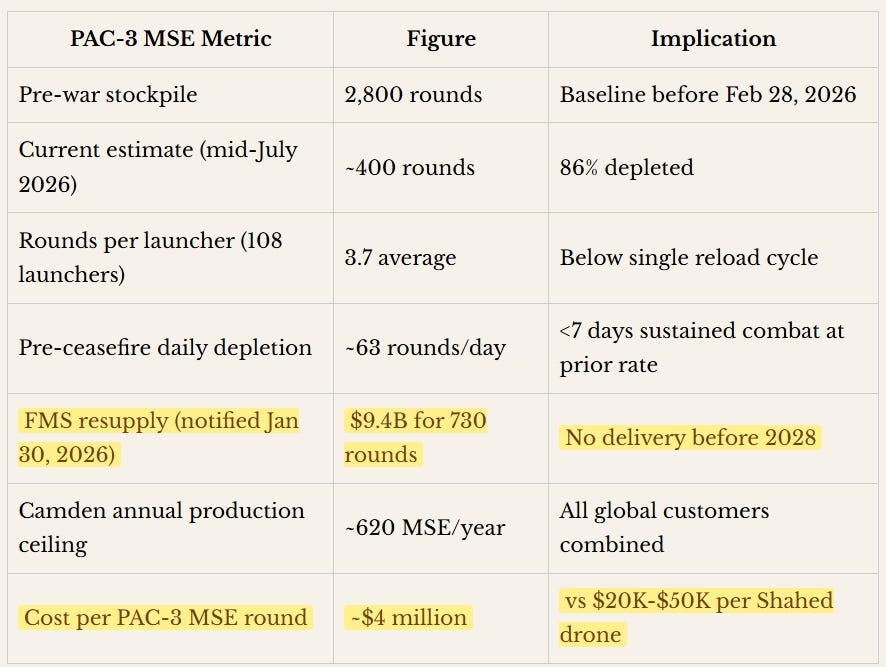
Saudi Arabia began the war—which is only six months old, remember—with 2,800 PAC-3’s. Eighty-six percent of those are gone, and now stockpiles are down to 400. That means each launcher is left is 3.7 each, on average. Saudi Arabia placed an order for 730 more, but those won’t come until 2028 at the earliest.
Before the “ceasefire”, daily depletion was 63 rounds per day, which means that if hostilities with Iran resume, Saudi Arabia will be completely out of interceptors in under a week.
With the wars in Ukraine and in the Middle East, NATO arsenals are being drained much faster than they can possibly be refilled, and now comes news that “China’s access to space” is going to dramatically accelerate, while their costs to put new payloads into orbit fall.
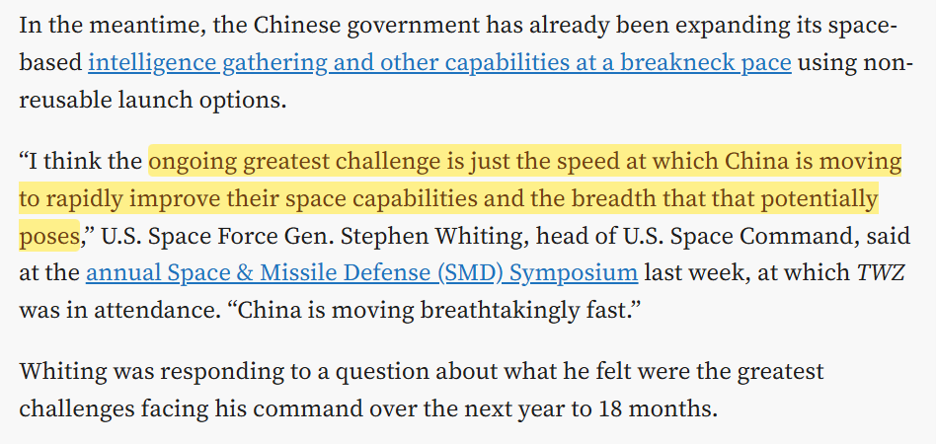
Space Force says that “China speed” is their greatest challenge, and believes now—in August—that anti-satellite systems is the best way forward. They selected 14 companies to design and build new satellite systems. And that leads to the second part of the space race: reusable rockets push the costs down, and enable more launches.
The second is the building and deployment of the satellites themselves. And here we run into another serious China problem: the supply chains for satellites run through the rare earth mines and refineries here, in China. Here is the list of those 14 companies selected for the Andromeda program. Six of those are already under sanction from China.
These are also some of the companies that are being asked to build new interceptor missiles, and other munitions to replace all the ones that have blown up in Gaza and in the Persian Gulf and in Ukraine. That’s to say that these same rare-earth metals and magnets that the Pentagon needs to replace their radars, and their interceptor missiles, and that Saudi needs if they hope to protect their country from Iranian inbounds for longer than seven days—China has locked down the supply chains for all of them.
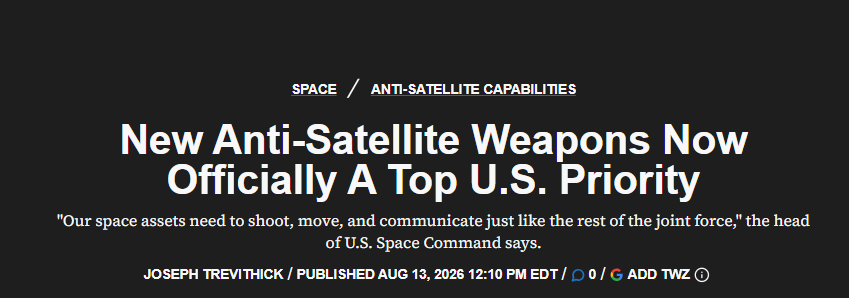
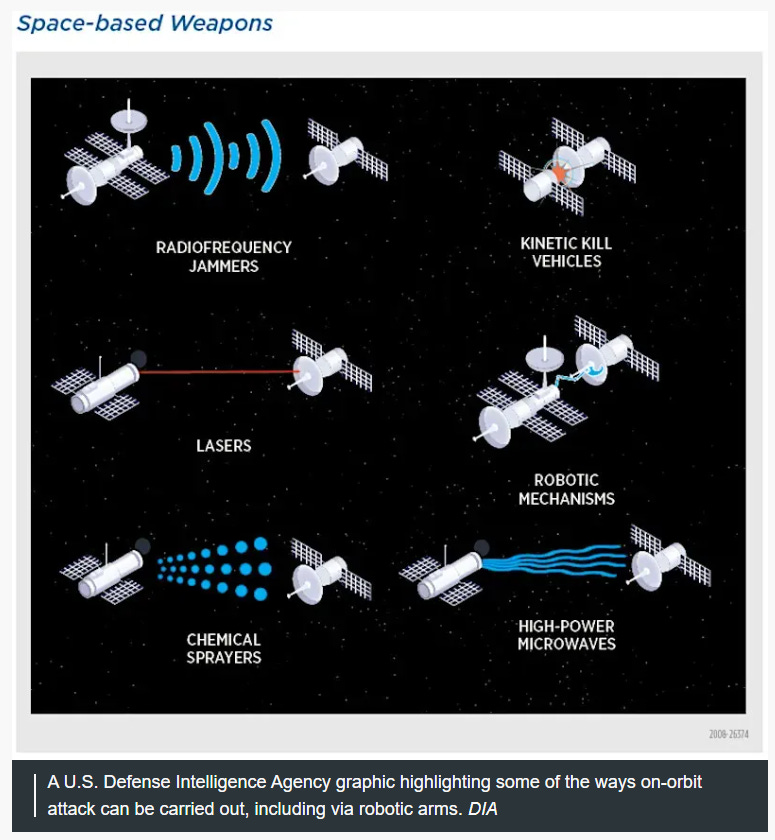
Handing out billion-dollar contracts to build satellites doesn’t mean that any satellites will actually be built. And when Space Force generals say in open-source media that their objective for their new satellites is to kill Chinese ones, we should assume that China won’t help them.
Be Good.
Resources and links:
China becomes second country to recover orbital booster with Long March 10B
https://spacenews.com/china-becomes-second-country-to-recover-orbital-booster-with-long-march-10b/
China successfully lands its Zhuque-3 rocket, rivaling Blue Origin and SpaceX
https://www.scientificamerican.com/article/china-successfully-lands-its-zhuque-3-rocket-rivaling-blue-origin-and-spacex/
China’s reusable rocket advances could strengthen the PLA’s space-based kill chain
https://interestingengineering.com/space/china-reusable-rocket-could-strengthen-the-pla-satellites
Why China’s reusable rocket breakthrough matters for the PLA’s ‘kill chain’
https://www.scmp.com/news/china/military/article/3364878/why-chinas-reusable-rocket-breakthrough-matters-plas-kill-chain
WSJ, China Closes the Satellite Gap in Space Race With the U.S.
https://www.wsj.com/world/china/china-closes-the-satellite-gap-in-space-race-with-the-u-s-12b432b0
U.S. Sanctions Chinese Satellite Firms It Says Helped Iran
https://www.wsj.com/livecoverage/iran-war-trump-news/card/u-s-sanctions-chinese-satellite-firms-it-says-helped-iran-QmNTxxB4I6pV7VYAMThn
China’s Growing Armada Of Spy Satellites Is Pushing Space Force To Go On The Offensive
https://www.twz.com/space/chinas-growing-armada-of-spy-satellites-is-pushing-space-force-to-go-on-the-offensive
China’s Reusable Space Launch Booster Recoveries Have Major Military Implications
https://www.twz.com/space/chinas-reusable-space-launch-booster-recoveries-have-major-military-implications
Iran Struck Prince Sultan and No One Was Required to Say sohttps://houseofsaud.com/iran-psab-strike-managed-ambiguity/
Key E-3 AWACS Damaged in Iranian Attack on Saudi Air Base
https://www.airandspaceforces.com/key-e-3-awacs-aircraft-damaged-iranian-attack-saudi-air-base/
New Anti-Satellite Weapons Now Officially A Top U.S. Priority
https://www.twz.com/space/new-anti-satellite-weapons-now-officially-a-top-u-s-priority
Space Force Picks 14 Firms to Compete to Build Reconnaissance Satellites
https://www.airandspaceforces.com/space-force-14-firms-compete-to-build-reconnaissance-satellites/
China Hits Back at US Sanctions on Tech Giants, Restricting Its Exports to American Defense Firms
https://www.military.com/china-hits-back-at-us-sanctions-on-tech-giants-restricting-its-exports-to-american-defense-firms
Nikkei, China hits dozens of US companies with export controls, procurement bans
https://asia.nikkei.com/economy/trade-war/china-hits-dozens-of-us-companies-with-export-controls-procurement-bans
Last Rounds? Status of Key Munitions at the Iran War Ceasefire
https://www.csis.org/analysis/last-rounds-status-key-munitions-iran-war-ceasefire
Kingdom of Saudi Arabia – PATRIOT Advanced Capability-3 Missile Segment Enhancement Missiles
https://media.defense.gov/2026/Jan/30/2003868787/-1/-1/0/PRESS RELEASE - SAUDI ARABIA 26-13 CN.PDF
China Makes High-Speed Laser Links in Orbit:
400-gigabit-per-second intersatellite comms reduce the need for ground stations
https://spectrum.ieee.org/satellite-internet-china-crosslink
Rare Earth Export Restrictions One Year Later
https://www.csis.org/analysis/rare-earth-export-restrictions-one-year-later
China’s “eyes” and Iran’s “fist”: Iran dumped GPS, switched to Beidou, and won the war
China commands 47% of remote sensing research, while U.S. produces just 9%
https://phys.org/news/2025-11-china-remote.html
Inside China / Business is a reader-supported publication. To receive new posts and support my work, consider becoming a free or paid subscriber.
From Inside China / Business via This RSS Feed.