

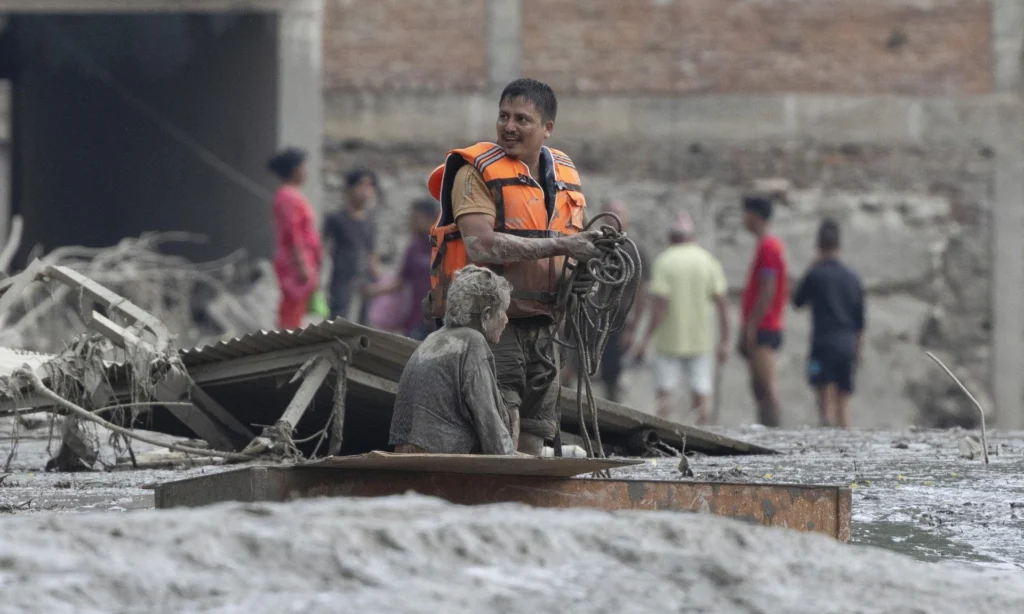
A flood of mud and sediment swept through northern Nepal near the Tibetan border on Wednesday, killing at least 160 people and leaving about 800 missing, with Rasuwa district among the hardest hit.
The torrent, a mixture of water, mud and rock, began moving shortly after 08:40 A.M. local time when a glacial detachment gave way about 20 kilometers from the Rasuwagadhi crossing, the main border post between Nepal and China, according to the National Authority for Reduction and Management of Disaster Risk (NDRRMA). The surge poured into the Lhende river and, by 09:15 A.M. local time, had reached the Bhote Koshi from the Tibetan side.
The disaster hit particularly hard in the Nepalese district of Rasuwa, in Bagmati Province, where a surge in water flow swept through villages, bridges and other infrastructure.
RELATED: China Deploys Rescue Teams After Flooding Hits Tibetan County Near Nepal
The abrupt rise in the water level caught residents of Timure, Rasuwagadhi and Syabrubesi unprepared. Security camera footage broadcast during the day showed houses, bridges, reservoirs and other structures collapsing while dozens of people fled toward higher ground.
Rasuwa district, in Bagmati province, absorbed the worst of the impact, along with parts of Gyirong county on the Chinese side of the border.
JUST IN: Death toll rises to 160, with hundreds still missing in the Nepal-Tibet floods, as devastating new video shows the aftermath. pic.twitter.com/5bqvk52vPB
— Scope Report (@ScopeReport_) August 26, 2026
The confirmed death toll stood at 160 by Wednesday night. Nepal’s police had recovered 157 bodies in the affected areas, and Chinese authorities reported three fatalities in Gyirong county.
There are 384 missing tourists (291 foreigners and 93 Nepalese citizens), along with 44 members of the Army, 28 police officers, 13 members of the Armed Police Force and 60 workers from various hydroelectric projects. China, meanwhile, reported 265 missing, bringing to nearly 800 the number of people unaccounted for in both countries. Until the last official report, 209 people had been rescued: 93 by land and 116 by air.
The flood also destroyed at least 80 bridges, including 35 vehicular bridges and 45 suspended pedestrian crossings, and caused serious damage to the facilities of the Langtang Khola hydroelectric project, whose construction had just been completed and which was scheduled to begin testing in the coming days.
The disaster zone runs along the upper course of the Bhote Koshi, a river corridor that carries traffic between the two countries. The damage to bridges and roads along that corridor disrupted movement through a valley that connects Nepal with the Tibet region.
That’s right, incredible to see a M5.2 resulting from a landslide, leading to one of 2026’s worst disasters. pic.twitter.com/U1jl7lxuAX
— Weather & Earth 25 (@Weather_Earth25) August 26, 2026
Glacier Collapse Suspected
Foreign Minister Shishir Khanal offered a preliminary account in which an earthquake at 08:37 A.M. local time triggered a large landslide, blocked the river course and later produced the flood. For its part, the U.S. Geological Survey initially registered a magnitude 4.4 event 77 kilometers northwest of Kodari at a depth of 10 kilometers, then revised the record and concluded that the energy came from a landslide, with a magnitude equivalent of 5.2, located roughly 55 kilometers northwest of Kodari, not from seismic activity.
The catastrophe fits a pattern documented by the United Nations, which reported in 2023 that Nepal’s snow-capped mountains had lost nearly a third of their ice in just over 30 years. The agency added that glaciers in the country melted 65% faster in the decade through 2023 than in the previous decade, a trend linked to global warming and to a growing risk of glacial floods.
The number of missing, roughly 800, underlines how suddenly the water moved through the valley. Authorities in Kathmandu and Beijing have not released a final count, and the provisional balance could still change as more information arrives.
International Solidarity
The European Union activated the Copernicus satellite system to map areas affected by the devastating flood and announced that it is prepared to mobilize further assistance.
The International Federation of the Red Cross and Red Crescent (IFRC) has released more than €1 million in emergency funds to support the response of the Nepal Red Cross.
For his part, Indian Prime Minister Narendra Modi showed his counterpart solidarity, assuring him that his teams “are closely coordinating rescue and relief efforts,” meanwhile 1en tons of aid have already been sent to Nepal.
From teleSUR English via This RSS Feed.