

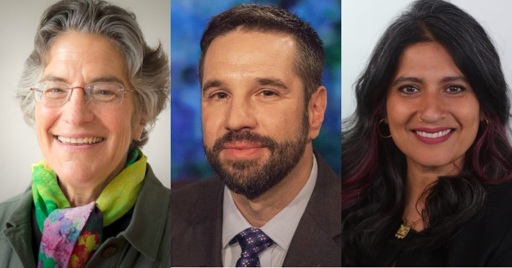
The August 21, 2026, episode of CounterSpin was a special archival show that featured interviews on Afghanistan with Phyllis Bennis, Matthew Hoh (both originally aired August 20, 2021) and with Sonali Kolhatkar, from October 10, 2010. This is a lightly edited transcript***.***
https://media.blubrry.com/counterspin/content.blubrry.com/counterspin/CounterSpin260821.mp3
New York Times (8/15/26)
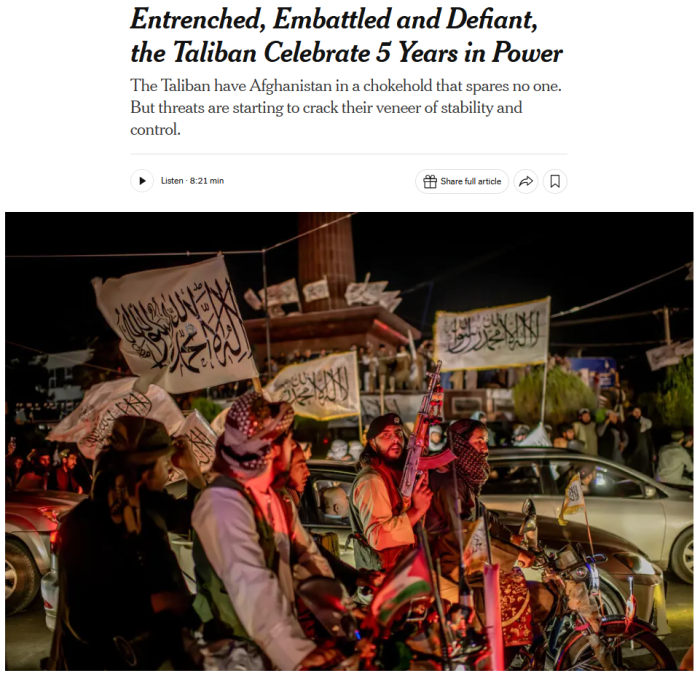
Janine Jackson: This week on CounterSpin: The US news media marked the anniversary of August 2021’s nominal withdrawal of US troops from Afghanistan. A New York Times story explained that Taliban flags were “flying high along the streets of Kabul,” hiding the deeper truth that “the Taliban are holding Afghan society in a chokehold that spares no one.” But, the Times alleges, “The Taliban know the world wants a stable Afghanistan—one that isn’t a source of refugees, drugs or terrorism.” I don’t have enough breath to describe the hypocritical fantasizing in that sort of statement.
But CounterSpin has hosted numerous reporters, researchers and activists over the course of the decades of US devastating intervention in Afghanistan—which did not, in fact, suddenly and righteously begin in the wake of the September 11, 2001, attacks. We’ll hear some of those conversations today.
And I will say, there has been some attention rightfully paid to the abandonment of Afghans who, at great danger to themselves, helped US troops, and who are now being treated as yet more brown hordes seeking to sneak into the US. But those historical, human rights–based conversations are being overwhelmed by storylines like that from the Times, that talks about Afghanistan’s “fragile peace” being “already at risk,” as though the United States hasn’t played a monumental role in making that peace impossible.
And while we’re reimagining history, please recall Dan Rather, on David Letterman on September 17, 2001, describing his definition of his job as journalist: “George Bush is the president, he makes the decisions, and, you know, as just one American, if he wants me to line up, just tell me where.”
We’re going to hear from Phyllis Bennis from the Institute for Policy Studies; from Matthew Hoh, senior fellow with the Center for International Policy; and from Sonali Kolhatkar, host/producer of Rising Up With Sonali, and author—most recently—of Breaking ICE: Community Defense Against State Terror and MAGA Fascism. And there is much more on Afghanistan on our website FAIR.org.
***
JJ: When Joe Biden made the call in the summer of 2021 to officially pull the US military out of Afghanistan, many people were happy, including many who opposed the 2001 invasion in the first place. That didn’t erase concerns about what would happen next—is it just ground troops coming out, and will drone strikes continue?—and whether the US would still honor responsibilities to a country they had occupied and used as a proxy warfront for decades.
We talked with Phyllis Bennis, director of the New Internationalism Project at the Institute for Policy Studies, and author of Before & After: US Foreign Policy and the War on Terrorism and Ending the US War in Afghanistan: A Primer, among other titles.
***
JJ: As events in Afghanistan are evolving quickly, I will note that we’re recording Tuesday, August 17 [2021]. And I would start, just as you do in your new piece for The Nation: We have a lot of questions right now about what’s going to happen. But what can we say about what we’re seeing in Afghanistan, and what may come next?
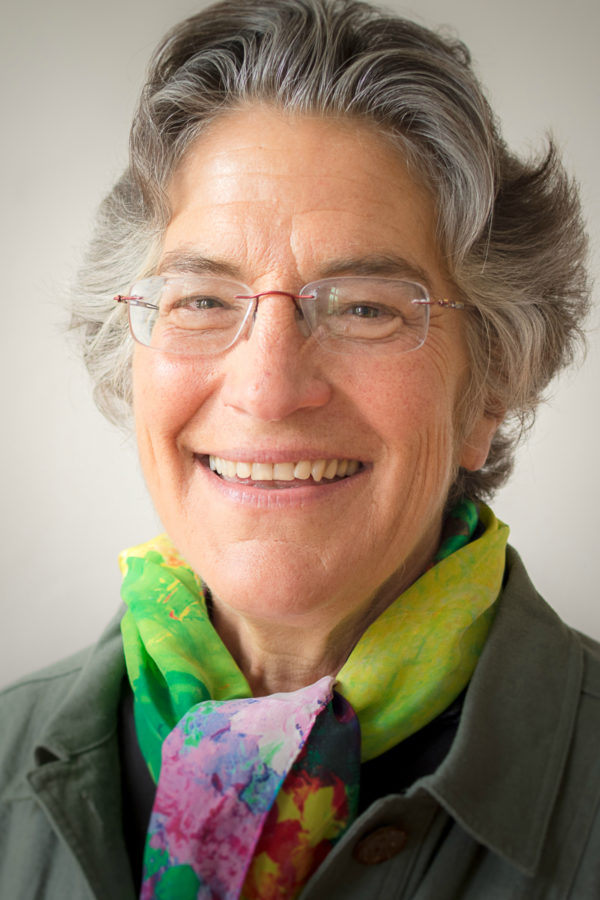
Phyllis Bennis: “This was a war that never should have been waged. The horrific crimes of 9/11 should have been dealt with as international, horrific crimes, and not as the beginning of a global war.”
Phyllis Bennis: I think that it’s very important that we recognize the significance of pulling out US troops, and the limitation of pulling out US troops. The significance is that this was a war that never should have been waged. The horrific crimes of 9/11 should have been dealt with as international, horrific crimes, and not as the beginning of a global war, in which the US interests would be asserted as taking precedence over the interests of every other country, every other people, in the world.
And once it started, it should have ended. Once it was going for a year, it should have ended. Once it went for 10 years, it should have ended. It’s finally ending now, almost 20 years on. That’s way too late. But it’s important that it is ending, the US role.
The limitation of that is that this does not end the struggle, and potentially even war, in Afghanistan. The war is going to be very different without the United States. But people in Afghanistan have a very difficult time ahead. Certainly the people who are afraid of what Taliban control could mean for them and their families personally, because of either their real or perceived connections to the US military, to US intelligence, and to other perceived, and accurately known, as Western institutions, whether it’s journalists, whether it’s nongovernmental organizations, all kinds of people. Women who’ve fought for women’s rights over these last 20 years, many of them are very afraid of being linked to the US occupation and targeted for that, as well as being targeted for being strong women with an independent streak at all.
So there’s a lot of problems ahead for Afghans. Pulling out the US troops, I think, was the most important part of it.
JJ: It’s been odd to see some in the US news media lay the entire state of affairs at Biden’s feet, as though everything was going great, somehow, until he mucked it up. But you explain in The Nation that there are things that we can and should be demanding of the US government now. We can’t undo what the US military did to the Afghan people. But there are things that we can be talking about right now, in terms of accountability.
PB: Absolutely. And I think accountability to the people of Afghanistan should remain our focal point for this next period. First, the number of refugees, asylum seekers, should be massively expanded. We have to expand the categories of people who are allowed in. And, crucially, we have to make it easier, make it possible for people to apply for and get that protection. It’s a huge challenge now, because people that are not already in Kabul may not be able to get to Kabul anytime soon. People in Kabul may have trouble getting to the airport.
But it’s also made harder because the United States, unlike every other country, is not simply opening their borders to people who clearly need protection. They’re demanding that people still fill out all kinds of paperwork that may not be possible right now. So we need to demand that they make it easier, that they make it possible, for people to apply for asylum, for refugee status, for protection, in any way that it becomes necessary.
Intercept (12/18/20)
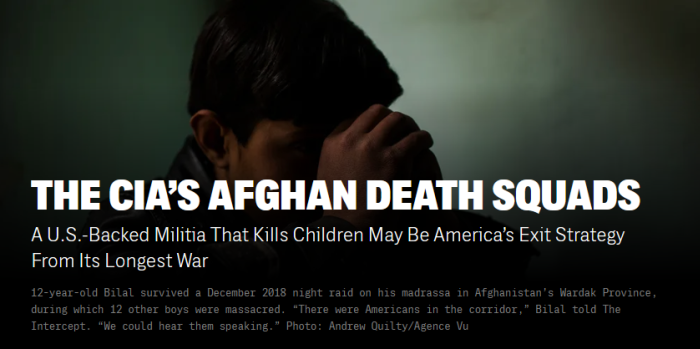
Second, we need to be sure that the bombing raids—both of planes, including B-52s, and drones—that have been carried out in recent weeks have stopped, and that the end of those bombing raids is permanent. The same for the CIA squads that are running death squads throughout Afghanistan. That should be permanently ended, not just at this moment, ready to come back from over the horizon.
Third, we need to be supporting UN and whatever other international efforts emerge to create and defend a humanitarian corridor, guaranteeing safe passage for humanitarian workers to get people in and to get access to water, food, shelter, medicine, for people that are living now in Kabul, and other places, who have been displaced from their homes, can’t get to their homes, and are stuck wherever they are in desperate need.
That has to include funding a massive program for Covid assistance. We’ve all seen the videos, the photographs, of people crowded together, living on streets in Kabul, etc. And these people are smack in the middle of a rising number of Covid cases already. This could become another disaster facing people in Afghanistan.
LA Times (9/13/21)
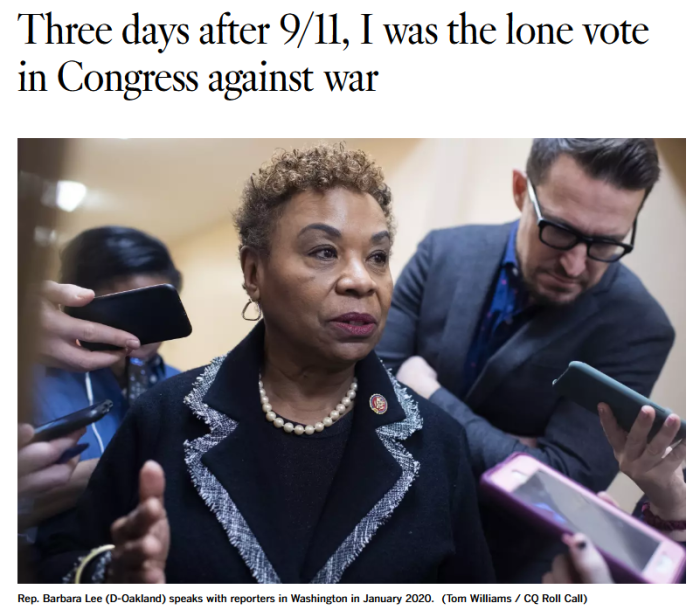
And finally, finally, Janine, I think it’s so crucial, even though it will be a long process, to assess what was wrong about this war from the beginning, why it was so easy for people to support this war, and why people in positions of power consistently supported it, with so few exceptions, like that of the heroic congressional representative from California, Barbara Lee, who was the only member of Congress to vote against the authorization for this war. That’s going to be a long process.
But in the meantime, we need to begin the process of acknowledging US responsibility for the impact of the war, the devastation that the war brought to the people of Afghanistan. We can work on that for years, the issues of reparations and compensation, questions of apology. But right now, we need to move towards acknowledgement that there was a US responsibility for what faced the people of Afghanistan during these 20 years.
***
JJ: In August 2021, we also spoke with Matthew Hoh, senior fellow with the Center for International Policy and a member of the Eisenhower Media Network. I started by asking him to draw a bigger historical picture than the 20-year war media were talking about.
***

Matthew Hoh: “What makes the tragedy about Afghanistan even more tragic is so much of this war, so much of this violence and suffering, it’s got almost nothing to do with the Afghans themselves.”
Matthew Hoh: I think the commentary that puts this war in a 20-year perspective is indicative of why the United States has failed so miserably in Afghanistan.
The United States has wanted this war in Afghanistan to be about Al Qaeda and 9/11. And, certainly, that’s what Joe Biden tried to do in his remarks the other day. And the reality is that this is a living legacy of the Cold War. This war begins, I think you could fairly start it, in 1973, when the king is deposed. And since that time—same year I was born, 48 years ago—there has been nothing but political chaos or violence, war, in Afghanistan. And the majority of that has been instigated to a degree, and supported greatly, by outside nations, chiefly the United States.
And what makes the tragedy about Afghanistan even more tragic is so much of this war, so much of this violence and suffering, it’s got almost nothing to do with the Afghans themselves.
The United States and the Soviet Union in the 1970s looked at Afghanistan as a forum of competition: Who is going to get Afghanistan to reflect their color on the map?
JJ: Right.
MH: Is Afghanistan going to be blue, or is it going to be red? And so I think that’s why you have these circumstances that unfold from that.
In 1979, before the Soviet Union invades, the Carter administration launches a policy of supporting Islamist rebel groups in Afghanistan, because in Zbigniew Brzezinski’s, Jimmy Carter’s national security advisor, in Brzezinski’s vision, the idea would be that we would utilize these Islamist rebel groups in Afghanistan to cause problems in Afghanistan, to bait the Soviet Union into invasion and give them their own Vietnam. And this occurs six months before the Soviet Union invades.
And so the Soviet Union does that. And the Soviet Union, of course, is certainly responsible for its actions. And one of the things we know about the Soviet Union’s decision to invade Afghanistan in 1979 was that it was in many ways influenced by the American removal from Iran. You can find this in discussions from the notes from the Politburo from the time. But the Soviets are worried that because the Americans lost their bases in Iran, that the Americans are now going to go into Afghanistan.
So even from this vantage point, you’re right; 40-some odd years later, you can still see, in our current decision making, how little of the United States’ decisions about Afghanistan have been about the Afghans themselves.
Certainly 9/11, where you’re talking about an organization of less than 400 people, Al Qaeda, 400 people worldwide, 9/11 attacks, where none of the hijackers were Afghans. Almost all of the planning, the training, the support for the attacks came from Pakistan, from Germany. The hijackers met in Malaysia, in Spain, possibly in the UAE or Qatar. And then, of course, we had hijackers here in this country for 18 months before the attacks. The most important training the hijackers received was in American flight academies and martial arts academies. But somehow it’s about Afghanistan.
And the United States, of course, is not the only one who is culpable in this. The Pakistanis, the Iranians, the Indians, the Russians, etc., many different nations have been playing what used to be called in the 19th century “The Great Game”—
JJ: Right.
MH: —you know, treating Afghanistan as if it is a real-life version of the game Risk.
JJ: Exactly.
MH: And the Afghan people have just endured unbelievable suffering because of that.
JJ: I was actually just going to invoke the game Risk. It’s all like an abstract chess game, as it were, and US media sort of present it that way. And had no hesitancy to move the goalposts: “Well, we’re punishing Al Qaeda.” “No, we’re saving women.” “No, we’re building a nation state.” It’s as if the goal doesn’t matter, because you’re just supposed to get behind whatever the US is doing.
Right now, US media news consumers are seeing chaos and calamity. And it’s being reported as being caused by the withdrawal of US troops. So a binary mindset says, “No! I don’t like chaos. Put the troops back.” Unfortunately, the general run of media coverage doesn’t really stay at a level much more subtle than that. So I want to ask you, how do we gird ourselves? What should we be holding in mind as this very war-framed conversation swirls around us in the coming days and weeks?
New York Times (8/20/21)
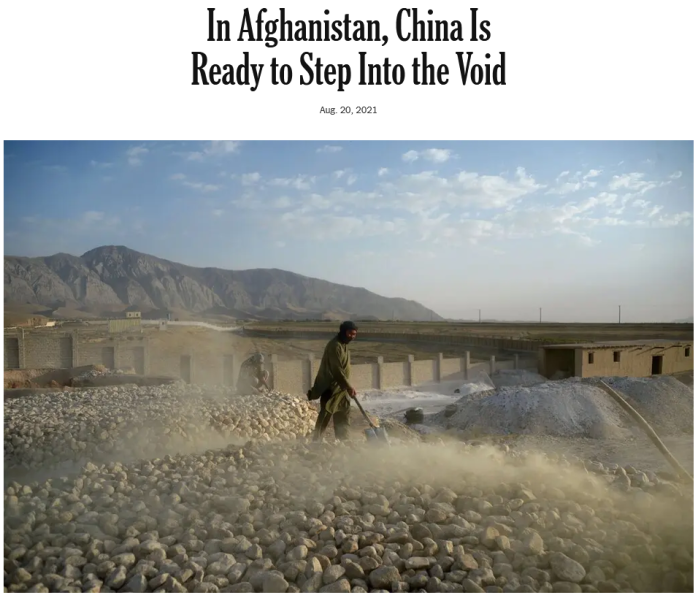
MH: I think we want to think that the events that are occurring right now, we have complete agency over, and they’re not influenced by the past, not influenced by history. And I think we have to be very much aware of that. So as you hear people say why we shouldn’t leave Afghanistan—I wish I was joking about this, but you see commentators, “serious” commentators, as people in DC would describe them: “If we’re not in Afghanistan, then the Chinese will be.” That’s what the Soviet Union said: “If we’re not in Afghanistan, then the Americans will be.”
That’s what the British said in the 19th century: “If we’re not in Afghanistan, the Russians will be.” Turns out the Russians never had any plan to invade Afghanistan in the 19th century. But the British invaded Afghanistan at least three times because of that.
So I think it’s important to tie ourselves to history, to understand how the same things keep unfolding. One of the things I think is important, too, is that, look, Joe Biden was in office, he was a US senator, when the Vietnam War ended. Just because something happened 50 years ago doesn’t mean that our people who are in power, making these decisions, aren’t the legacies of that.
Just as I described the Afghan War as being a living legacy of the Cold War, it still exists.
Take a man like Donald Rumsfeld. He was the Secretary of Defense when the Vietnam War ended. I had this experience one time when I was in the Marine Corps, and Donald Rumsfeld came up to me, and he pointed at a portrait of Eisenhower that myself and a friend were standing in front of. And he said, “You know how old I am? I’m so old I used to work with that guy.”
And so you can understand that. The man who was in charge of the Defense Department at the end of Vietnam had worked with Dwight Eisenhower. Dwight Eisenhower was old enough to have known and worked with Civil War veterans. So we’re not actually that far removed from history.
So to think that what occurred in the 1970s in Afghanistan, what occurred in the 1980s in Afghanistan, what occurred in the 1990s, doesn’t have repercussions now is one of the reasons why, I think, that the media coverage and people’s understanding of the war is so very basic, is so limited.
***
JJ: Christiane Amanpour couldn’t have been clearer, declaring on CNN this August 15, “The US invasion of Afghanistan after 9/11 expelled the Taliban and ushered in a time when women could work, learn and dream again.” A hot second after it was about defeating Al-Qaeda, the invasion of Afghanistan became about freeing Afghan women and girls.
CounterSpin interrogated that storyline with Sonali Kolhatkar. She’s host/producer of Rising Up with Sonali, and author of Breaking ICE: Community Defense Against State Terror and MAGA Fascism, and also, with her partner James Ingalls, Bleeding Afghanistan: Washington, Warlords and the Propaganda of Silence, which was published in 2006 by Seven Stories Press. Here she is talking with FAIR’s Peter Hart in October 2010.
***
Time (12/3/01)
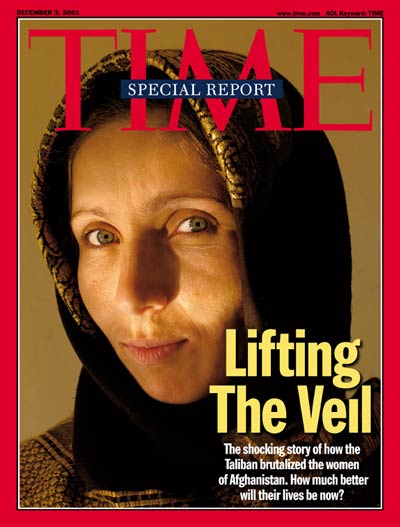
Peter Hart: As the US war in Afghanistan began, the cover of Time magazine on December 3, 2001, announced: “Lifting the Veil: The Shocking Story of How the Taliban Brutalized the Women in Afghanistan. How Much Better Will Their Lives Be Now?” Almost nine bloody years later, with the war grinding on, the cover of Time magazine features a disfigured Afghan woman and the text, “What Happens if We Leave Afghanistan?”
The political context for both of these statements is fairly clear: One a hopeful signal that the war has been launched to liberate women in Afghanistan. And now, more recently, this week’s Time comes amidst growing doubts about that war, and the release of tens of thousands of classified documents that portray the violence and confusion of the US war.
As the Obama White House tries to craft a coherent defense of the war amidst talk of “timelines” and “benchmarks,” Time magazine is signaling that the original defense of the war should still hold up. But does their argument make sense?
Sonali Kolhatkar is host of the radio program Uprising, based at KPFK in Los Angeles. She’s co-director of the Afghan Women’s Mission and co-author of the book Bleeding Afghanistan: Washington, Warlords and the Propaganda of Silence. Sonali, welcome back to CounterSpin.
Sonali Kolhatkar: It’s my pleasure. Thanks, Peter.
PH: We’re probably beyond the point of asking how people felt when they saw this Time cover; the intent is so obvious and their editorial explanation suggests little in the way of nuance. Why Time did this is clear, as their managing editor Richard Stengel explained when he was on NBC’s Chris Matthews Show:
What we have brought to that country was freedom for women in a way that they’d never had before. Girls are going to school, women are in parliament, women are on television.
The flip side, obviously, is that women are brutalized by the Taliban, and thus we must stay in Afghanistan. What do you think when you hear comments like Stengel’s, and see this cover story in Time magazine?
SK: The reality is much more nuanced than what most people like to admit. First of all, what Stengel says about us bringing freedom to Afghan women is ludicrous. There are a few things that Afghan women did gain as a result of the US defeat of the Taliban, and most of those were on paper. They were constitutional; there are now quotas in the government for women’s representation, and even a line in the constitution that says women are equal to men. But also in the constitution is the line that Islamic Sharia law is the supreme law of the land, and that was done in order to appease the US’s Taliban-like friends, who are just as misogynist as the Taliban.
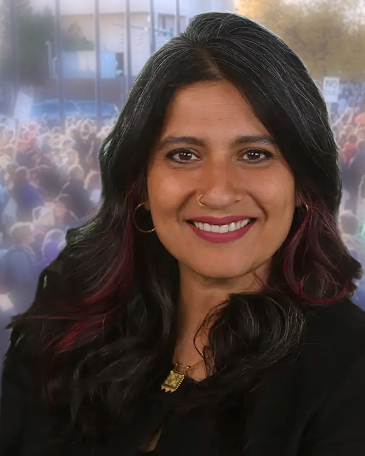
Sonali Kolhatkar: “We create this distinction between misogynists who are enemies and misogynists who are friends, but to Afghan women, there is no difference.”
And what neither Time, nor what many of these mainstream reporters admit, as well as members of the Obama and before that Bush administration admit, is that when it comes to women’s rights, as long as they’re our friends, it doesn’t matter if we undermine women’s rights with the empowerment of misogynist warlords. We create this distinction between misogynists who are enemies and misogynists who are friends, but to Afghan women, there is no difference.
For example, in today’s Afghanistan under US occupation, there are record numbers of women in prison, languishing in prison, for these so-called “honor crimes,” that have been put there by judges appointed by our guy, Hamid Karzai. There are warlords with known histories of criminal, violent behavior, condemned across the world, that are in parliament. Members of parliament who are women have been kicked out of parliament by men like this. This is supposedly the freedom that Afghan women got.
And under our own occupation, the Taliban, that many people in Afghanistan really reviled, are now becoming more popular, because they’re able to say that ‘we’re fighting US imperialism.’ And so in a strange way, the US has actually empowered misogynists on both sides of this war. The Taliban are becoming more legitimate among Afghan people, even though the majority of Afghan people don’t agree with their anti-women policies, but because they’re the only ones who are claiming that they’re protecting people from the bombs of NATO and the US.
The Time magazine cover should have said something to the effect of, well, this is what is happening to women under our occupation.
And another thing that Rick Stengel didn’t admit was that Afghan women did enjoy freedoms, to an extent, before the Soviet invasion in the late 1980s. And we forget that this history happened. It’s not like we freed Afghan women from some barbarism, and gave them a taste of freedom that they never knew. They had freedom, and they had some level and measure of freedom, but that was all set back because of war and foreign interference.
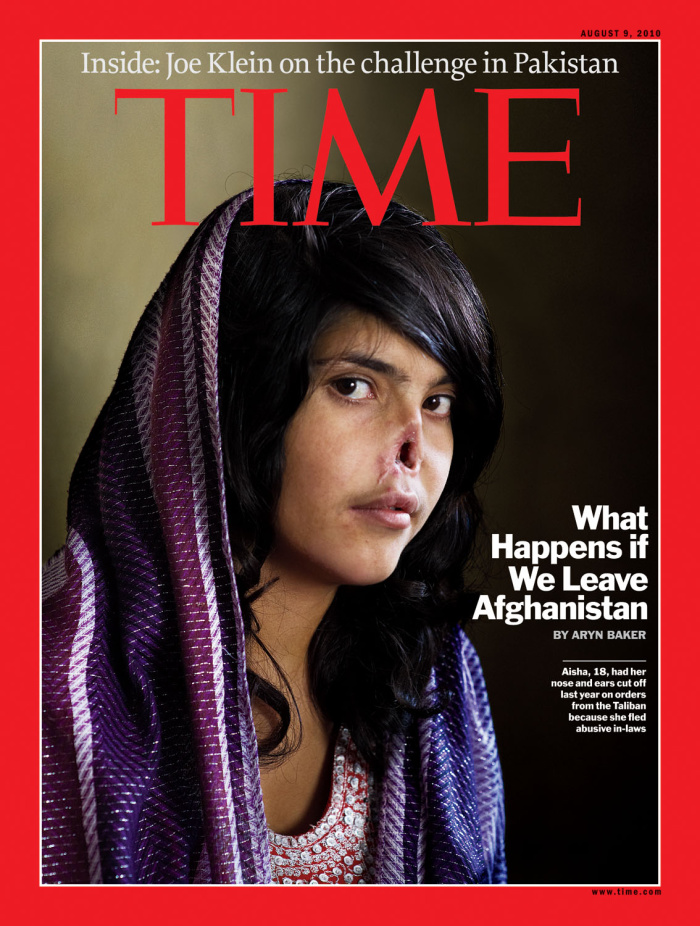
Time (8/9/10)
PH: You see that, actually, in the Time magazine piece, that there is a paragraph that mentions that 40 years ago, Afghanistan was a fairly cosmopolitan country, particularly in Kabul, so you get this sense that the piece is somewhat at odds with the cover. It begins to fall apart further when you think that this woman who’s portrayed on the cover, this happened to her last year, so the presence of US troops in her country did not help her one bit.
You do see this debate breaking down along two lines, and it’s a very difficult debate to engage, but it’s the one that’s in the media. You have to support the US war in order to impede the growth or the spread of the Taliban, or you end this war and you unleash this wave of barbarism across the country. You’re given those two options in the media, and it seems like it’s very difficult to choose the latter.
SK: I think what a lot of people are missing is that the issue of women’s rights is essentially a red herring in Afghanistan. No one really cares about women’s rights; they only care about women’s rights when it becomes important to justify the war, for example, in 2001, and now when the support for the war is flagging. Inside Afghanistan, the issue of women’s rights—whether it’s legal rights, whether it’s political rights, human rights for women, etc.—it changes with time, depending upon who’s in power in which locality. But who’s fighting wars, and which foreign armies are fighting wars, and which misogynist or fundamentalist warlords are fighting wars on the ground, makes little difference for women.
And so I think it should be made very, very clear to most people, women’s rights have always been a PR effort for the US military. They’ve always been part of the PR effort. Wars are not fought to liberate women. Wars are fought over power, but never to liberate women.
If you want to find out what Afghan women, and what a true Afghan hero, a woman like Malalai Joya, who is respected and loved throughout the country, what she really thinks about the US occupation, read her book. On page 1 of her book, she criticizes the US occupation, and she has long called for the occupation to end.
And what she and other women’s rights activists in Afghanistan are saying: Right now, we have three enemies on the ground. We have the US and NATO occupation, we have the government warlords in the parliament, and we have the Taliban. It’s better for us to fight against two instead of three enemies, and so they want the US and NATO out of there, and they essentially realize that they have to liberate themselves, because nobody’s going to do it for them.
***
JJ: That was Sonali Kolhatkar. Before her you heard Matthew Hoh, and before him, Phyllis Bennis.
From FAIR via This RSS Feed.