

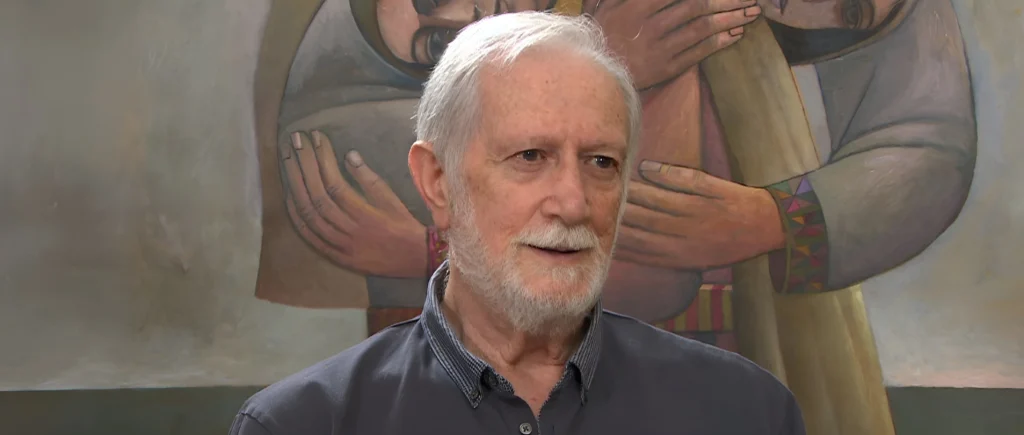
From iconic canvases of historic Jerusalem to textured mud reliefs, explore the master painter’s celebrated career.
Sliman Mansour (1947–2026) was a pioneering Palestinian painter, sculptor, author, and cultural organizer whose five-decade career established a visual vocabulary of modern Palestinian identity and resistance.
Born in Birzeit on the eve of the 1948 Nakba, Mansour came of age amidst regional displacement and military occupation. He studied at the Bezalel Academy of Arts and Design in Jerusalem, graduating in 1970.
RELATED: Sliman Mansour Painted Palestinian Identity and Resistance
Rather than adopting the Western Abstract Expressionism taught at the academy, Mansour turned to social realism to directly reflect the lived realities and material conditions of his people.
Mansour derived inspiration from the native people’s culture and landscape of Palestine. His work draws heavily on agrarian traditions; Mansour centralized the Palestinian peasant worker, ancient olive and orange groves, limestone village architecture, and traditional tatreez (cross-stitch embroidery).
Stylistically, he synthesized Levantine folk art, Byzantine religious iconography, and Mexican Muralism, creating public, accessible art centered on labor, heritage, and collective endurance (Sumud).
Among his most famous works is Jamal al-Mahamil (The Camel of Burdens, 1973), an oil painting depicting an elderly porter carrying the city of Jerusalem in an eye-shaped sack on his back.
The Jamal al-Mahamil became a iconic symbol of exile, resilience, and working-class struggle, hanging in homes across the region. Other major works include Patience and Hope (1976), Rituals Under Occupation (1989), and The Shrinking Piece (1996).
During the First “Intifada” in 1987, Mansour co-founded the New Visions collective alongside artists Vera Tamari, Tayseer Barakat, and Nabil Anani.
Responding to Israeli military bans on Palestinian symbols and paints, the group led an economic boycott of Israeli art supplies. Instead, Mansour pioneered the use of natural, local materials, creating relief sculptures made directly from Palestinian mud, straw, henna, and wood.
Beyond Mansour’s canvas, Mansour built crucial cultural infrastructure, serving as president of the League of Palestinian Artists (1986–1990) and co-founding the al-Wasiti Art Center in East Jerusalem and the International Academy of Art Palestine in Ramallah.
Celebrated artist Sliman Mansour, one of the founding figures of contemporary Palestinian art, has died at the age of 79 after a long illness, his family announced on Monday.
On Talk to Al Jazeera, he reflected on the heavy burden of painting under occupation. pic.twitter.com/qR2XyFHO8X
— Talk to Al Jazeera (@TalktoAlJazeera) August 25, 2026
Sliman Mansour died in Jerusalem in August 2026 at age 79, leaving behind a legacy as a master of anti-colonial visual art. Below is a sample of his works taken from the Sliman Mansour official page:
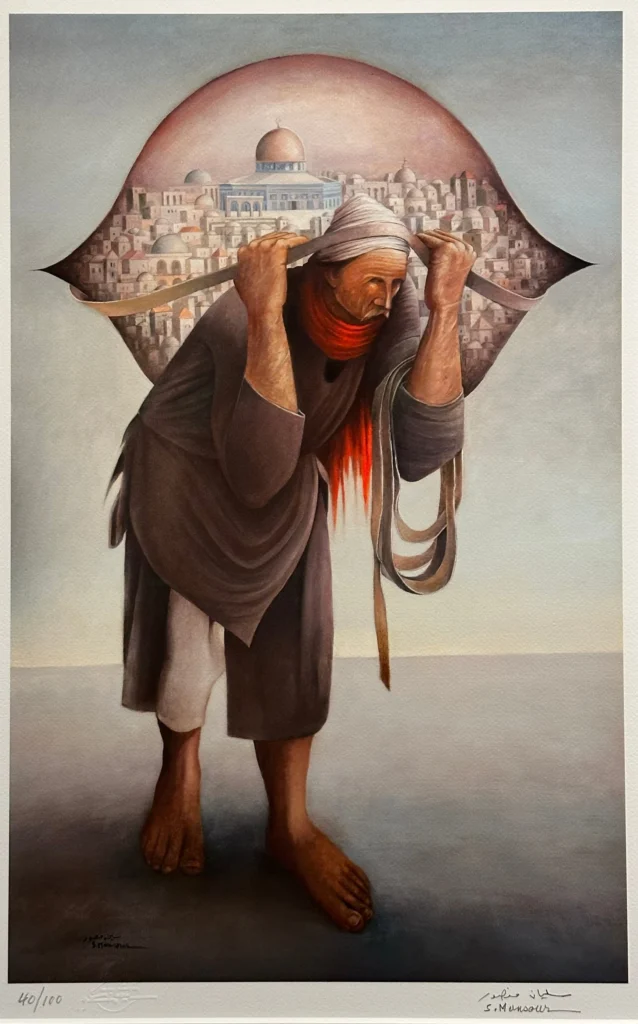
The Camel of Hardship, 1973 – Oil on Canvas
A masterpiece that distills the weight of Palestinian suffering and resilience into a single, searing allegorical composition. The painting presents an aged, weary man bent beneath an impossible burden, the entire Old City of Jerusalem, its domes, and minarets encased within a sphere secured by a coarse rope that digs into his back, transforming him into a living beast of burden who carries the sacred city not as a conqueror but as a guardian. The stooped posture of this man speaks to decades of hardship while his steady footing affirms an unbreakable determination to remain upright.
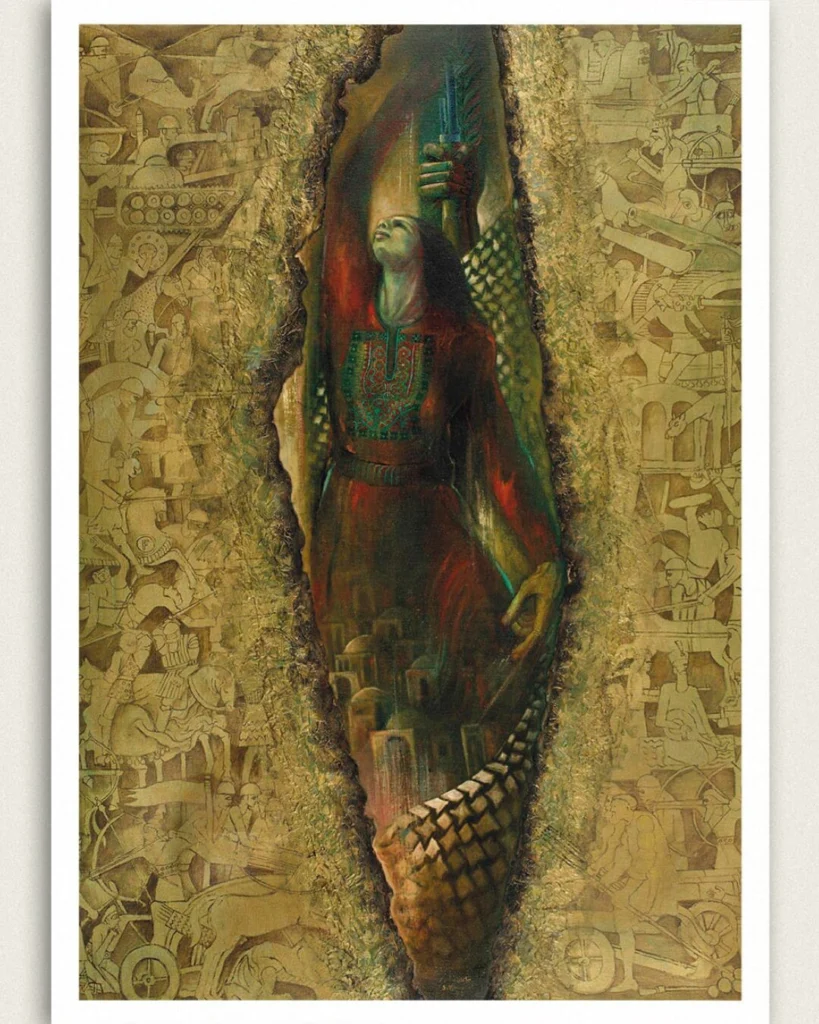
The Rising (Al-Nahda), 1977 – Oil and Collage on Canvas
The composition of this piece presents a central figure, often read as a woman embodying the land itself, emerging with quiet force from a fractured, textured surface, her form breaking through as if born from stone and memory, with golden ochre tones and traditional motifs radiating around her like a halo of ancestral light. Mansour’s masterful use of oil paint defines a rich chromatic palette, with intense reds in her clothing contrasting against the earth tones of the background.
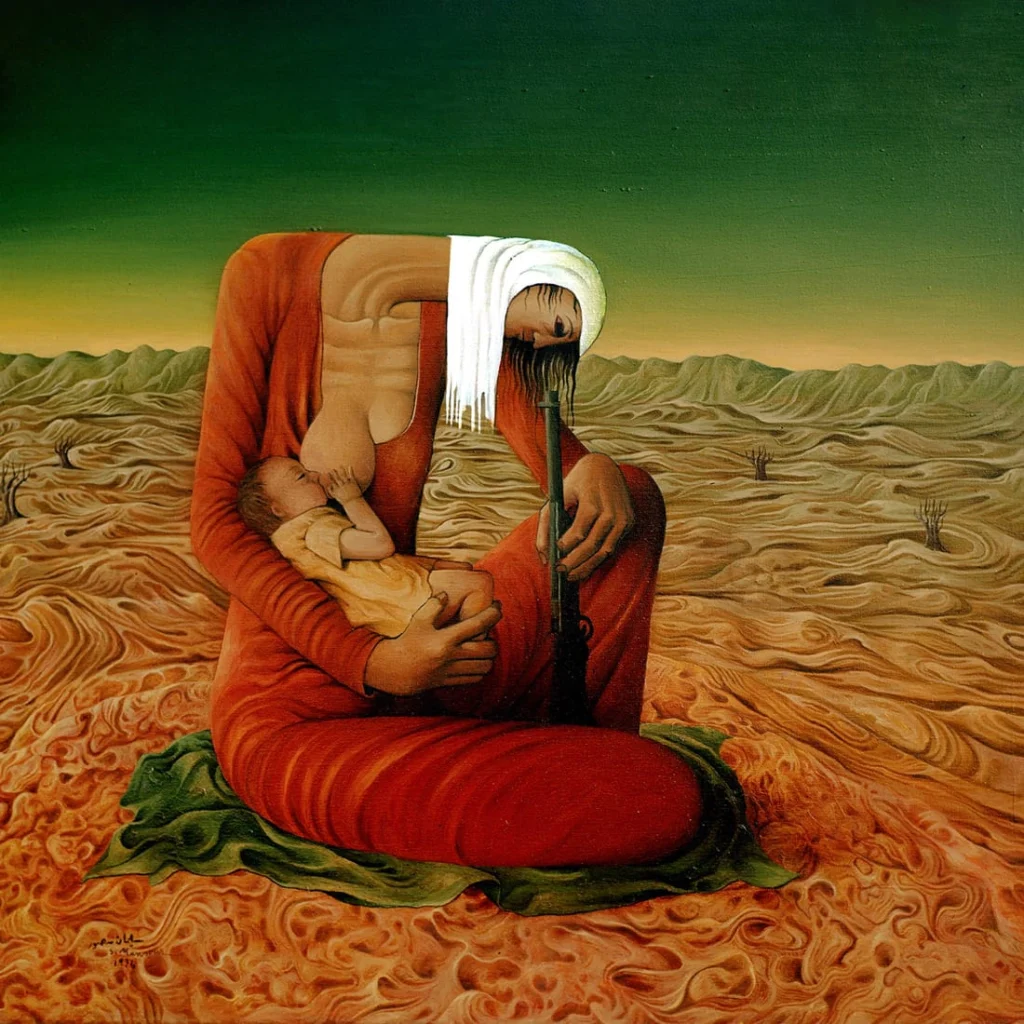
Motherhood, 1976 – Oil on Canvas
The composition presents a woman of elongated, almost sculptural form, draped in a vivid red robe that blazes against the ochre tones of a desert landscape, her serene face and graceful neck evoking a timeless, almost sacred quality as she breastfeeds a child while holding a rifle firmly in her other hand. A duality that captures the profound tension at the heart of Palestinian existence, where tenderness and defense, nurture and resistance, coexist as inseparable acts of survival. Mansour’s classical oil technique achieves remarkable depth and texture, with soft shading that brings the undulating desert to life and a vibrant chromatic contrast that elevates the mother’s red garment into a symbol of life, passion, and sacrifice against the earth’s muted embrace.
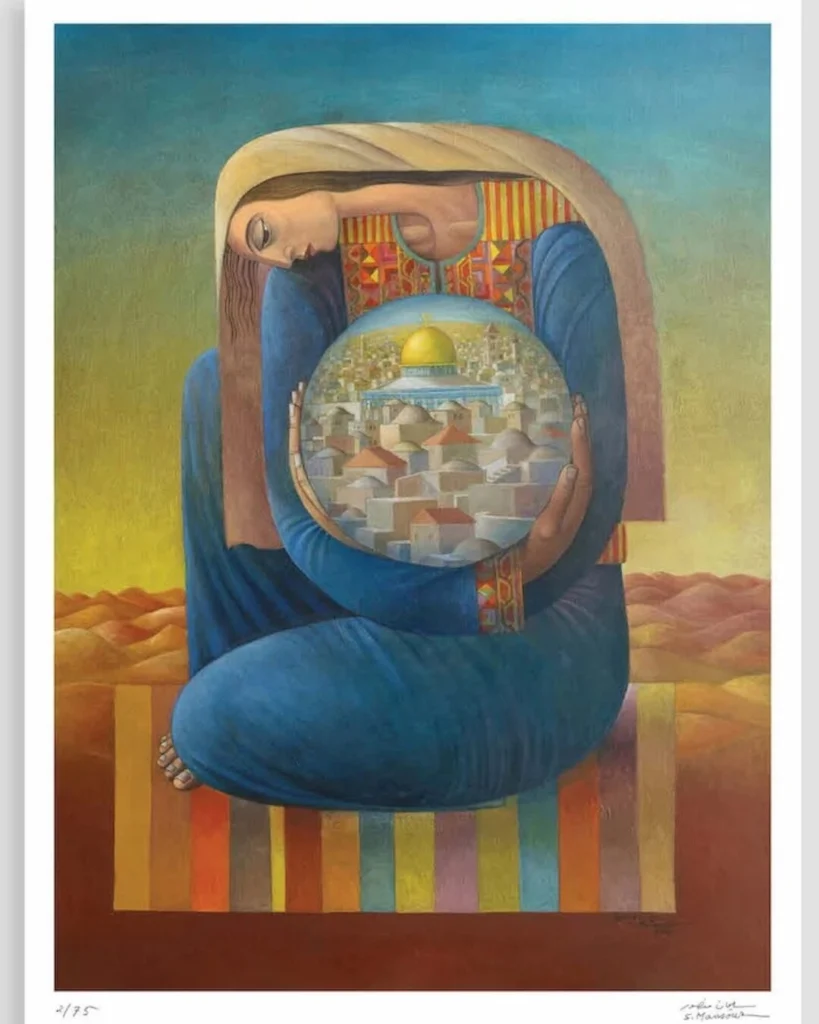
Woman Holding Jerusalem (Jerusalem in the Heart), 1979 – Oil on Canvas
A powerful work that transforms the maternal embrace into a profound allegory of Palestinian identity, rootedness, and unwavering Sumud. The composition presents a woman in traditional dress, her arms wrapped protectively around a luminous sphere containing the city of Jerusalem, cradling its domes and minarets as if holding the very heart of her people against her chest. The woman’s serene, timeless features and the intricate embroidery of her thobe anchor the composition in Palestinian tradition.
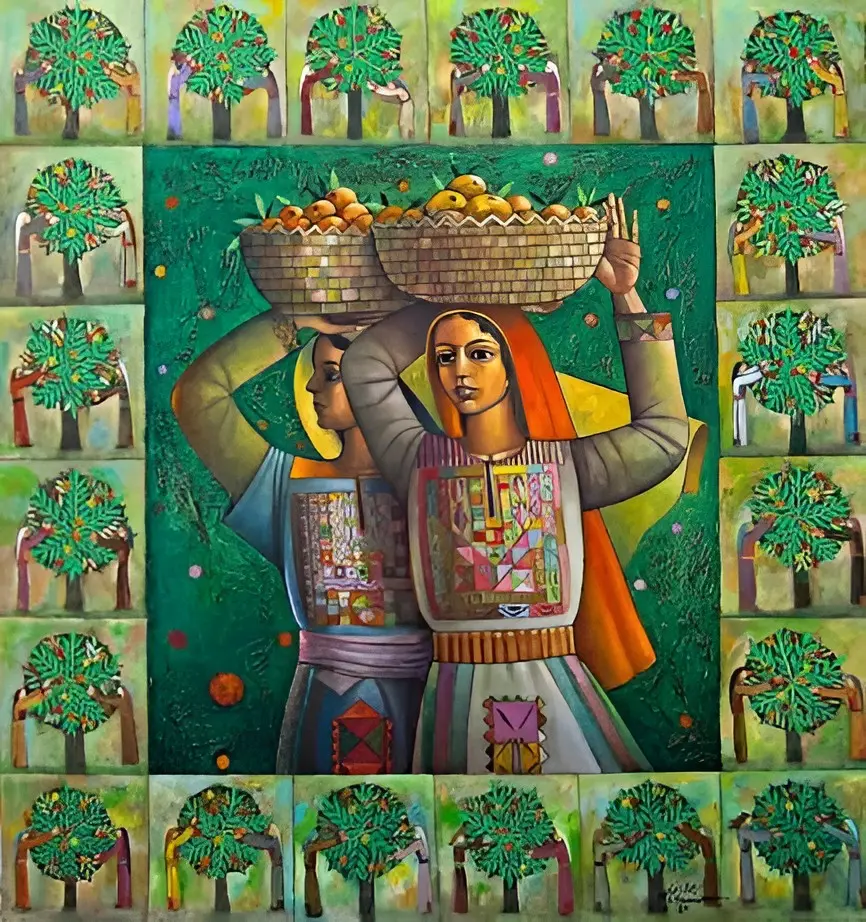
Orange Grove, 1984 – Oil on Canvas
Sliman Mansour transforms an everyday scene into a profound visual hymn to the land and its people. The composition presents two women in embroidered traditional thobes, their postures dignified as they balance baskets of sunlit oranges upon their heads. Mansour’s oil technique employs thick layers of paint and textured brushstrokes that give remarkable volume to the embroidery of the dresses and the woven relief of the baskets. In this work, the act of carrying oranges becomes a metaphor for carrying memory itself. Bearing and steady hands speak to a resilience that finds dignity in the simplest and most sacred of acts: tending the earth and gathering its gifts.
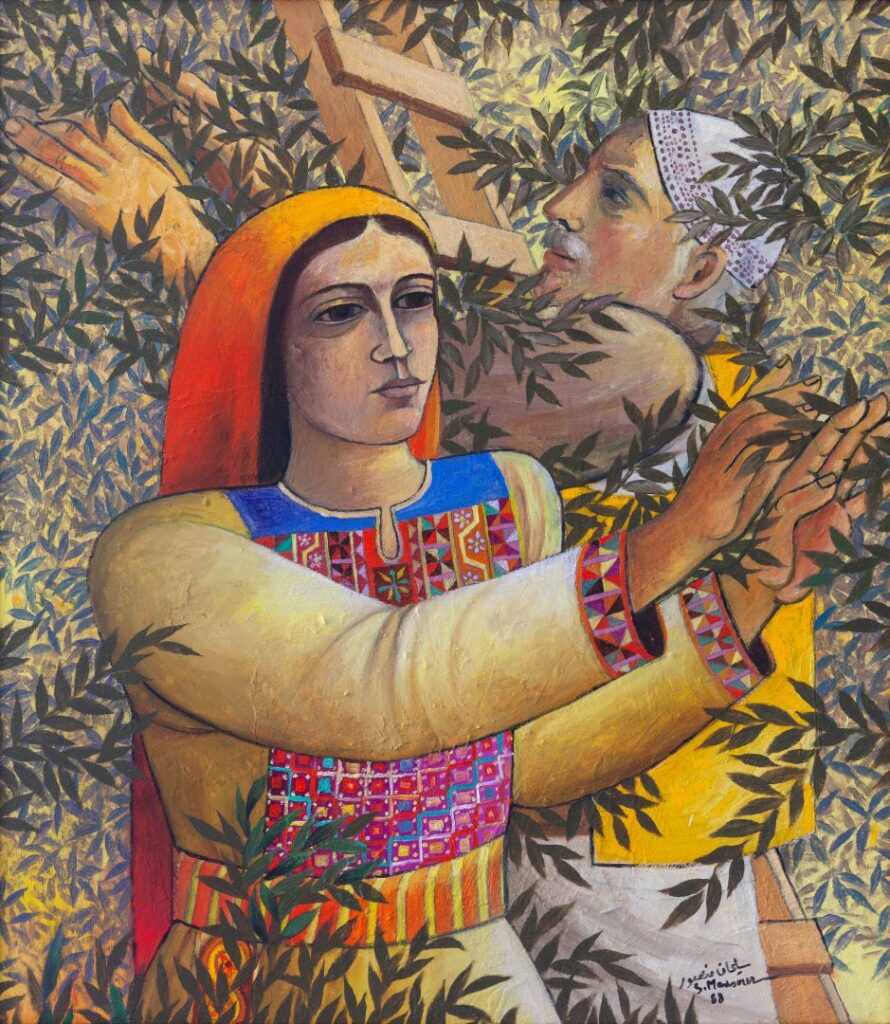
Olive Harvest, 1988 – Oil on Canvas
Mansour captures a moment of quiet dignity and collective labor. This piece presents a woman in vibrant traditional dress, her orange headscarf and embroidered thobe glowing against the landscape, working alongside a man to gather olives from ancient trees. The woman’s focused presence and the rhythmic repetition of the olive branches frame this scene as both a celebration of agricultural heritage and a quiet act of defiance, affirming that to harvest is to remain, to persist, to belong.
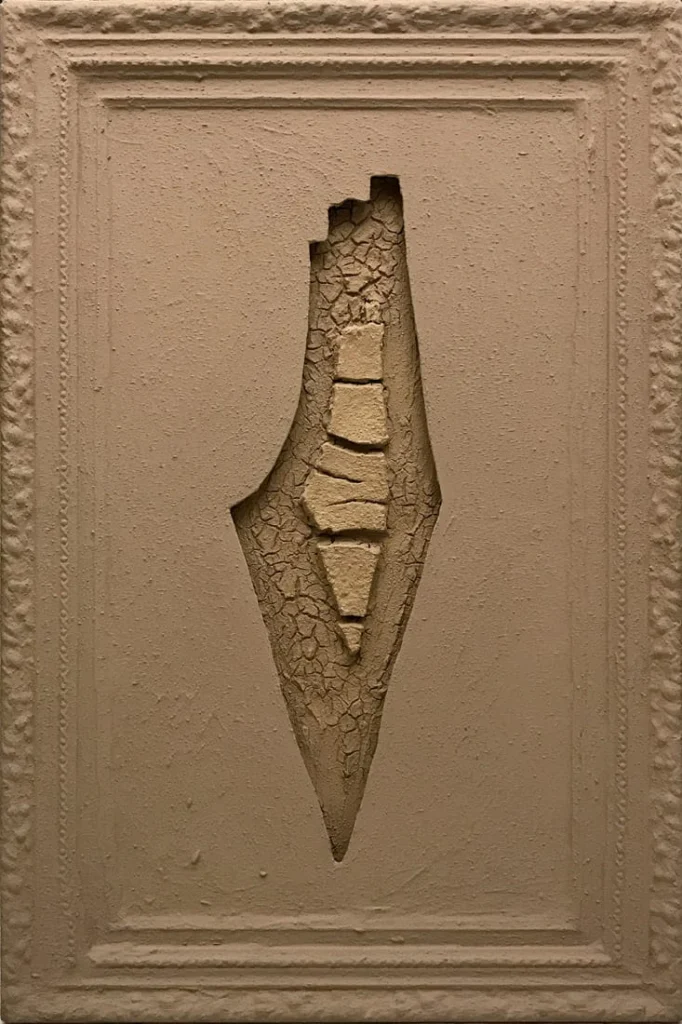
Shrinking Object, 1996 – Clay and Mixed Media on Wood
This piece is one of Sliman Mansour’s most conceptually significant works, a clay and mixed-media piece on wood that transforms the map of Palestine into a living, breathing testament to loss and resilience. Molded from fresh earth onto a wooden surface, the work was designed to self-destruct over time, as the moisture evaporated, the clay naturally shrank, cracked, and fragmented, mirroring the very territorial erosion and division Mansour sought to critique in response to the 1993 Oslo Accords. Created with Palestinian earth at a time when Mansour and his New Visions collective had boycotted Israeli industrial art materials, transforming clay into a weapon of rootedness and defiance.
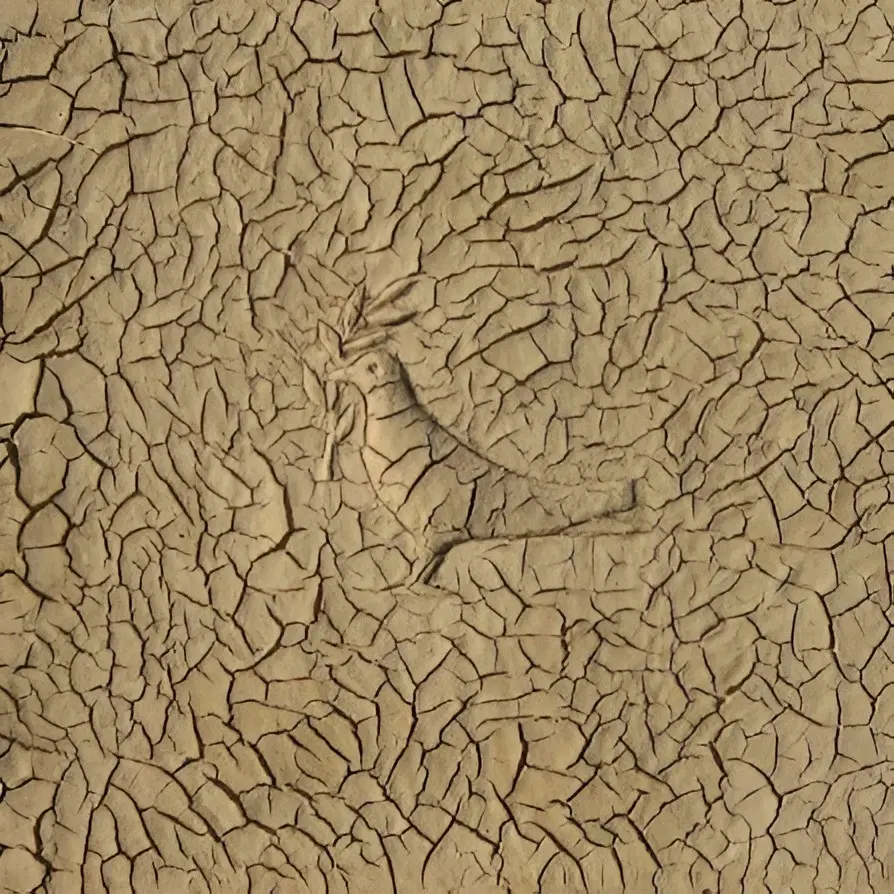
Peace, 2007 – Mud on Wood
A tactile poetic work from Sliman Mansour’s later career, a sculptural relief created entirely from mud applied to a wooden support that transforms the soil of Palestine into both medium and message. The composition presents the silhouette of a dove bearing an olive branch, sculpted with remarkable simplicity upon a surface of dry, cracked earth. Mansour’s use of Palestinian earth, sometimes mixed with straw, natural dyes, or henna, ensures that this canvas is not merely a representation of home but a physical piece of it.
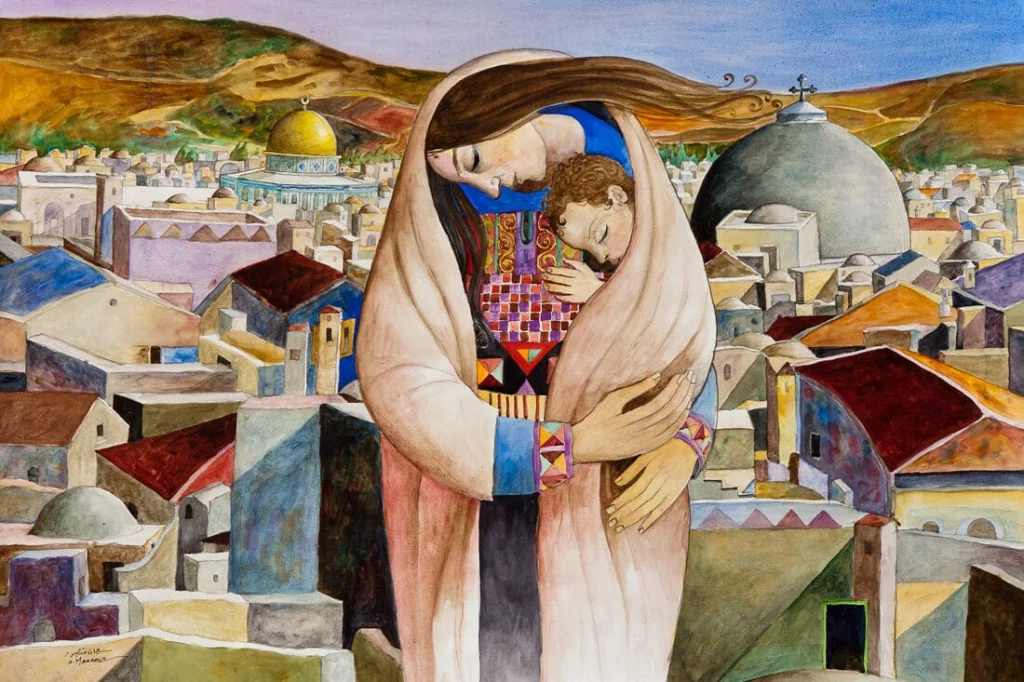
Mother and Child, 2009 – Watercolor on Paper
This piece offers an intimate and tender register within Sliman Mansour’s celebrated oeuvre, a watercolor on paper that delicately weaves together the personal and the political through the artist’s signature fusion of painting and traditional Palestinian embroidery. The composition presents a maternal figure cradling her child wrapped in a protective blanket, their forms set against a cityscape unmistakably defined by the iconic silhouette of Jerusalem’s Dome of the Rock. Mansour’s sensitive handling of watercolor allows for a softness and translucency that contrasts with the more textural, earth-bound quality of his oil works, while his incorporation of tatreez motifs bridges the gap between fine art and folk tradition.
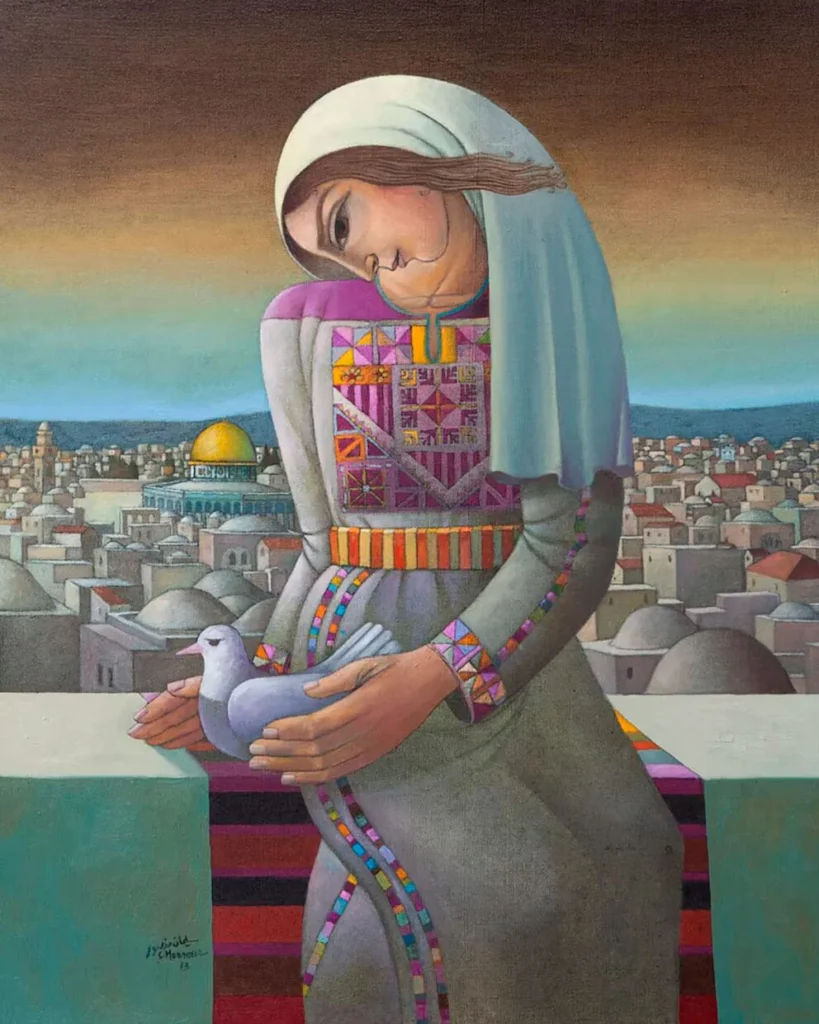
Woman with Pigeon, 2013 – Oil on Canvas
A large-scale oil on canvas that weaves together the intimate and the monumental with remarkable grace. The painting presents a woman in an embroidered traditional dress, her serene figure cradling a gentle pigeon, while behind her rises an urban landscape unmistakably reminiscent of Jerusalem, crowned by the iconic silhouette of the Dome of the Rock. Mansour’s signature blend of figurative expressionism and Palestinian symbolic realism allows the woman’s tranquil countenance and the bird’s fragile presence to speak of resilience not as defiance, but as quiet, steadfast endurance.
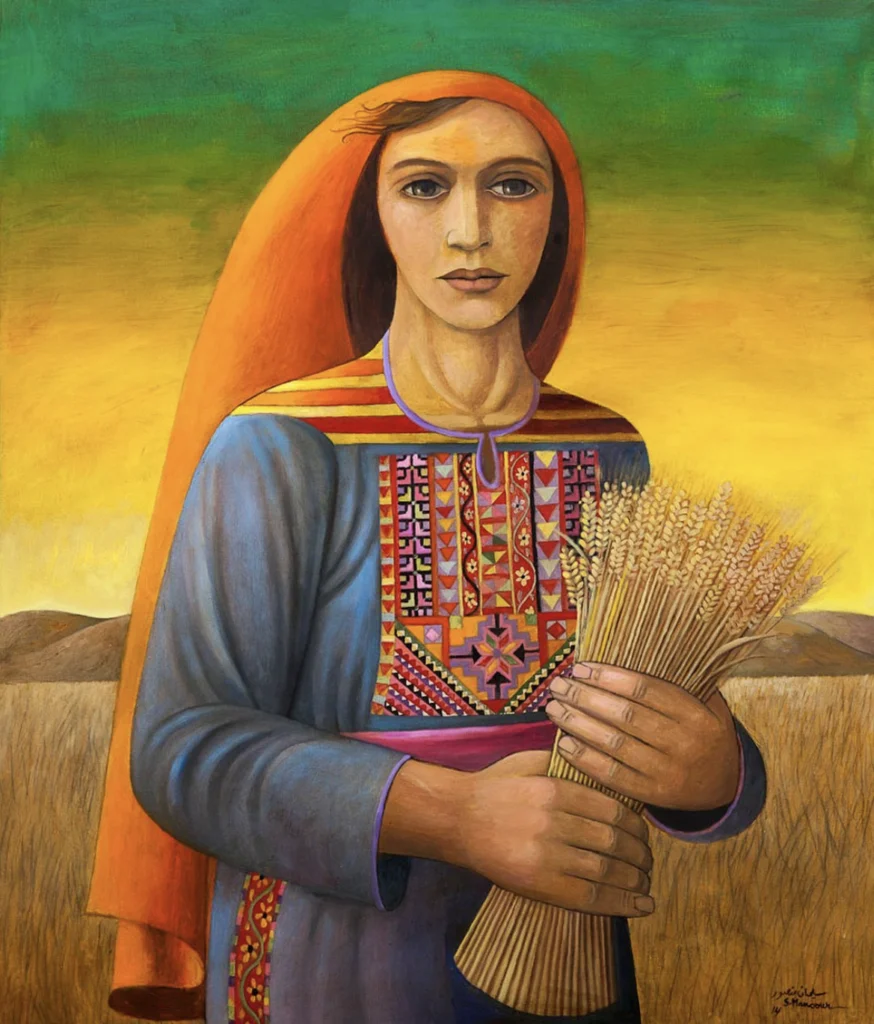
Wheat Harvest, 2015 – Oil on Canvas
Wheat Harvest is a luminous and dignified ode to Palestinian agrarian identity, an oil-on-canvas work in which Sliman Mansour captures the quiet nobility of labor through the poised figure of a woman in traditional dress, her hands gently cradling a sheaf of golden wheat against a warm, sun-drenched backdrop. The artist’s expressive realism breathes life into every detail, from the intricate embroidery adorning her thobe to the subtle interplay of ochre, amber, and russet tones that suffuse the composition with the palpable warmth of harvest season.
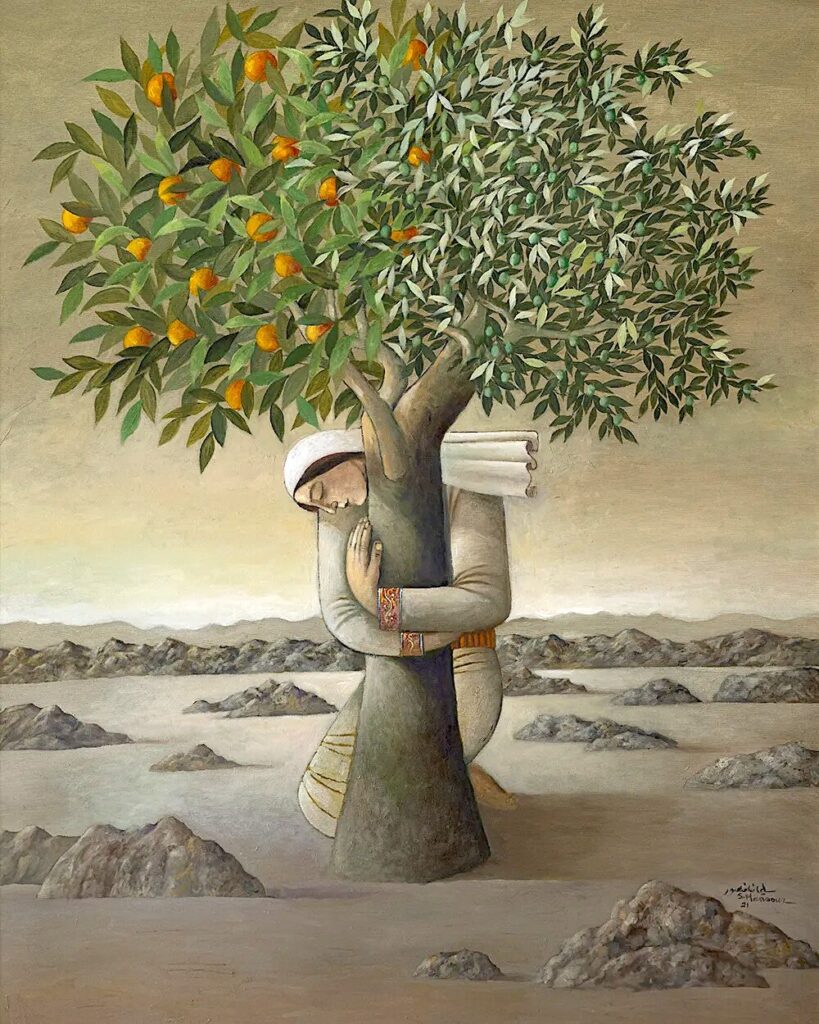
From the River to the Sea, 2021 – Oil and Acrylic on Canvas
A striking testament to Sliman Mansour’s work, offering a poignant allegory of Palestinian Sumud through the intimate embrace of a figure with a forked tree, one side laden with oranges, the other with olives. Executed in oil and acrylic on a medium canvas, the work marks a notable return to conventional paints for an artist who famously rejected Israeli art materials during the First Intifada, yet this technical shift only amplifies its global reach without diluting its political weight. The painting has unfolded in the digital realm, going viral after Mansour shared it in May 2021 to commemorate the Nakba.
From teleSUR English via This RSS Feed.