

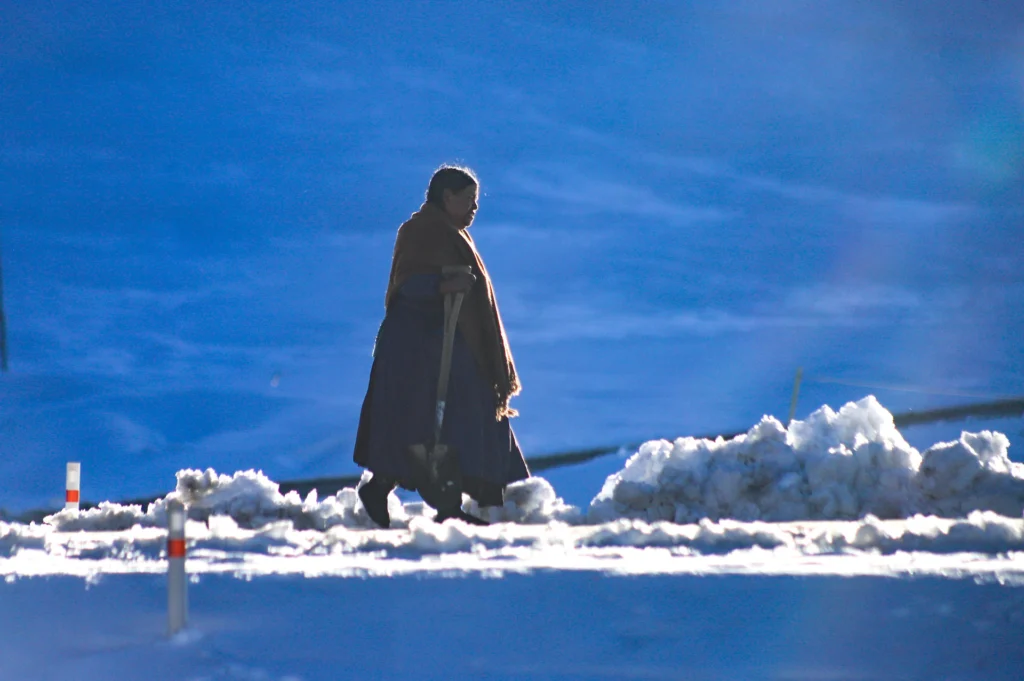
A preliminary government balance counts 121,731 families affected by snowstorms across six departments of Bolivia, with heavy losses in crops and camelid herds.
A climate emergency driven by snowfalls and freezing temperatures is under way in the Bolivian highlands, according to recent civil defense reports.
The new balance from the Deputy Ministry of Civil Defense arrived as preliminary, released while the climate emergency is still unfolding.
RELATED: Bolivia Weather Emergency Affects More Than 114,000 Families
Roberto Rivero, Deputy Minister of Civil Defense, reported 96,462 households registered as affected and another 25,269 classified as “damaged,” the second category in the official tally according to levels of harm.
Potosí, Oruro, La Paz, Cochabamba, Chuquisaca and Tarija concentrate the further damage. Behind the household figures stand 93,934 hectares of crops damaged and another 1,289 hectares lost entirely. Extreme cold and accumulated snow also killed at least 897 head of camelid livestock, according to the balance.
The figure updates earlier emergency reports that had already counted more than 100,000 families affected by rains and snowfalls in Bolivia, a sign that the crisis keeps widening.
Bolivia: Cayó nieve en La Paz
La nevada abarcó a 6 de los 9 departamentos que componen el país vecino.
— NPY Oficial (@npyoficial) August 26, 2026

Text reads: “Bolivia: Snow in La Paz. The snowfall covered 6 of the 9 departments that make up the neighboring country. There are about 20,000 families with affected homes and schools are closed, as well as other government institutions, due to the storm.”
The government’s strategy contemplates the distribution of forage and veterinary supplies for the surviving herds, direct humanitarian aid for affected families and an agricultural insurance policy that will cover 70,000 hectares in the most affected zones.
Across the six regions, municipal governments are processing disaster declarations, a mechanism that unlocks access to state assistance funds and to backing from the central government.
Three Funding Stages
The national government has planned to allocate 164.4 million Bolivian Pesos (approximately 14,210,560 U.S. dollars) for the care of emergencies caused by snowfall, frost, rain, floods and strong winds affecting different regions of the country, reported the deputy minister of Civil Defense, Roberto Rivero.
Rivero detailed that the funds will be released in three stages: 80 million Bolivian pesos (around 6,931,980 U.S. dollars) correspond to a first phase, 72.7 million (6,299,437 U.S. dollars) to a second one and 11.96 million (about 1,036,331 U.S. dollars) to a third stage.
The distribution of resources responds to an emergency with different faces across the territory. In the west, snowfalls and frosts dominate the scene. Potosí, Cochabamba and La Paz report rains and floods, while strong winds mainly affected Potosí and La Paz. Potosí currently concentrates the largest impact, according to the authorities.
Consolidated official figures on damage are not yet available. The Deputy Ministry carries out an evaluation in coordination with the municipalities to determine the needs of each region. Reports received so far indicate that 39 municipalities present damage from snow and frost, while another eight register problems derived from rain and floods.
Aid Tops 210 Tons
As part of the response, the Bolivian government deployed more than 210 tons of humanitarian aid toward the affected departments. The assistance will be distributed progressively, taking into account the emergency declarations and the requests presented by municipal governments.
Snowfalls caused the isolation of some communities and municipalities. National authorities coordinate with the Bolivian Highway Administration and the Armed Forces to use heavy machinery to rehabilitate affected roads. Rivero explained that, besides the available machinery, equipment is rented where emergencies occur to accelerate the cleaning and reopening of paths. The measure seeks to restore access to towns that remained cut off by the snow.
The National Service of Meteorology and Hydrology, municipal risk management units, governorships and regional civil defense representations take part in the surveillance. The permanent monitoring allows authorities to adjust the distribution of resources as new reports arrive from the municipalities.
The Bolivian government maintains active surveillance over another climate threat. The so-called Super Niño, an intensified phenomenon, is drawing closer, and officials have kept vigilance active.
From teleSUR English via This RSS Feed.