

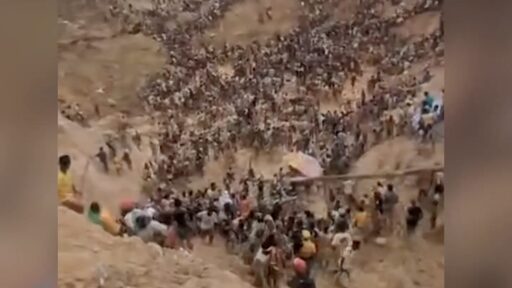

More than 100 artisanal miners have died following the collapse of a gold mine in Zamboye, Central African Republic (CAR), near the border with Cameroon. Several others were injured, while some remained missing as rescue and recovery operations continued.
The disaster on August 18 has once again brought attention to the dangerous conditions under which thousands of artisanal miners across Africa work. The collapse occurred at a sprawling, low-tech artisanal gold-mining site where miners worked in and around underground tunnels and open pits. Authorities subsequently closed the Zamboye site, citing non-compliance with mining standards and administrative directives, while a judicial investigation was opened to establish the circumstances of the collapse and possible responsibility.
The tragedy is just one of many, indicating the persistent safety risks in the country’s largely informal small-scale mining sector. CAR experienced several deadly mining accidents this year, including collapses in February, March, and June.
Risks of artisanal mining
Across the African continent, artisanal and small-scale mining provides an important source of income for communities where formal employment opportunities are limited. But miners frequently work with inadequate protective equipment, weak shaft-support systems, limited technical assistance and little access to emergency rescue services in case of a disaster.
Benedict Aminer, a Kenyan researcher who has studied artisanal gold mining communities, told BreakThrough News the problem needs to be understood beyond the immediate causes of individual accidents.
“Artisanal mining sites become vulnerable to deadly accidents when miners are working with limited technical knowledge, rudimentary equipment and inadequate safety systems,” Aminer said.
He identified poorly supported shafts, flooding, inadequate ventilation, unsafe blasting, insufficient protective equipment, and limited emergency preparedness among the principal risks confronting artisanal miners.
Research undertaken in Kenyan mining communities, he said, has encountered many of the same problems seen in CAR.
“During research in Ramula, Siaya County, we encountered miners transporting the body of a colleague who had died following a pit collapse,” he said. “Later, five miners died following the collapse of a shaft at Kilima Pesa in Lolgorian.”
Artisanal mining and the question of livelihood
The Central African Republic disaster also points to a difficult question surrounding artisanal mining, how to protect miners without destroying the livelihoods on which communities depend.
Artisanal mining is often described by authorities as illegal or informal, but for many workers it represents one of the few available sources of income. In areas facing high levels of unemployment and limited economic opportunities, people may enter mining despite the dangers because they have few alternatives, some corporates also exploit this for low wages.
“The tragedy in the Central African Republic therefore needs to be looked at beyond the immediate question of the mine collapse,” Aminer said. “It raises a much bigger question about the conditions under which artisanal miners are forced to work.”
This, he argued, should not be interpreted as an acceptance of unsafe mining practices.
“Miners have a right to safe working conditions, and governments have a responsibility to protect life,” he said.
The problem is that individual miners generally lack the resources required to undertake geological assessments, install sophisticated shaft-support systems, acquire emergency rescue equipment or obtain professional engineering advice.
The result can be a dangerous cycle in which poverty, informality and inadequate technical capacity reinforce one another.
Kenya as a case study
Kenya has developed a legal and institutional framework governing artisanal and small-scale mining, including provisions dealing with licensing, environmental management and mine safety.
But the experience of miners on the ground differs considerably from what the regulatory framework provides on paper.
Aminer said research in Kenyan mining communities found that many miners and cooperatives were willing to formalize their operations but faced difficulties with licensing procedures, compliance costs, access to information, and technical requirements.
Some miners have organized themselves into cooperatives in the hope that collective organization would make formalization easier. But obtaining a license does not necessarily resolve the practical challenges of mining safely.
“Formalization can still remain difficult,” he said.
The result, according to Aminer, is a cycle in which informality restricts miners’ access to government support, while the costs and complexity associated with formalization make it difficult for them to enter the formal system.
From criminalization to support
The Central African Republic disaster then raises questions about how African governments should approach artisanal mining.
For Aminer, the starting point should be support-based formalization rather than criminalization.
Formalization, he said, should provide miners with tangible benefits, including access to designated mining areas, technical assistance, safer equipment, appropriate financing, geological information, training, transparent markets and government extension services.
“Miners generally want safer and more organized mining, but they need support to achieve it,” he said.
Responsible mechanization should also form part of that approach. Mechanization does not necessarily have to displace artisanal miners, particularly where appropriate technologies can improve safety and productivity while remaining accessible to small-scale operators.
Preventing disasters before they happen
Mine inspection is another critical area. Rather than responding only after fatalities occur, governments need to develop preventive systems involving regular inspections, geological and geotechnical assessments.
The CAR disaster demonstrated the consequences of weak emergency capacity. Rescue efforts were reportedly hampered by limited equipment and expertise, making it difficult for workers to reach people trapped beneath the rubble.
Better access to finance and mineral markets is also a key issue. Many artisanal gold miners depend on brokers and have limited bargaining power over the price of their production. Transparent mineral-buying systems, accurate weighing and testing, collective marketing and stronger cooperatives could improve miners’ incomes while reducing their dependence on intermediaries to corporates.
A continental challenge
Simply declaring mines illegal does not eliminate the economic conditions that drive people into them. Nor does closing an unsafe site necessarily make mining communities safer if miners subsequently move to another unregulated operation.
“Closing an unsafe mine may sometimes be necessary to protect lives,” Aminer said, “but closing it without providing safer alternatives or addressing the livelihood needs of the community can simply push miners into another informal and potentially more dangerous operation.”
The challenge, therefore, is to move beyond a regulatory approach centered primarily on controlling miners. The objective should be to support miners to work safely, responsibly and legally.
From BT News via This RSS Feed.