

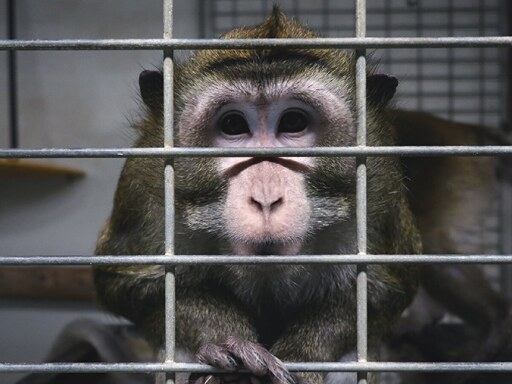

The secrecy which surrounds information on the use of animal experiments in science has been ruled unlawful by the Upper Tribunal in a landmark case brought by animal protection organisation, Cruelty Free International.
A specially-convened three-judge panel heard the case in the Upper Tribunal, the equivalent of the High Court in the tribunal system which decides Freedom of Information Act appeals.
The case, ‘Cruelty Free International v Information Commissioner and Home Office’, concerned Section 24 of the Animals (Scientific Procedures) Act 1986 (ASPA). This prohibits Home Office ministers and officials from disclosing information given to them in confidence by animal researchers.
Crucially, this includes detailed applications for licences to conduct animal testing. The Home Office assumes everything is confidential, apart from the short summaries which the applicant legally has to publish but which often omit crucial information.
Under Section 44 of the Freedom of Information Act, statutory prohibitions on disclosure, such as Section 24 ASPA, constitute an absolute exemption from disclosure, whereby the public body in question does not have to consider whether there is overriding public interest in the information being available, as it does with most other exemptions.
Animal experiments shouldn’t be secret
Cruelty Free International argued that Section 24 is contrary to Article 10 of the European Convention on Human Rights, which, following a European Court of Human Rights case called Magyar, obliges governments to disclose information in certain circumstances.
These include where the information is publicly important and the requester acts as a public watchdog, such as the media or a responsible NGO such as Cruelty Free International.
Cruelty Free International’s request focused on the Home Office’s evaluation of applications for licences to conduct animal experiments on cosmetics. For 30 years, the department had refused licences for this purpose, on the basis that the pain suffered by the animals was not justified for products regarded as unimportant.
Before granting a licence, the home secretary has to be sure that the benefits of experiments outweigh the suffering to the animals (the harm:benefit test). However, the home secretary started granting cosmetics licences again in 2019, in secret.
Cruelty Free International wanted to know why the assessment of harms and benefits had changed. Public opinion overwhelmingly opposes cosmetics animal tests, in particular. The Home Office refused to disclose the evaluations, citing section 24.
Upper Tribunal accepts Cruelty Free International’s argument
The Upper Tribunal has now decided that Cruelty Free International met the Magyar tests and the Home Office could not rely on the exceptions to Article 10.
Crucially, the department accepted as long as 12 years ago that there was no justification for retaining Section 24 in its present form in an era of much greater governmental transparency. But it has done nothing to remedy the situation.
Importantly, legitimate interests such as confidentiality and safety already have full protection through other Freedom of Information Act exemptions.
The Upper Tribunal has limited remedies available to it. Cruelty Free International now expects the case to go to the Court of Appeal for final resolution.
Cruelty Free International’s director of science and regulatory affairs, Dr Emma Grange, said:
This is a really important ruling. The public has a right to know the basis for granting licences for animal experiments. It should not be a cosy club between researchers and regulators.
The harm:benefit test is essentially an ethical assessment, and public and parliamentarians should be able to influence its practical application. Far too many licences are granted which few would regard as justified on any basis.
In addition, how the Home Office reaches scientific judgements should be open to scrutiny, because there is increasing acceptance that many animal experiments are unreliable. This is of the first importance for human health.
Featured image via Cruelty Free International / Carlota Saorsa
By The Canary
From Canary via This RSS Feed.