

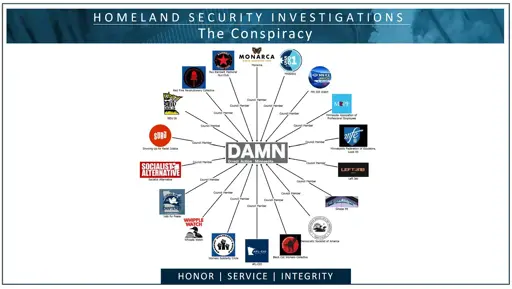
The Government’s “Conspiracy” Map
Some of the documents that have been released by the Federal Government during discovery for the case of the MN15 are telling. The 15 are community activists, union activists and officers who were charged by the Feds with conspiracy to inflict harm and commit violence against ICE agents; the latter were carrying out their “duty” of abducting, injuring, and murdering civilians on the streets of the Twin Cities. The defendants face prison terms of anywhere from five to twenty years.
The hub-and-spoke network diagram of 18 organizations that the government says they believe were part of, related to, or financially supporting a vast criminal conspiracy to do violence against and obstruct the lawful work of Federal agents. With the word “CONSPIRACY” written in all caps across the top of the page, the document purports to expose the super secret illegal collaboration between a sprawling web of “domestic terrorists” or “Antifa” (a term made up by the right to describe a non-existent organization: Antifa is actually just shorthand for “anti-fascist,” a label that one would hope nearly any well-informed resident of the U.S. could get behind). In the middle of the circle is Direct Action Minnesota (DAMN), the organization alleged to be (literally) “at the center” of this so-called conspiracy, with lines connecting each of the orgs to that hub, like the spokes on a wheel.
Among the organizations were some you might figure would be thrown in there: DSA, a favorite target right now for both Trumpand the Democratic Party; the Sunrise Movement, which organized noise demonstrations at hotels where ICE agents were quartered; and 50501, one of the groups that has helped build the massive No Kings rallies across the country.
More surprising, at least to us, was the inclusion of the over-300,000-strong Minnesota AFL-CIO. The AFL-CIO is a federation of over 1,000 Local Unions in the state of Minnesota, including steelworkers, bus drivers, construction workers, miners, restaurant workers, healthcare workers, airline workers, and more. In other words, the discovery document reveals that the federal government has its sites trained on nearly every union in the state — an absurd proposition. However, this enormous overreach by the Feds tracks exactly with the aggressively anti-union stance of a federal administration that attempted to gut American Federation of Government Employees (AFGE) within the first weeks of taking office.
But the absurdity of treating a labor federation representing hundreds of thousands of workers as part of a criminal conspiracy is precisely what makes the document so revealing. What prosecutors presented as a conspiracy chart is, viewed another way, a network map: a visualization of the relationships among unions, community organizations, and political groups engaged in legal collective action. The government is not simply interested in a handful of activists it believes broke the law. It is mapping the institutions, relationships, and networks through which ordinary people have learned to act collectively. And among the most important of those institutions are unions.
What prosecutors have inadvertently produced is a crude map of movement infrastructure: unions connected to community organizations, socialist organizations connected to immigrant-defense networks, climate activists connected to labor organizers, and people moving between all of them. What the government calls conspiracy is, in many cases, simply organization.
When Opposition Becomes Power
And there is a reason the government is interested in these networks. Minnesota demonstrated the danger an organized working-class poses to an authoritarian government: it can turn widespread opposition into collective power. Trump was handed a significant defeat by the working-class of Minnesota when we acted collectively in defense of immigrant communities. He was forced to draw down ICE’s presencein the state because of the combined force of our defensive struggle (mutual aid and rapid response networks) and our offensive one (the astounding number of large demonstrations, including the 100,000-strong march on January 23 and especially the mass strike the same day). All of the MN15 were involved in significant ways in these projects.
Tens of thousands of Minnesotans opposed the occupation. But opposition by itself did not create the power that forced the administration to retreat. People organized — in neighborhoods, community groups, churches, political organizations and, critically, workplaces and unions. On January 23, that infrastructure made possible something exceedingly rare in American politics: mass collective action that included the withdrawal of labor. The lesson was not simply that people were angry. It was that organized people could make their opposition materially consequential.
That is why the government’s interest appears to extend beyond individual activists to the networks connecting them. Many of the defendants in the MN15 case helped convene a Workers’ Assembly on February 15, 2026, bringing together nearly 400 people, including members of 30 union locals, not simply to protest what had happened, but to discuss how to turn a moment of resistance into durable working-class organization — and how to organize another mass strike.
It’s clear from the discovery material that more than one secret police agent was in attendance as well. As the Feds compile their enemies list, notice what they seem particularly interested in: who is organizing resistance, how that resistance stretches across a diverse range of local organizations, who connects those organizations to one another, and what new coalitions are forming. The government appears interested not simply in dissent, but in the infrastructure capable of transforming dissent into collective action.
The Movement the Government Fears
One organization named on the government’s chart is the Workers’ Solidarity Circle (of which we are co-founding and former members). The Feds have their eyes on Workers’ Solidarity Circle because it includes some of the most active and dedicated union members and organizers in the Twin Cities. This organization was central to organizing the Workers’ Assemblies on February 15 and April 5. Its members played a significant role in pushing forward the general strike of January 23, making the government’s interest in it considerably less mysterious.
What’s also become clear is that the federal government started surveillance efforts in November, before the beginning of Operation Metro Surge, the military occupation of the Twin Cities, likely because they knew their violent tactics would provoke resistance. Federal police agencies infiltrated peaceful, legal meetings. They tried to provoke activists into violent behavior. They tried to disrupt the internal functioning of peaceful, legal groups through infiltration. However, none of this stopped the resistance, and a highly disciplined Twin Cities population refused to be baited.
Repression Works by Isolation
On the surface all this seems stupid and clumsy. The Minnesota AFL-CIO is clearly not and never has been part of an Antifa conspiracy to interfere with or injure ICE agents. And of course there is no such conspiracy to begin with. But repression does not have to produce credible conspiracy charts to accomplish its purpose. Its audience is much larger than the people being prosecuted.
If you are part of a group that raises support for families whose mothers have been abducted by ICE, you should shut up and stop what you are doing. If you are fighting climate change by fighting pipelines, shut up or watch out. If you are a union member on strike, watch your back. If you oppose genocide in Gaza, be careful. If you are on the front lines of the fight for economic justice and you don’t like capitalism, you could be in trouble. If you are fighting for democratic rights, you might want to rethink what you’re doing. There are millions of people who have engaged in the activities and causes described above. The message to all of them? Shut up or be prepared for government retribution.
That is the larger political function of repression like this. The point is not simply to imprison the people who are charged. It is to alter the behavior of everyone watching. If attending a meeting, donating to a defense fund, joining a demonstration, organizing a strike, or belonging to the wrong organization might put your name or photograph on a government chart, millions of people may decide that participation simply isn’t worth the risk. And that chilling effect is precisely why the answer to repression cannot be retreat. It has to be participation on a scale too large to isolate and criminalize.
Defending Everyone’s Right to Organize
If you haven’t guessed by now, there’s a lot at stake if you want to retain some measure of democracy. The government has already tried, convicted, and sentenced thePrairieland Defendants in Texas — 30-year sentences, and one of 100 years. In addition to its case against the MN15, the Feds are also preparing to try to crush theMichigan 8, activists in the anti-genocide movement.
These cases are not isolated. They are part of a broader federal initiative operating under National Security Presidential Memorandum 7 (NSPM-7) and Joint Task Force Vanguard, which has brought together a series of prosecutions across the country. In addition to Minnesota, Texas, and Michigan, federal prosecutors have pursued cases against activists connected to movements such as Stop Cop City in Georgia and other political struggles. What links these cases is not simply the allegation that particular individuals committed illegal acts, but a broader prosecutorial approach that seeks to map relationships among organizations, communications, political associations, and networks of solidarity. The government’s own framing reveals what it sees as threatening: not only individual acts, but the infrastructure that allows ordinary people to organize collectively.
Many of the government’s cases around the country have already fallen apart because prosecutors have lied to judges, withheld evidence, and because there was ultimately no basis for the charges brought. In Minnesota, prosecutors have offered plea deals to theRighteous 39 — a group including well-known journalists Don Lemon and Georgia Fort that interrupted a church service where the pastor was a high-ranking official in ICE. Whatever happens in these individual cases, together they send an unmistakable message: political participation itself can carry an increasingly high price.
Which brings us to the strategic question: How do you defend democratic rights when the government is attempting to make people afraid to exercise them?
What’s needed now is the broadest possibleunited front around defense of freedom of speech, freedom of assembly, freedom of association, the right to vote, and democratic rights generally. We will need to build broad resistance that includes unions, churches, community groups, 50501, Indivisible, Sunrise, celebrities, football stars, and politicians — anyone who can agree that we need to defend the MN15, the Righteous 39, the Michigan 8, others who have been targeted by government repression, and those who have yet to be targeted.
We may not agree with the political outlooks, strategies, or tactics of some of those who have been made examples of by the government. We certainly will not agree with everyone we find ourselves in coalition with. But we make a serious mistake if we turn those disagreements into tests for who deserves our defense or who is permitted to participate in the fight against repression. The government’s own diagrams should tell us something: it is not particularly concerned with the differences among socialists, liberals, unionists, climate activists, immigrant-rights organizers, churches, or community groups. It is interested in the connections among them and in their capacity to act together. We should be at least as capable of recognizing the significance of those connections as the government is.
A united front does not require us to abandon our disagreements, dilute our politics, or pretend that every organization has the same goals. It means refusing to allow those differences to prevent collective action where our interests converge. We have to recognize what must be defended together so that we retain the democratic space in which those disagreements — and our organizing — remain possible.
The Answer Is More Participation, Not Less
And there is a deeper strategic reason for this. Repression works by isolation. The government selects a person or group, portrays them as dangerous or beyond the bounds of legitimate politics, and counts on everyone else deciding that defending them is too risky, too controversial, or simply not their fight. Once we accept that logic, the circle of people who can be safely abandoned can expand very quickly. A movement capable of resisting repression has to operate according to the opposite principle: an attack intended to isolate one part of the movement should produce greater solidarity across the rest of it.
But within that broad democratic front, the workers’ movement has a particular role to play. Workers possess something that even millions of individual protesters lack: organized collective power at the point that makes society function (or not). Workers can refuse to work. Unions can mobilize institutions rather than isolated individuals. And, as Minnesota demonstrated, organized workers can help knit workplaces and communities together into something capable not merely of registering opposition but of imposing political and economic costs.
This is why the attack on unions and the attack on democratic rights cannot be treated as separate struggles. Weakening the organizations through which workers act collectively weakens one of the most powerful forces available for defending democracy. Conversely, building a larger, more militant, more democratic workers’ movement expands our capacity to defend everyone’s rights.
The stakes are far too high to erect barriers to the mass participation needed to defend democratic rights against the Trump administration’s accelerating erosion of them. The answer to these attempts to frighten people out of political life must be to bring vastly more people into it. Defense committees should be forming in every city in the U.S. and internationally. Unions should be mobilizing their members. Organizations should be defending one another rather than calculating whether someone else’s repression is politically convenient to ignore. Every prosecution should become an occasion for bringing more people into collective action.
Our Connections Are Our Power
Perhaps the government’s own diagram contains the most important lesson of all. They are mapping our connections because our connections are our power. They are looking for the threads that bind movements together. We should not do their work for them by cutting those threads ourselves. Our task is to multiply them.
Every single person reading this should understand that in one way or another, you are on the list.
This article was originally published on Workers Resist on August 23.
The post The Conspiracy Is Us appeared first on Left Voice.
From Left Voice via This RSS Feed.