

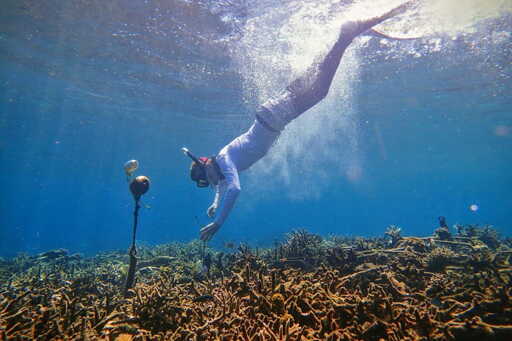
When he went for a dive between the tiny islands off the coast of South Sulawesi, Indonesia, marine biologist and AI researcher Ben Williams could often hear as many as three fish bombs detonate. “But the thing is, because sounds travel so far underwater, the bombing is often happening quite far away,” he said. “So you could hear one that feels like a kick in the chest, then you look up [above the water], and you can’t even see a boat on the horizon.” Those islands, the Spermonde Archipelago, were once home to a pristine and vibrant network of coral reefs. But from 1990 to 2022, some three-quarters of this coral was killed, primarily by the illegal practice of blast fishing. In it, fishers toss improvised explosives into the sea to kill and stun fish en masse and scoop up the mostly intact ones, leaving underwater wreckage behind. “If you look at the rubble after a city’s been blown up in a war zone,” Williams told Mongabay in a video call, “it’s not too dissimilar.” Since 2013, local communities, conservation organizations and scientists have collaborated on the Mars Coral Reef Restoration Project, an effort to restore those damaged reefs. Williams joined researchers studying the effectiveness of those efforts in 2019. His particular contribution focused on using recent advances in data science to investigate Spermonde’s marine soundscape: Where a healthy reef sings like an alien jungle come to life at night, a dead one crackles like a forest smoldering after a…This article was originally published on Mongabay
From Conservation news via This RSS Feed.
What kinda redneck shit is this?
