

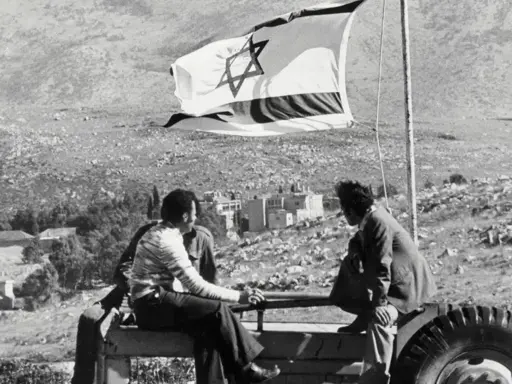

Following the signing of the 1968 Cairo Agreement and the subsequent expulsion of the Palestinian resistance movement from Jordan during the events of Black September 1970 and the spring of 1971, southern Lebanon was thrust into the direct line of fire.
Approximately 9,000 fedayeen fighters escaped from Jordan into Syria during 1971, and by November of that year, a massive commando buildup was underway in the Arqub region. This demographic and military migration fundamentally shifted the primary arena of anti-fedayeen operations conducted by the so-called “Israel Defense Forces” (IDF) from the Jordan Valley to southern Lebanon.
The Shift to Reprisal and Deterrence Doctrine
The official Israeli doctrine regarding the Palestinian presence in Lebanon had been articulated even before cross-border guerrilla operations had begun in earnest.
On 26 December 1968, an attack on an Israeli El Al civilian airliner at the Athens airport by two Palestinian guerrillas originating from Beirut prompted Israel’s Transport Minister, Moshe Carmel, to declare that Tel Aviv would not relieve the Lebanese government of direct responsibility for acts of sabotage organized on Lebanese soil. Two days later, on 28 December 1968, Israeli commandos executed a daring heliborne raid on Beirut International Airport, destroying 13 commercial airliners. Unlike their British mandatory predecessors 30 years earlier, the Israelis chose not to politely request Lebanese official cooperation in curbing anti-Zionist activities; instead, they instituted a harsh doctrine of state-level collective punishment.
Israeli military pressure mounted rapidly. On 6 March 1970, the Israeli Northern District Commander, Major General Mordechai Gur, publicly threatened to turn a six-mile stretch of southern Lebanon into a scorched-earth desert – a chilling echoes of 1955, when the Lebanese government had felt compelled to clear refugees from a 10-kilometre border zone.
In May 1970, an Israeli force of 2,000 troops conducted a 32-hour armoured sweep of the Arqub. A broader, more destructive operation took place between 25 and 28 February 1972, following a stern warning by Israeli Chief of Staff Lieutenant General David Elazar that fedayeen activities were liable to bring disaster upon the civilian villages of South Lebanon.
Following the 1972 Arqub operation, Israeli Defense Minister Moshe Dayan ominously announced that Israel reserved the explicit right to occupy Lebanese territory indefinitely unless Beirut took immediate steps to oust the commandos from the slopes of Mount Hermon. A further massive sweep through the Marj’ayoun Valley and along the Mediterranean coast occurred on 16 and 17 September 1972, following the Munich Olympics Operation.
Total War against Guerrilla Presence
Although Palestinian commandos yielded to new territorial restrictions imposed by the panicked Lebanese government in late 1972, Israel fundamentally altered its operational rules of engagement.
On 15 October 1972, Israel launched sweeping air strikes against Palestinian targets deep inside Lebanon, announcing that it would no longer wait for specific commando incursions or terrorist acts before striking. Former Israeli Chief of Military Intelligence Chaim Herzog articulated this posture, stating that Israel was no longer engaged in mere reprisal, but in a total war against terror, adding that the very presence of guerrillas in the area between the border and the Litani River constituted an active provocation against which Israel was free to act preemptively.
According to Lebanese official sources, 44 major Israeli ground and air attacks occurred between mid-1968 and mid-1974, resulting in the deaths of over 880 Lebanese and Palestinian civilians. These incessant strikes constituted a devastating drain on Lebanon’s fragile governmental legitimacy. Crucially, the traditional Maronite political leadership and its conservative constituency came to view the Palestinian guerrillas, rather than Israel itself, as chiefly to blame for this disastrous state of affairs.
To the extent that Israeli strikes were not merely retaliatory, Israel’s overriding strategic objective lay in deliberately provoking a violent, armed confrontation between Lebanon’s Maronite community and the Palestinian commandos. This strategy bore immediate fruit: following a bold Israeli commando assassination raid in the heart of Beirut on 10 April 1973, which left three senior Palestinian leaders dead, open warfare erupted between the Lebanese Army and the fedayeen from 1 to 17 May 1973. Concentrated around the urban refugee camps of Beirut, the fighting ended in a political standoff, dealing a severe psychological blow to the Lebanese military’s prestige.
The 1974 Escalation and the Infiltration Wave
In the spring of 1974, the Palestinian-Israeli confrontation acquired a deadly new operational dimension as fedayeen raiders operating from southern Lebanon began penetrating directly into Israeli border settlements to conduct high-profile hostage-taking raids:
- Qiryat Shemona (11 April 1974): Three commandos stormed an apartment building, killing sixteen Israeli settlers and two soldiers. Israel retaliated the next day by demolishing structures in five Lebanese border villages. Dayan warned that if Qiryat Shemona could not live in peace, all of southern Lebanon would be rendered uninhabitable.
- Ma’alot (15 May 1974): Three fedayeen seized a school, resulting in the deaths of twenty-five Israeli settlers. Israel responded with devastating aerial bombardments against Palestinian camps across Lebanon, causing heavy civilian casualties.
- Shamir (13 June 1974): A commando raid resulted in three Israeli deaths, triggering immediate, renewed air strikes.
- Nahariya (24 June 1974): A seaborne attack produced four Israeli deaths, prompting heavy artillery bombardments of southern Lebanese villages and naval shelling of three Lebanese commercial ports.
The Modern ‘Tegart’s Wall’ and the Collapse into Civil War
Driven by intense domestic political pressure to halt these bloody infiltrations, Israel initiated a massive engineering project in May 1974 to completely seal the Lebanese frontier. For the first time since the dismantling of the 1938 Tegart’s Wall, a physical barrier was constructed along the old international boundary. Between late 1968 and mid-1974, the frontier had contained no significant physical obstacles; now, Israel erected a twelve-foot-high steel security fence topped with concertina wire and integrated with sophisticated electronic motion sensors.
A smoothed dirt track was plowed along the Israeli side of the fence to detect footprints, complemented by fortified machine-gun pillboxes erected at regular intervals. This modern security barrier proved substantially more effective than its 1938 predecessor, primarily due to the complete absence of an indigenous Arab population on the Israeli side of the border following the demographically transformative events of 1948. Nevertheless, Zionist Israeli military officers acknowledged that no fence was infallible against small, determined bands of four or fewer guerrillas prepared to sacrifice their lives.
Ultimately, the unrelenting cycle of cross-border raids, devastating retaliatory strikes, and internal political paralysis completely shattered the fragile fabric of the Lebanese state. Israel’s policy of holding Beirut accountable while systematically bombarding its territory succeeded in driving a permanent wedge between the Christian Maronite establishment and the Palestinian resistance movement backed by Lebanese nationalist figures and parties. When full-scale civil war erupted in Lebanon in the spring of 1975, the total collapse of central state authority afforded Israel an unprecedented strategic opportunity. Rather than relying solely on periodic military sweeps and electronic border fences, Israel began directly arming, funding, and organizing anti-fedayeen Lebanese Christian militias in the south, laying the operational foundations for a proxy enclave that would guard northern Israel for the next quarter of a century.
Featured image via Middle East Eye
From Canary via This RSS Feed.