


This article by Aníbal García Fernández originally appeared in the August 24, 2026 edition of Contralínea, an independent Mexican investigative magazine.
Some twenty foundations tied to the business sector made donations in 2025 totaling 2.7 billion pesos. Not all of the donations were for philanthropy; part of it went to fund opponents of the 4T. Among the civil associations, the following stand out: Fundación Coppel, Fundación Diez Morodo, Fundación FEMSA, Fondo Mexicano para la Conservación de la Naturaleza, and Fundación Maelva.
A total of 20 Mexican grantee organizations tied to the business sector made donations totaling 2,717,817,908.18 pesos in 2025 alone. The amount is equivalent to paying more than 424,000 old-age pensions (6,400 pesos bimonthly). The top five are Fundación Coppel (575,261,711.95 pesos), Fundación Diez Morodo AC (491,413,720.24 pesos), Fundación FEMSA (290,461,772 pesos), Fondo Mexicano para la Conservación de la Naturaleza AC (246,590,971.53 pesos), and Fundación Maelva (246,404,046.51 pesos).
However, not all of the donations described above go to opposition groups; they are varied and range from vulnerable sectors, supposed environmental protection, hospitals, and foundations dedicated to health and comprehensive care for the population as they fulfill their social role and function.
Given the loss of funding from the United States Agency for International Development (USAID) and the redirection of resources from the United States, one can posit as a hypothesis that it will be, to a certain extent, the Mexican business class that will have to make up for the shortfall of those resources for coup-plotting ends.
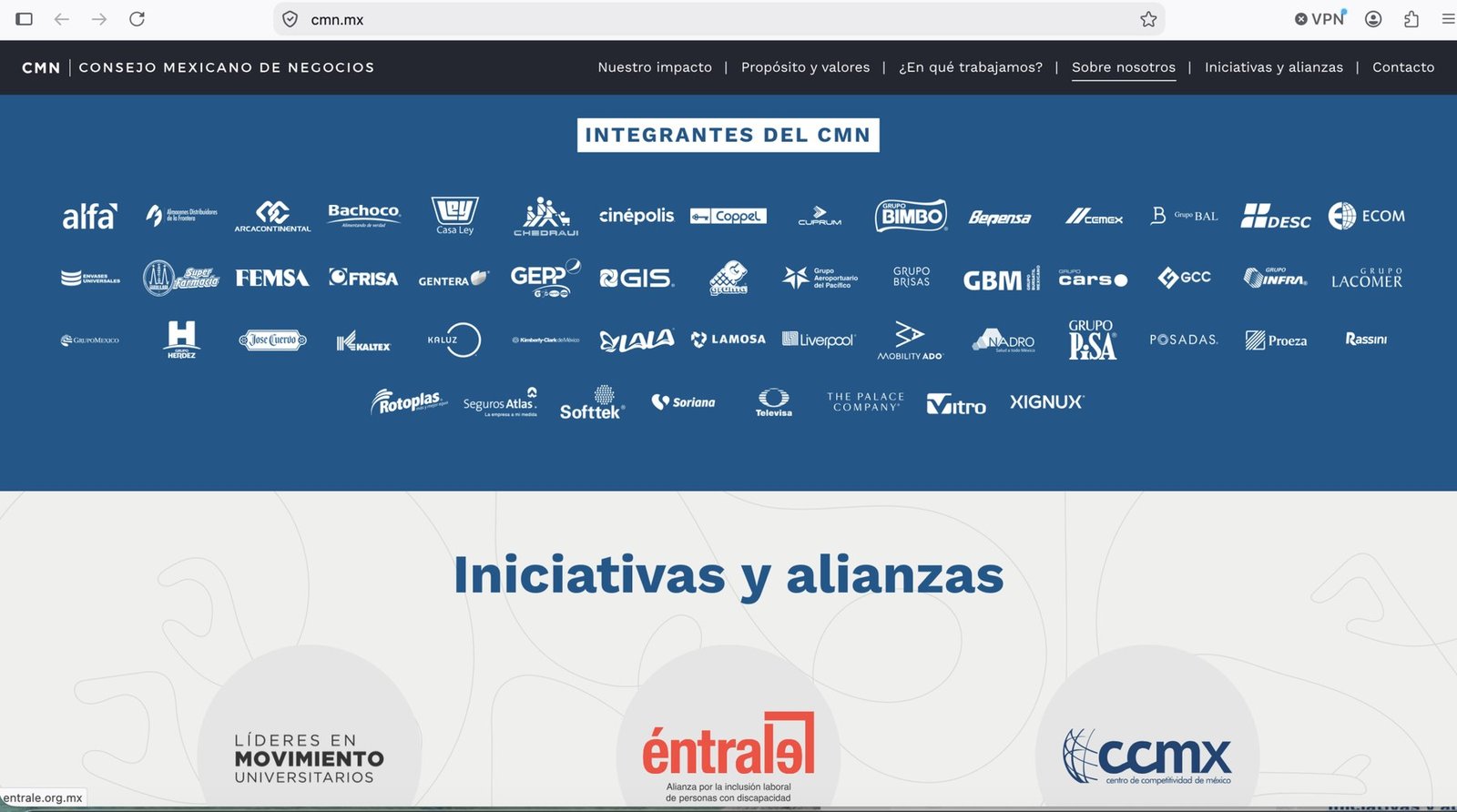
Members of the Mexican Business Council (CMN). Screenshot: cmn.mx.
Fundación Coppel
Fundación Coppel, led by Susana Coppel García, gave a donation to Aspen Institute México in 2025 of 1,360,000 pesos, according to data reviewed by Contralínea. Aspen Institute is little known, but it has a General Assembly of Associates chaired by Luis Gerardo Torres (partner and director of Jáuregui y Del Valle), which includes Leonardo Lomelí, rector of the National Autonomous University of Mexico (UNAM). In addition, its Advisory Committee features the Fundación Miguel Alemán and the National Association of Universities and Institutions of Higher Education (ANUIES). Among its list of “friends” is María Amparo Casar, of Mexicanos Contra la Corrupción y la Impunidad (MCCI); and the PRI members José Narro Robles, former UNAM rector, and Claudia Ruiz Massieu, among others. Among its group of economists are Luis de la Calle and Jaime Zabludovsky, associated with conservative think tanks that have systematically opposed the government of former president Andrés Manuel López Obrador and now that of President Claudia Sheinbaum.
To Consejo de la Comunicación AC, Fundación Coppel gave 13,934,459.6 pesos. It also gave donations of 186,500 to the Mexican Council on International Affairs AC (Comexi), led by Dr. Héctor Cárdenas and president of Ergo Group. Cárdenas collaborated with international bodies such as the World Bank, the United States Department of Labor, the French Development Agency, and the dismantled USAID, now folded into the State Department.
Comexi counts among its corporate members Amazon, Grupo Bimbo, FEMSA, Tenaris, Fundación Coppel, among others. Its institutional members include the North American Development Bank, the European Union, the United States Embassy in Mexico, and ITAM, among others. It has a Youth program that includes David Gallegos Rubio of Students for Liberty, an organization linked to the Atlas Network. Also part of the youth program is Diego Marroquín of the Brookings Institution—a conservative US think tank funded by the Mexican Business Council with more than 19 million pesos between 2021 and 2023—among another dozen young people in the private and public sectors, in Mexican embassies around the world, and in government institutions.
Comexi is no ordinary institution; among its founding members are businessmen and politicians of the old regime who shaped neoliberalism. They include Adrián Lajous, Alberto Baillères, Carlos Slim, Denise Dresser, Eugenio Clariond, Federico Reyes Heroles, Ildefonso Guajardo (former economy secretary under Peña Nieto), Jaime Serra (former finance secretary under Ernesto Zedillo), Jaime Zabludovsky, Luis Rubio, Pedro Aspe (former finance secretary under Salinas de Gortari), among others [1].
Fundación Coppel also continued funding the Mexican Institute for Competitiveness (IMCO), one of the conservative think tanks tied to the Mexican business class and to right-wing and coup-plotting institutions like the defunct USAID. Fundación Coppel gave it 500,000 pesos in 2025.
Another of the organizations funded by Coppel was Mexicanos Primero Sinaloa AC, with 3,500,000 pesos, and Mexicanos Primero Visión 2030 AC with 2,050,000 pesos. This organization is led by Claudio X. González Guajardo—”toxic Junior,” as President Claudia Sheinbaum dubbed him—Pablo González Guajardo, and Alejandro Ramírez Magaña. Mexicanos Primero, Visión 2030 invested the funding in the “study on continuing education, program for professional teacher development” with 1,736,683.26 pesos; also in “media monitoring,” 1,123,897.93 pesos, and other programs aimed at schools, teachers, and students.
Fundación Coppel is also among the funders of environmental-defense organizations tied to the Mexican bourgeoisie, such as Pronatura Noreste, to which it gave 100,000 pesos, and Reforestemos México, which it gave 1,874,737.75 pesos.
Fundación Diez Morodo
Fundación Diez Morodo AC, led by Valentín Diez, recorded donations of 420,011,050 pesos in 2025, according to data reviewed by this weekly. In turn, this foundation gave resources to opposition groups such as the Mexican Business Council (CMN), to which it gave 5,000,000 pesos in 2025 alone. It also allocated donations to the Mexican Business Council for Foreign Trade, Investment and Technology AC, led by Valentín Diez, which includes Altagracia Gómez, coordinator of the Advisory Council for Regional Economic Development and Relocation (CADERR). This same institution includes businessmen of the stature of José Medina Mora Icaza, president of the Business Coordinating Council, and Jorge Esteve Recolons, coordinator of the USMCA Committee of the Mexican Business Council.

Illustration: Contralínea.
Mexican Business Council
The CMN is one of the most important institutions in the country, because it concentrates the main domestic capital, and from a political standpoint it also manages to establish public policy, as was the case during the neoliberal period. In addition to paying lobbying services to a former CIA agent, the CMN funded IMCO with 16,666,667 pesos in 2025 alone. In turn, IMCO recorded donations in 2025 of 15,800,000 pesos from domestic legal entities and 10,247,595 pesos in donations from a foreign legal entity.
At IMCO we again find Valentín Diez, Juan Ernesto Pardinas, Alejandro Ramírez Magaña (who has ties to the Fundación Libertad, an international far-right network), Jaime Serra, Claudio X. González Laporte, Eugenio Clariond, among others.
In 2025, IMCO funded the Energy Monitor program, to which it allocated 1,016,751.45 pesos. To the “CFE in the Crosshairs” program it allocated 587,456.4 pesos, according to data reviewed by Contralínea.
The CMN also funded México Evalúa, another conservative think tank, one funded in its day by US coup-plotting institutions such as the National Endowment for Democracy and USAID. The 2025 donation was 12,500,000 pesos.
México Evalúa is led by Luis Rubio, Fernando Sendero, Luis de la Calle, Federico Jesús Reyes-Heroles González-Garza, Jaime Zabludovsky, Edna Jaime, and former justice José Ramón Cossío Díaz. This institution allocated resources to a justice program totaling 10,794,051.42 pesos.
The CMN also funded The Center for a New American Security in 2025 with 921,830 pesos. This US-based Center is led by Richard Fontaine, who worked at the State Department and was a member of the United States Defense Policy Board from 2021 to 2025. The vice president is Paul Scharre, who worked in the Office of the Secretary of Defense (OSD), where he established policies on autonomous and unmanned systems.
Finally, the US Mexico Foundation received 6,864,030 pesos in 2025 from the powerful Mexican Business Council. This institution is led by Enrique Perret, who is also president and founder of the North Capital Forum. Before this post he was president of ProMéxico, the Mexican government’s promotion agency; he was technical secretary for Competitiveness and coordinator of advisors to the president of the National Banking and Securities Commission. He was also part of the advisory board of Enseña por México, linked to Teach for All, and served on the board of Reinserta.
Fundación Maelva
This foundation gave funding to México Unido Contra la Delincuencia AC, chaired by Josefina Ricaño and Fernando Ramos. Maelva gave 1,969,442.83 pesos in 2025. This foundation is led, again, by Valentín Diez Morodo. In 2025, it reported donation income of 221 million pesos. The case of the foundation led by businessman Diez Morodo is special because it in turn gave funding to Fundación Coppel in the amount of 1,000,000 pesos, to Germán Larrea’s Fundación Grupo México it gave 5,687,897 pesos, and to the Chapultepec Forest Trust 2,000,000 pesos in 2025 alone.
This last trust is led by Sharon Dalit Fastlicht Kurian, wife of Emilio Azcárraga Jean. Also part of this trust is Antonio del Valle, which received donations in 2025 of 57,098,685.75 pesos in 2025 alone.
Fundación Kaluz
This foundation is led by María Blanca del Valle Perochena, and is in turn a funder of Fundación Coppel, since last year it gave 225,000 pesos, and it also funded Mejor México. This organization has on its advisory board María Amparo Casar of Mexicanos Contra la Corrupción y la Impunidad, as well as José Medina Mora. In its stated purpose as a foundation, it mentions that it “contributes to building a country without corruption.”
Iniciativa Climática México
This institution is led by María Isabel Studer Noguez and Sonia Medina Gómez. As Contralínea has detailed, Iniciativa Climática México (ICM) received from USAID between 2018 and 2020 2,122,470 dollars (constant 2023) for the project whose objective was to “reduce the social conflict associated with renewable energy projects, with an emphasis on wind and solar energy. The expansion of renewable energy development in Mexico has experienced delays and resistance, which prevents it from meeting its international commitments.”
ICM received foreign donations of 522,508,631 pesos in 2025 alone, a substantial increase, since in 2024 foreign donations were 187,615,131 pesos, according to data reviewed by this weekly.
Iniciativa Climática México distributes its donations to several organizations, among them México Evalúa, to which it contributed 522,292 pesos in 2025. To Cartocrítica it gave 1,521,140 pesos. To the Mexican Center for Environmental Law (CEMDA), which opposed the Maya Train and is led by María Eugenia de la Fuente Hernando and Gustavo Adolfo Alanís Ortega, it gave 2,029,480 pesos. In turn, CEMDA gave Cartocrítica another 257,400 pesos. CEMDA received 65,530,663 pesos in foreign donations and 2,945,330 pesos from domestic individuals and legal entities.
Iniciativa Climática México also funded the Institute for Development, Energy and Environment AC (IDEA) with 20,540,080 pesos in 2025; in 2024 it gave 14,944,742 pesos. IDEA is led by Luisa Sierra Brozon and Marco Aurelio Jano Ito. According to its website, IDEA emerged from Iniciativa Climática México.
Luisa Sierra directed ICM’s energy program, studied Public Policy at the Washington Center, and took part in the Energy and Climate Partnership of the Americas Fellows; she is part of the steering committee of the P4G-GtZ Coalition Alliance for Mexico and the International Network of Energy Transition think tanks.
Marco Aurelio Jano Ito was a Research Fellow at the Net Zero Innovation Institute of Cardiff University and collaborated with the Mario Molina Center and ICM.
The Mario Molina Center received 225,000 pesos from ICM in 2020 and 1,325,000 pesos in 2023, and is led by Juan Carlos Belausteguigoitia Rius, who in turn is also part of Pronatura, another institution funded both by the Mexican business class and by the United States, as Contralínea has detailed.
María Isabel Studer Noguez was an associate of the Atlantic Council, the political arm of NATO, and was director of The Nature Conservancy Mexico, another organization funded by the US Department of Agriculture and Department of the Interior. It also received USAID resources in 2008 and 2009; one of the funded projects had the objective of managing natural resources over the long term, mitigating conflicts, and fostering reconciliation “within the framework of the objective of peace and security.” The Nature Conservancy’s objective under the López Obrador government was to contain social problems.
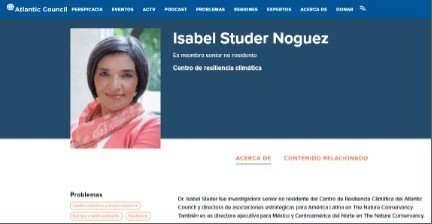
María Isabel Studer Noguez’s profile on the Atlantic Council website. Screenshot: Atlantic Council.
Studer Noguez has other ties as well: member of the board of the World Environment Center in Washington DC, of the Sustainability Experts Advisory Council of the Dow Chemical Company, of the Water Advisory Council of Mexico, of the French Development Agency in Mexico, and of the National Council of Tourism Companies. She was a member of the National Council on Climate Change, chaired by Nobel laureate Mario Molina, of the Advisory Council of the Private Sector Study Center for Sustainable Development, of the Scientific Committee of the Institute for Sustainable Development and International Relations of Sciences Po (Paris), and of the Advisory Council of the Notre Dame Global Adaptation Index (ND-GAIN). She was a Fulbright and Ford fellow.
ICM has on its advisory group Alejandra Rabasa Salinas, who was legal undersecretary of Planning and Environmental Policy at the Ministry of the Environment and Natural Resources (Semarnat) and director of Legal Affairs of the National Commission of Natural Protected Areas, and Renée González Montagut, who is also director general of the Fondo Mexicano para la Conservación de la Naturaleza, which counts among its members Juan Pablo del Valle Perochena, María de Lourdes Hernández Velasco, Fabiola López Barrera, Adriana Neneka Malvido Arriaga, María Guadalupe Mendoza Trejo, Francisco Suárez Hernández, and Luis Octavio Martínez Morales. This Fund received donations in 2025 totaling 394,686,004 pesos, of which 366 million came from the foreign public sector.
In 2025, this Fund gave Nacional Financiera 11,001,212.15 pesos, particularly to the Biodiversity Fund trust. To Semarnat, chaired by Alicia Bárcena, it gave 9,022,594.88 pesos in kind.
Another funded organization was the Neovolcanic Axis Conservation Fund AC, led by Karl Jurgen Hoth Vonder Meden. It received 18,999,625.3 pesos from the Fondo Mexicano para la Conservación de la Naturaleza in 2025. The Mexican neovolcanic axis is a special zone, since it will be one of the areas that will gain importance for geothermal energy.
And Mexicanos Contra la Corrupción y la Impunidad, once led by Claudio X. González, and where María Amparo Casar remains, recorded donations of 234,444.31 pesos in 2025, a brutal decrease, since in 2024, even while USAID was still active, it received 14,269,824 pesos. Not even the Mexican business class came out to defend that project.
Aníbal García Fernández
PhD, master's, and bachelor's in Latin American studies from the National Autonomous University of Mexico (UNAM). Member of the CLACSO working groups "Crisis and the World Economy" and "Violence in Central America." His main lines of research are the Inter-American Cold War, energy geopolitics, Latin American dependency and integration, militarism, and economic relations between the United States and Latin America.
[1] Comexi. (2025). Annual report. https://storage.ghost.io/c/ac/fc/acfc0832-6b0f-4b30-af16-0a7e41c415b5/content/files/2026/06/INFORME-2025.pdf
-

Twenty Foundations Moved from Philanthropy to Funding Opponents of Mexico’s 4T
August 26, 2026August 26, 2026
Aníbal García Fernández tracks 20 business-linked foundations that gave 2.7 billion pesos in 2025. As USAID money dried up, part of it was redirected to think tanks and NGOs.
-
Sheinbaum Analyzes Initiative to Prohibit Dual Nationality in the Presidency and Governorships
August 26, 2026August 26, 2026
The idea surfaced from the stalled extradition of ex-Tamaulipas governor Cabeza de Vaca, who holds US-Mexican nationality.
-
Graciela Domínguez, Virtual Interim Governor of Sinaloa, Is an Honest Woman, Sheinbaum Says
August 26, 2026
The federal deputy, tapped by Sinaloa’s Congress to replace Rocha Moya, brings 35 years in politics and a stint as state education secretary to the interim post.
The post Twenty Foundations Moved from Philanthropy to Funding Opponents of Mexico’s 4T appeared first on Mexico Solidarity Media.
From Mexico Solidarity Media via This RSS Feed.
Are you a bot? A person would have included a link explaining what the fuck 4T is.
https://en.wikipedia.org/wiki/Fourth_Transformation