

MANILA*—*The National Union of Students of the Philippines (NUSP) said that the country’s learning crisis is caused by state neglect and the continuing commercialization of education, not by the suspension of classes during disasters.
NUSP released the statement after EDCOM 2 Executive Director Dr. Karol Mark Yee’s warned that consecutive class suspensions due to inclement weather may deepen the ongoing learning crisis. Yee presented plans to amend Executive Order No. 66, s. 2012, which sets the rules for the cancellation or suspension of classes and government work during typhoons and calamities.
NUSP said that amid disasters and the worsening climate crisis, students and academic personnel’s safety must be prioritized. “Students and teachers must not risk their lives to meet certain metrics based on output rather than holistic development and overall well-being.”
NUSP stressed that the Marcos Jr. administration cannot continue to shift the burden of the learning crisis on students and teachers. “We are not convinced by his sham proclamations that education is his ‘greatest priority’ while billions are slashed from the education budget and poured into projects vulnerable to corruption.”
Systemic neglect, corruption
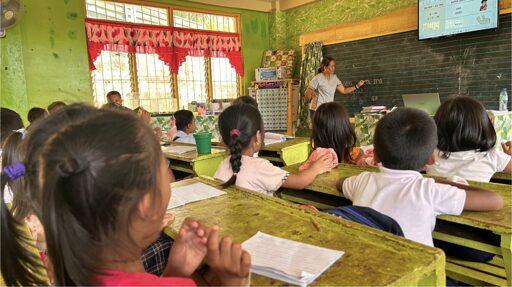
An article from the Development Aid showed that in the previous year, the Philippine government underfunded the education sector, accounting for only 3.6% of the country’s gross domestic product which is below the Unesco-recommended 4-6%.
According to the Makabayan bloc, the budget for the Department of Education (DepEd) suffers the largest total cut of P44.57 billion, with Maintenance and Other Operating Expenses (MOOE) cut by P33.7 billion. “This is driven by a crippling 64.22% budget cut, effectively halting the construction of much-needed classrooms. This will leave our students in overcrowded and dilapidated learning environments,” Makabayan said.
The coalition highlighted the allocation of PHP 58.53 billion of the pork budget for the Local Government Support Fund. “This LGU pork will be used at the discretion of local chief executives for ayuda, infrastructure projects, and the purchase of vehicles.”
DevelopmentAid said that around 5,000 schools in the Philippines remain without electricity, and 10,000 are without clean water.
NUSP said that 49 out of 113 SUCs will face budget cuts under the 2027 National Expenditure Program (NEP). Despite the education sector’s proposal for a total budget of Php 976 billion out of the proposed Php 7.2 trillion, the Commission on Higher Education will only receive a budget of Php 34.6 billion, which is already reduced from the initially proposed P47.5 billion.
In a statement, the Central Luzon State University Supreme Student Council (CLSU USSC) said that other than corruption, there is also the university administration’s and local authorities’ slow response to the emergency cancellation of classes. “[This] conversation cannot be separated from the broader issue of accountability in governance. Concerns over the use of public funds, allocation of resources, and decisions that directly affect student welfare must not be treated as matters beyond public scrutiny.”
CLSU experienced flooding due to the onslaught of the Southwest Monsoon in the country for the past few weeks. At the University of Santo Tomas, around 5,000 students were stranded inside their campus as heavy flooding blocked its gates on Aug. 17, following the late cancellation of classes from the Manila LGU.
Holding government accountable
“Class suspensions do not create the learning crisis. Government neglect does. Chronic underfunding does. Corruption does. The commercialization and privatization of education do,” NUSP said.
The student union demanded that Marcos Jr. be held accountable for exacerbating the systemic roots of the crisis and upholding its responsibility to provide accessible, quality, and safe education for all. (RTS,DAA)
The post State neglect fuel education crisis, student union says appeared first on Bulatlat.
From Bulatlat via This RSS Feed.
You must log in or # to comment.