

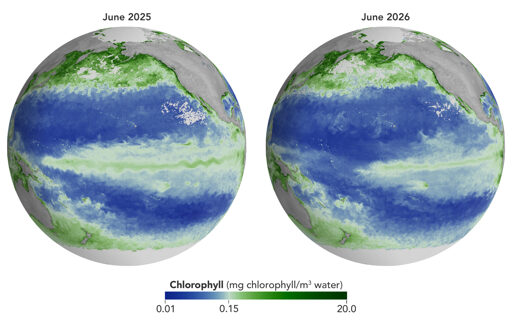
As the 2026 El Niño strengthens in the equatorial Pacific, satellites are capturing the first major signs of disruption to the marine food web. According to by NASA’s Earth Observatory observations, satellite measurements show a substantial drop in surface concentrations of chlorophyll across the Central Pacific compared with neutral conditions in June 2025. Chlorophyll is the pigment that helps plants absorbs sunlight to generate energy, and its reduction indicates a decline in phytoplankton, the base of the ocean’s food webs. Hyung-Gyu Lim, an associate professor of oceanography at Chonnam National University in South Korea, told Mongabay by email that a developing El Niño can slow the process of upwelling, where nutrient-rich cold waters rise from the ocean depths to the surface. “This may trigger less nutrient supply. It is not surprising for me,” Lim said. Matthew Kehrli and Graham Trolley, oceanographers at NASA’s Goddard Space Flight Center, wrote in a NASA Earth Observatory article that El Niño can suppress upwelling because easterly equatorial trade winds weaken, causing the warm surface layer of the ocean to extend deeper. They added that as El Niño progresses, chlorophyll concentrations will likely decrease further over a broader region. The ecological consequences of this nutrient decline would mean less food available for zooplankton, as well as for fish, seabirds, and marine mammals, the NASA Earth Observatory article said. This affects fisheries: Peru’s anchovy fisheries, for example, saw significant declines in catch during previous El Niño events, driven by warmer surface waters, reduced upwelling, and lower…This article was originally published on Mongabay
From Conservation news via This RSS Feed.