

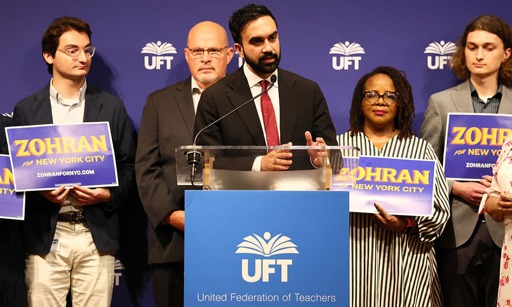
Over the past week, the Mamdani administration and the United Federation of Teachers (UFT) have been in a battle over the fate of the RESPECT Check Act, a law that would provide payments to New York City Public School paraprofessionals (known as “paras”) to boost shamefully low wages and fix severe staffing shortages.
The Mamdani administration’s lawsuit challenging the already woefully inadequate RESPECT Check not only turns its back on the some of the most essential yet lowest-paid education workers, but also reveals the limitations of the UFT’s bureaucratic methods of relying on negotiations with City Council rather than working-class methods to fight for the demands of its members.
What’s Going On?
In July, the RESPECT Check Act passed unanimously by the City Council, supported by a motley crew ranging from the UFT, Legal Aid Society and democratic socialist councilwoman Tiffany Cabán to even right-wing politicians falsely claiming to stand with paraprofessionals. The law would provide eligible public school paraprofessionals with up to $10,000 during the 2026-27 school year, distributed through four $2,500 payments.
It became law in August when Mayor Zohran Mamdani declined to sign nor veto it.
But last week, Mamdani, who previously supported the RESPECT Check, has sued City Council arguing that it is illegal and bypasses collective bargaining. Advised by his legal team, Mamdani’s move is supported by fiscal watchdogs like the Citizens Budget Commission, the union-hostile Manhattan Institute, and even the New York Post Editorial Board.
And paraprofessionals have been left in limbo.
The administration argues that compensation must be settled through collective bargaining and that the Council has improperly interfered with a process governed by the Taylor Law, the New York State statute that grants public workers collective-bargaining rights but reins in worker combativity by prohibiting public-sector strikes.
In other words, paras are being told that even after years of inflation, low wages and instability, they cannot obtain immediate relief but instead must wait for the bargaining calendar. That’s once every five years, if the timeline runs according to plan. The current UFT contract expires in 2027.
But whatever legal arguments City Hall may advance, the political questions should be straightforward for anyone who claims to stand with working people: Why are paraprofessional wages so low in the first place? And why should the mayor use the power of his administration to take away an immediate material gain from some of the lowest-paid workers in the school system?
Para Pay is Scandalously Low
Paraprofessionals are indispensable to New York City schools. They work closely with students who need the most individualized attention, providing all types of support from reading interventions to bilingual services to one-on-one support for students with disabilities. They are overwhelmingly women of color, and are also far more likely than teachers to live in the districts and school zones where they work.
Yet their compensation has remained scandalously low. The starting salary for a paraprofessional is roughly $32,000 with a maximum cap — even after 15 years of experience — of $57,000. The school system has faced thousands of vacancies for paraprofessionals, who themselves have described having to work two and sometimes three jobs simply to survive in New York City. According to a new study, a single adult now needs to earn $124,342 a year before taxes to live “comfortably” in New York State — even the highest-paid paras don’t earn half of that.
The RESPECT Check does not come close to solving that crisis. It does not permanently restructure the salary schedule, provide a living wage or repair decades of inequality. But that is an argument for more — not an argument for taking the $10,000 away.
The current precarious situation of paraprofessionals is the result of years of systematic underfunding of public education budgets, as well as the 2023 contract negotiations between former Mayor Eric Adams’s administration and current UFT President Michael Mulgrew, which imposed five years of poverty wages on paras.
In a city controlled by billionaires, public education continues to be the last priority. The ones who should pay for the crisis are the rich and not workers dividing a meager budget among ourselves.
The Taylor Law Against the Working Class
Mamdani is asking a court to stop this one-time extra payment because it did not go through the approved collective-bargaining process, and claims to defend rights guaranteed by the Taylor Law. On the other hand, the union insists that the measure does not interfere with contract bargaining.
But when both City Hall and the UFT leadership hold the Taylor Law as an almost sacred framework for labor relations, workers should ask, whose interests does it ultimately protect?
Invoking labor law as the source of workers’ rights obscures where workers’ power actually comes from. We should take advantage of every legal avenue in our favor, but our strength doesn’t come from laws guaranteed by the capitalist state — especially those that emerged from attempts to stifle workers’ power. It comes from our ability to impose our demands by withholding our labor and taking collective action.
Even the National Labor Relations Act of 1935, despite being hailed as a progressive part of the New Deal, was not a benevolent gift to workers. Its purpose was to quell labor unrest in a period of profound workers struggle and bind the labor movement to a legalistic framework managed by the capitalist state.
Robert W. Linn, a former city labor-relations commissioner who continues to advise City Hall, defended the Taylor Law by warning that without a “rigorous collective bargaining approach,” unions and workers might turn to legislators or engage in work stoppages, raising the possibility of returning to the labor “chaos” of the 1960s. What officials call “chaos” was also a period in which workers across the country exercised significant collective power before the onslaught of neoliberalism that took a chainsaw to workers rights and labor unions both internationally and domestically.
The Taylor Law itself emerged in 1967 after a disruptive transit workers’ strike, when city officials didn’t have the legal mechanism to discipline the striking workers that ground the city to a halt.
There’s a reason that New York’s Public Employment Relations Board explicitly describes the prohibition on strikes as a central provision of the law: workers’ power is exactly what the law seeks to curtail by forcing them to negotiate with one hand tied behind their backs.
Mamdani’s defenders argue that the RESPECT Check could weaken unions by allowing politicians or legislatures to circumvent collective bargaining in order to impose worse wages or working conditions. That concern should not simply be dismissed; workers should absolutely be wary and resist every attack imposed on our class.
But it’s worth noting when these arguments are invoked and when they are ignored. So-called progressive Democrats have been perfectly willing to use the legislature to subvert the collective-bargaining process, such as when AOC and other Democrats supported imposing a contract on rail workers to avert a strike under the Biden administration.
In that case, Biden and Congress used state power to impose conditions on workers that should have been negotiated through collective bargaining. While it was “legal” and supported by Supreme Court precedent, the government undemocratically imposed a contract on workers and restricted their ability to fight, even as workers themselves wanted to go on strike. In the case of paras here, the intervention would provide a material improvement for an extremely underpaid group of workers. It is revealing that Democrats are willing to intervene to block potentially disruptive workers’ action, but not to benefit some of the most exploited workers in NYC schools.
What’s more, if the Taylor Law is the standard to uphold for Mamdani, what is to say he doesn’t penalize workers and unions if they decide to break the Taylor Law and strike? The potential to discipline labor is the unspoken flip side of Mamdani’s defense of the Taylor Law, all while he claims to speak to the “interests” of the working class.
By asking whether these questions are “legal” according to bourgeois law but not whether it’s in the best interest of workers, which side are we on?
Collective bargaining should protect workers against attacks by the bosses, but it should not be transformed into a legal argument for preventing workers from receiving improvements in their compensation and working conditions, even ones as insufficient as the RESPECT Check. Similarly, we would not oppose a law requiring public- and private-sector employers to index wages to inflation or raise the minimum wage simply because those improvements were established through legislation rather than collective bargaining.
The labor movement did not win its greatest advances because workers obediently waited for government officials to tell them which forms of struggle were permissible. Workers won because they organized, disrupted business as usual and built enough collective power to force employers and governments to concede.
UFT Leadership is Not Off the Hook
After patting themselves on the back for its passage, the UFT leadership, headed by Michael Mulgrew and the Unity Caucus, now smugly denounces the lawsuit and acts as though it is spearheading the fight for para pay.
But paraprofessionals did not suddenly become underpaid in 2026. This is a result of decades of selling out the union’s most precarious members.
The UFT itself has acknowledged that percentage-based increases have widened the gap between paraprofessionals and higher-paid school employees, a product of the harmful pattern bargaining system. A 3 percent raise produces only a small dollar increase for a worker earning around $32,000, while providing a much larger raise to someone earning above $75,000. UFT testimony notes that between 2005 and 2025, starting para salaries increased by roughly $12,000 while salaries at the top of the school-administrator scale rose far more dramatically.
That raises a question the union leadership must answer: if the situation is as urgent as the UFT now correctly says it is, why were paraprofessionals allowed to fall so far behind contract after contract?
Many workers rightfully are distrustful and angry at Mulgrew and Unity, not only for pursuing a strategy of “fighting for paras” that was so tenuous in the first place, but because of years of undemocratic practices and half a century of uninterrupted bureaucratic control.
This embarrassing public fight has revealed the limitations of relying on deals with City Council rather than engaging in actual workers’ democracy and struggle. And it shows why a serious labor strategy cannot treat the restrictions of bourgeois law as the outer boundary of what workers are permitted to even contemplate.
There are real concerns about whether RESPECT Check will later be used as an excuse to deprioritize paras in bargaining the upcoming contract. Additionally, some worry that money that comes from outside the contract would be an excuse to put less money into future contracts, lowering the pattern for all the other city workers too.
But the answer to these concerns can’t be to accept less, make excuses, or engage in more top-down negotiations with City Hall. It has to be to organize a combative labor movement to fight the anti-worker status quo. That means challenging the anti-strike Taylor Law itself, refusing to abide by the limits set by pattern bargaining, and dropping the undemocratic practices of making the bargaining committee sign non-disclosure agreements.
The UFT should hold assemblies of rank-and-file paraprofessionals in every borough, organize joint meetings of paras, teachers and other school workers, and allow workers to discuss and vote on their demands that could include permanent wage increase indexed to inflation, improved benefits, manageable workloads, adequate staffing, and much more.
And then workers should organize a plan from below, one rooted in collective action and class struggle capable of winning those demands.
Paraprofessionals Should Not Fight Alone
This struggle cannot be left to paraprofessionals alone.
Teachers, counselors, social workers, school staff, parents and students all have an interest in ending the crisis that paraprofessionals face. A school cannot function properly when the workers responsible for some of its most sensitive student support are forced to juggle multiple jobs or leave the system because their salaries are impossible to live on.
The history of paraprofessional organizing in New York is itself rooted in deep working-class struggle. The city’s early paraprofessional workforce emerged from community organizing in the 1960s, with many of those positions filled by working-class Black and Latina women. Today’s struggles should recover that tradition of organizing rather than treating paras as an afterthought within the school system.
Recent struggles like the Minneapolis educators’ strike in 2022 have repeatedly demonstrated the potential power of solidarity across job titles and communities. The principle should be simple: an injury to paras is an injury to teachers, and an attack on one section of the education workforce must become a fight for the entire school community.
Mamdani should drop the lawsuit and allow paraprofessionals to receive the payments. The UFT members must then negotiate a contract that permanently and substantially raises para wages and improves working conditions, and Mamdani should direct his Office of Labor Relations to agree to that.
This will also entail going beyond accommodating millionaires and billionaires and taking up a real fight with the state to tax the rich at the time of drawing budgets to actually fund the contract. It is a fight that will require mass mobilization if it is to go all the way, far beyond the insufficient pied-a-terre tax negotiated this year that was barely enough to “balance” capitalist budget (a concept that socialists should take issue with — balancing the capitalist budget should not come through delaying class-size mandates and restructuring pension plans).
A labor movement worthy of the name does not tell poorly paid workers that they must continue waiting because the calendar, the bargaining cycle, or the law says their turn has not yet arrived. It is one that can unite workers across titles and sectors to win what they need, when they need it, with our own methods.
Paras, teachers, and education workers more broadly cannot rely neither on the Mamdani administration nor the bureaucratic leadership of the UFT. We need to unite across titles to guarantee a real fight for improving conditions for paraprofessionals. The struggle should be organized from below, with assemblies that allow for discussion and democratic decision making by paras themselves.
The post The Fight Over Para Pay Shows the Limits of Mamdani and the UFT Leadership appeared first on Left Voice.
From Left Voice via This RSS Feed.