

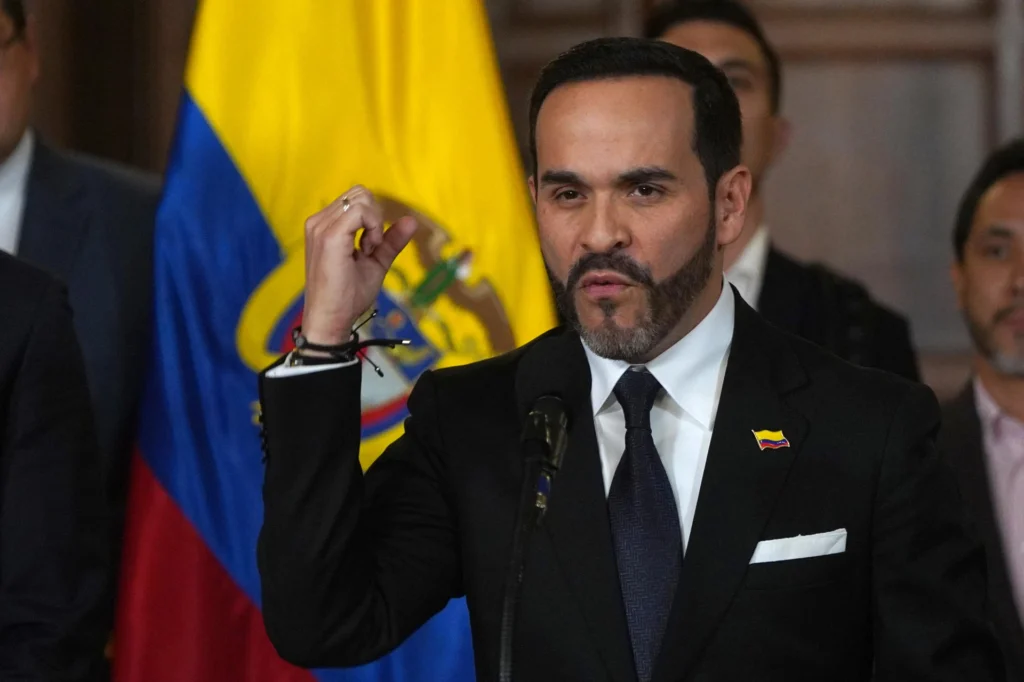
Colombian President Abelardo de la Espriella has instructed to carry out operations identifying irregular migrants, prioritizing foreigners who commit crimes and deporting those without regularized status.
The Colombian President detailed that the operations, which set aside a Human Rights approach to focus on the criminalization of migration, must first prioritize immigrants who commit crimes and later those without a regularized migratory situation, who “in the short term will have to be deported.”
The directive expands the executive’s security agenda beyond migration, since it also eliminates differences in the categorization of groups operating outside the law.
RELATED: Colombian President De La Espriella Alters Peace Stations’ Programming
Under the new instruction, all armed and illegal organizations operating in the country will be treated under the single category of terrorist groups. This way of enabling state action and the use of force occurs outside international regulations that clearly distinguish criminal organizations from those that promote terrorism.
Presidente De La Espriella anuncia estrategia integral de seguridad: todos los
grupos criminales serán tratados como terroristas. pic.twitter.com/HV5dJcog7K— Presidencia Colombia
(@infopresidencia) August 25, 2026
Text reads: “President De La Espriella announces comprehensive security strategy: all the criminal groups will be treated as terrorists.”
Warns of Violence and Criminalization
Among the actions ordered, the Government mandated the immediate formation of a National Search Block against Extortion, integrated by the Military Forces, the Police, the Prosecutor’s Office and the Judiciary. It also ordered the reactivation of the Financial Information and Analysis Unit (UIAF) to inspect bank movements of the last four years, along with urgent prison transfers, raids and a reward system.
The plan includes the persecution of the land cartel, the fight against the loan known as “drop by drop” and the creation of elite corps of prosecutors and specialized judges per city. These measures form part of a broader security strategy that the Government presents as a response to urban violence, extortion and organized crime.
Gustavo Petro, finishing his mandate, criticized the measures by comparing them with the U.S: Immigration and Customs Enforcement (ICE) service and warned about the risk of unleashing violence. Petro alerted that this repressive strategy against youth in popular neighborhoods will only bring more violence, death and a potential social outbreak.
“The ICE strategy has caused much pain, violence and death in the United States. Abelardo wants to make ICEs to confront youth in the popular neighborhoods of large cities, that will only bring more violence and death,” Petro emphasized in early July in a publication on his account on the social network X.
The former Colombian President’s warning came amid growing debate about the direction of Colombian security policy in the transition of government. De la Espriella, who took office with a campaign promise of order and firmness against crime, has accelerated the implementation of measures that concentrate enforcement powers in the Executive Power.
Human Rights organizations have expressed concern about the combination of immigration operations and the unified classification of armed groups as terrorist, arguing that both measures blur the legal distinctions that protect fundamental guarantees in contexts of conflict. The criminalization of migration particularly worries civil society, since it exposes migrant populations to detention and deportation without adequate due process.
The operations in Barranquilla represent the first visible phase of the new strategy, with the Police and Colombian Migration coordinating identity checks and documentation verification in key sectors of the city. Local authorities say the measures seek to respond to citizen complaints about insecurity, although critics point out that linking migration with crime feeds xenophobic narratives that do not correspond to the statistical reality of violence in the country.
The coming weeks will test the scope of the measures: the formation of the extortion block, the reactivation of financial intelligence and the deportation operations will define whether the strategy achieves its stated objectives or, as Petro warned, deepens social tensions. The response of the affected communities and the international community’s reading of a policy that equates migration with crime will also mark a debate that is just beginning in Colombia.
From teleSUR English via This RSS Feed.