

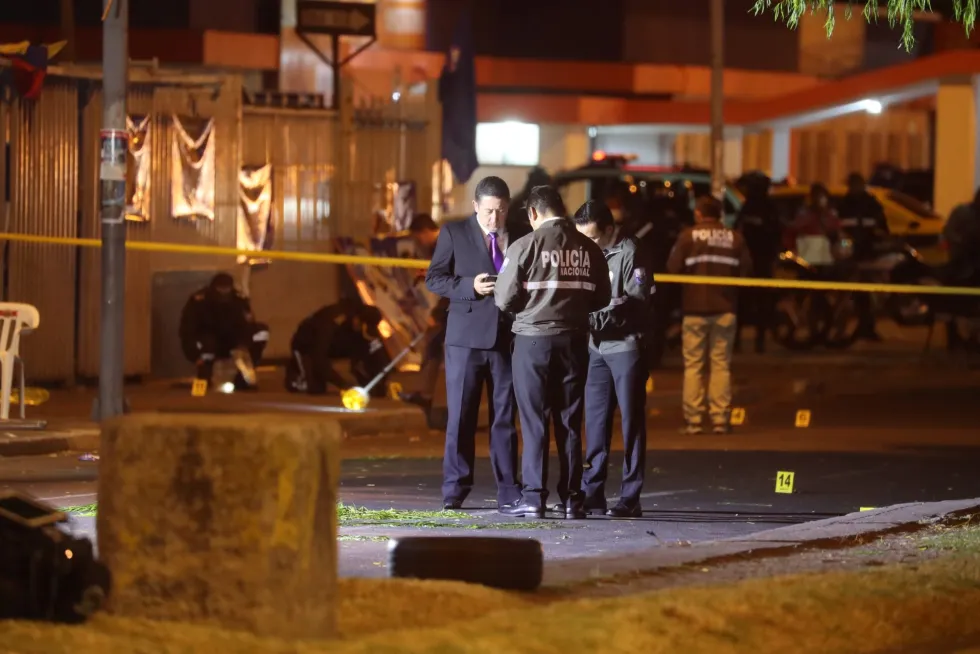
Ecuador registered 345 murdered minors between January and July 2026, a historic maximum according to the Ministry of Interior, equivalent to one homicide every 14 hours and 45 minutes.
The figure is part of a total of 4,882 homicides reported nationwide during the period, placing minors as 7% of the victims.
In the year-on-year comparison, the increase is 1.8% compared to the 339 cases recorded in the first seven months of 2025; the rise reaches 54% compared to the 224 cases of 2024 and climbs to 77.8% against the 194 murdered minors in the same period of 2023.
RELATED: Record 742 Disappearances Expose Absent State in Ecuador
Official reports identify a strong concentration of crimes in the country’s coastal region. Guayaquil stands as the most affected canton with 111 murdered minors; Durán ranks second with 28 cases, while Manta and Esmeraldas record 15 child and adolescent victims each.
Regarding the mechanisms of aggression, in 321 of the 345 cases the aggressors used firearms. The remaining files report 13 attacks with sharp weapons, six by strangulation, two through constrictor or blunt weapons and one case of poisoning. The preponderance of firearms confirms armed violence as the main cause of violent death of minors in the country.
#Seguridad | En promedio, un menor de edad fue asesinado cada 14 horas y 45 minutos. La mayoría de crímenes ocurrieron en Guayaquil, Durán, Manta y Esmeraldas.#LaRadioDeLasNoticias
Los detalleshttps://t.co/7McY9dSuar pic.twitter.com/4YZruFn1Kj
— Radio Pichincha (@radio_pichincha) August 25, 2026
Text reads: “On average, one minor was killed every 14 hours and 45 minutes. Most crimes occurred in Guayaquil, Durán, Manta and Esmeraldas.”
Children Caught in Crossfire
The violence balance includes recent events illustrating the exposure of childhood to crossfire. On August 21, a 7-year-old boy was seriously wounded after receiving three bullet impacts in an amusement area of the Suburbio de Guayaquil, during an alleged threat against the administrators of the place. On June 3, hitmen on motorcycles murdered a 14-year-old adolescent in the Juan Montalvo cooperative. Both episodes add to the pattern of selective attacks and collateral victims marking the security crisis in the port city and its surroundings.
The scenario poses a direct challenge to child protection policies and to the containment plans for organized crime on the Ecuadorian coast. The sicariato modality, the territorial concentration in Guayaquil and neighboring cantons, and the persistent use of firearms indicate that the institutional response has not managed to reverse the rising curve of homicides of minors.
Human Rights organizations have repeatedly warned that violence is expanding beyond traditional conflict zones, reaching recreational spaces, schools and neighborhoods where children live and play. The case of the 7-year-old wounded at a mechanical games area illustrates how even spaces designed for recreation have become scenes of armed attacks, deepening the humanitarian emergency that places Ecuadorian childhood at its center.
https://t.co/paajYlIdUS
Una mujer y un niño fueron baleados mientras esperaban para subir a los juegos, en el suburbio de Guayaquil. La ciudadana está estable. Moradores aseguran que el ataque está relacionado con extorsiones. pic.twitter.com/7Ol0kQdGiK
— Ecuavisa Noticias (@EcuavisaInforma) August 24, 2026
Text reads: “A woman and a child were shot while waiting to go to the games, in the suburb of Guayaquil. The citizen is stable. Residents claim that the attack is related to extortion.”
The sustained increase in child homicides also reflects structural weaknesses: poverty, limited access to education and health, and the expansion of criminal economies that recruit adolescents or use neighborhoods as territorial battlegrounds. Analysts note that the figures expose the failure of strategies focused exclusively on punitive response, demanding comprehensive approaches that combine security with social investment in the most affected coastal territories.
With Guayaquil concentrating nearly a third of the victims, local authorities face growing pressure to design prevention programs capable of protecting minors from both direct attacks and the environmental violence surrounding them. The emergency requires immediate and verifiable actions, as the toll continues to climb: every 14 hours and 45 minutes, a child or adolescent loses his or her life in Ecuador, marking one of the most serious Human rRghts crisis in the country’s recent history.
From teleSUR English via This RSS Feed.