

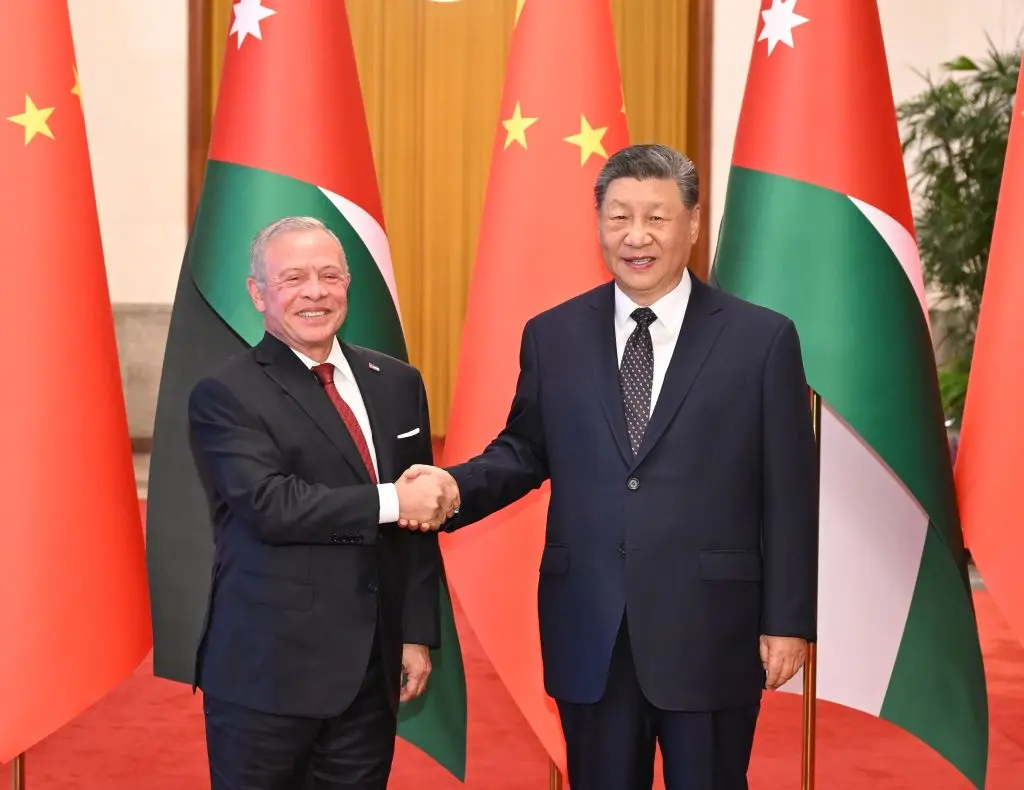
Jordan’s King Visits Beijing to Seek Solutions to Middle East Conflicts and Strengthen Ties with China.
The Palestinian question was at the center of Jordanian King Abdullah II’s state visit to China. During a meeting with President Xi Jinping on Monday (24) in Beijing, the two countries reaffirmed their support for the establishment of an independent Palestinian state and the two-state solution.
Xi presented four principles for a political settlement of the Palestinian question, while a joint China-Jordan statement described the two-state solution as “the only way” to achieve a just and lasting peace.
RELATED: Israel Spends $142 Billion on Gaza Genocide Campaign
The meeting took place amid the genocide against the Palestinian people in the Gaza Strip. The UN Independent International Commission of Inquiry concluded that Israeli authorities and security forces “committed and continue to commit genocide” against Palestinians in the territory. In June this year, the commission said Israel continued to commit genocide and denounced, among other practices, deliberate attacks against Palestinian children.
More than 73,000 Palestinians have been killed in Gaza since October 2023, according to the territory’s Ministry of Health. Israel’s offensive has also caused large-scale destruction of civilian infrastructure, mass displacement and a severe humanitarian crisis. The UN continues to record Palestinian deaths even during the ceasefire.
President Xi Jinping held talks with His Majesty King Abdullah II of Jordan.
President Xi Jinping stressed that the Palestinian question is the core of the Middle East issue, and efforts to resolve it should be guided by four principles.1️⃣ We must uphold political settlement,… pic.twitter.com/jg7HAqTDBO
— FU Cong 傅聪 (@ChinaAmbUN) August 24, 2026
Xi: “The Palestinian question is at the center of the conflicts in the Middle East”
Welcoming Abdullah II, Xi said that “the Palestinian question lies at the center of the conflicts in the Middle East.” The Chinese President called for the resumption of negotiations between Palestinians and Israelis and the establishment of an independent Palestinian State as the direction for a political settlement.
The first of the four principles presented by Xi is precisely the pursuit of a political solution to the Palestinian question. The second is that “Palestinians govern Palestine.” Xi said this principle should apply both to the administration of the West Bank and to the reconstruction of Gaza after the war. Explaining China’s position, he said: “Palestine is the homeland of all Palestinians.”
The third point is humanitarian. According to Xi, the international community must act to protect civilians and ensure the delivery of aid. The UN Security Council, in particular, “must effectively fulfill its responsibility to protect the safety of civilians, ensure the delivery of humanitarian assistance and put an end to humanitarian catastrophes.”
The fourth principle is the defense of justice and equity, with respect for international law and concrete measures to address the causes and consequences of the conflict and achieve a comprehensive, just and lasting solution.
The position was reinforced in the joint statement signed during the visit. China and Jordan supported the establishment of an independent and sovereign Palestinian state within the borders of June 4, 1967, with East Jerusalem as its capital, and supported Palestine’s admission as a full member of the United Nations.
Regarding Gaza, both countries called for the consolidation of the ceasefire and the immediate, adequate and unrestricted entry of humanitarian aid. They also called for Palestinians to administer their own affairs in the territory and preserve unity between Gaza and the West Bank, while reaffirming the role of the United Nations Relief and Works Agency for Palestine Refugees (UNRWA).
The scale of the crisis helps put the positions presented by Beijing and Amman into context. In addition to the tens of thousands killed, thousands of Palestinians remain wounded and displaced, while hospitals and other essential infrastructure in Gaza have been devastated by Israel’s offensive.
In the West Bank, the situation has also deteriorated. The joint statement condemned the expansion of Israeli settlements, land confiscation and settler violence in the occupied West Bank and East Jerusalem. China and Jordan called for respect for international law and United Nations resolutions.
The UN Commission of Inquiry has also documented increased settler violence and the displacement of Palestinians in the West Bank, saying these actions are part of a broader process of annexation and displacement of the Palestinian population.
Beijing also reaffirmed its support for the Hashemite Custodianship exercised by King Abdullah II over Muslim and Christian holy sites in Jerusalem.
Abdullah II stressed the importance of China’s position for Arab countries. According to the king, Jordan values Beijing’s position on the Middle East and its support for the Palestinian cause. “China’s just position is very important to the countries of the region,” he said.
The genocide in Gaza is also the subject of proceedings brought by South Africa against Israel before the International Court of Justice, under the Convention on the Prevention and Punishment of the Crime of Genocide. The case remains pending and should not be confused with the conclusion of the UN Commission of Inquiry: the ICJ has not yet issued a final judgment on the merits of the genocide allegations.
Iran and the Regional Crisis
The Palestinian question was not the only regional issue discussed by Xi Jinping and Abdullah II. The two leaders also addressed the war between the United States and Iran and the risks of a new escalation in the Middle East.
Xi said that China “has consistently advocated a comprehensive ceasefire and an end to hostilities” and the resolution of disputes through political and diplomatic means. The Chinese president also called for respect for the sovereignty and security of countries in the region, including Jordan.
In the joint statement, China and Jordan called for maintaining the ceasefire between the United States and Iran and urged a “comprehensive solution capable of eliminating the roots of tensions” through dialogue and negotiations.
The two countries also called for the resumption of normal navigation through the Strait of Hormuz, one of the main maritime routes for international energy transportation.
Xi also highlighted Jordan’s “unique and important role” in the Middle East and said China is ready to work with Amman to contribute to peace, stability and prosperity in the region.
At the conclusion of my visit to China, I thank President Xi Jinping and the Government and people of China for their gracious hospitality. Our meetings in Beijing, Shenzhen, and Shanghai presented important opportunities to bolster our Strategic Partnership, and expand…
— عبدالله بن الحسين (@KingAbdullahII) August 24, 2026
China and Jordan Deepen Partnership
The visit marked Abdullah II’s return to China since his last visit to the country in 2015, when the two governments announced the establishment of a strategic partnership. Diplomatic relations were established in 1977 and will mark their 50th anniversary in 2027.
According to Xi, amid changes in the international and regional landscape, a “more substantive and dynamic” China-Jordan relationship meets the expectations of both peoples and follows the movement of Global South countries toward greater cooperation.
The Chinese President called for closer alignment of development strategies and expanded cooperation in the economy and trade, infrastructure, transportation and mining, as well as areas such as the digital economy, artificial intelligence and green energy. He summarized the bilateral relationship by saying: “China-Jordan cooperation is essentially mutually beneficial and win-win.”
Trade between the two countries reached around US$6.7 billion in 2025, while cumulative Chinese investment in Jordan between 2010 and 2025 exceeded US$3.56 billion.
During the visit, the two governments witnessed the signing of agreements and memorandums covering foreign affairs, the economy and trade, industrial and supply chains, and judicial cooperation.
Abdullah II also visited Shanghai and Shenzhen during the trip, as part of an agenda focused on expanding economic cooperation. In the aviation sector, Royal Jordanian and Air China signed a memorandum to expand commercial and operational cooperation between the two airlines.
The joint statement also calls for measures to launch direct flights between China and Jordan as soon as possible, with the aim of facilitating the movement of people and goods.
Premier Li Qiang called for stronger cooperation under the Belt and Road Initiative and in areas such as green development, the digital economy and people-to-people exchanges. The premier also highlighted Jordan’s contribution to closer ties between China and Arab countries.
Abdullah, for his part, highlighted China’s development and its international role.
“I am truly delighted to be back in the People’s Republic of China after my visit in 2015. It is a pleasure to see how your great nation has continued to advance and prosper over the past decade. We deeply value our ties with China and remain firmly committed to expanding cooperation in various fields,” he said.
The king added: “We deeply respect China for its model of development and economic growth, as well as its leadership on the international stage.” According to Abdullah, the visit demonstrates “the sincere commitment of our countries to advancing relations and mutual development.”
Jordan reaffirmed during the meeting its adherence to the one-China principle and stated that it considers Taiwan part of Chinese territory. Abdullah also expressed support for the global initiatives proposed by Xi and called for a greater role for China on the international stage.
From teleSUR English via This RSS Feed.