

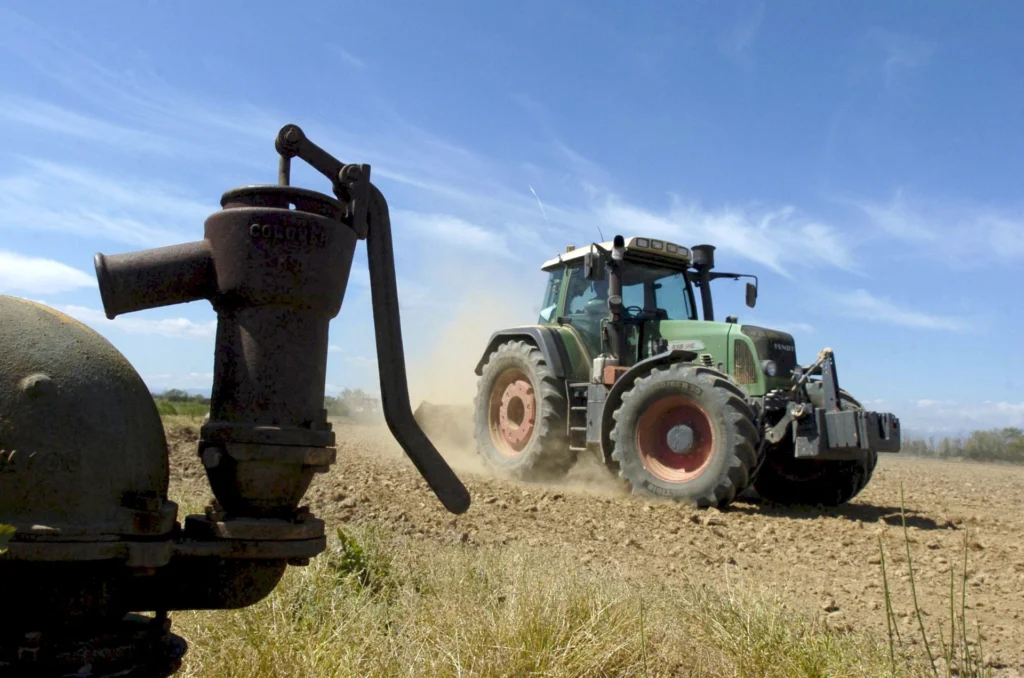
Extreme heat and drought have hit summer harvests across much of Europe, placing the European Union’s agricultural forecasts up to 14% below the five-year average, according to the European Commission.
The phenomenon arrives at the height of the northern summer, when water demand reaches its peak and corn and other seasonal crops complete their maturation cycle.
The most recent report from the Joint Research Centre of the European Commission, the bloc’s science and knowledge service, warns that high temperatures reduced soil fertility, accelerated crop deterioration and triggered a worrying decline in pastures for livestock.
RELATED: Danube Drought: 40°C Heat Triggers Alarming River Lows in Europe
The European Union’s agricultural forecasts for the current campaign have fallen to 14% below the average of the last five years, one of the sharpest drops registered in recent seasons. The zones hardest hit by the water deficit and persistent heat concentrate in central and western Europe, covering territories of France, southern Germany, northern and central Italy, Austria, the Czech Republic, Slovakia, Hungary and western Romania, where severe local losses are foreseen.
In the Netherlands, Belgium, Luxembourg, Slovenia and Croatia, the impact is moderate and has especially affected corn plantations lacking irrigation systems, a crop essential for animal feed and the food industry. In other countries such as Ireland, Denmark, Poland, Ukraine and Bulgaria, the drought has begun to drain moisture from soils, threatening harvest yields if the water deficit extends over the coming weeks.
Ver esta publicación en Instagram
Una publicación compartida de teleSUR English (@telesurenglish)
Spain Escapes Worst Damage
Spain has managed to avoid the most serious damage observed in the rest of the continent, maintaining its production forecasts stable at figures close to the previous five-year average, according to the report. Spanish authorities keep the alert in the north due to heat waves, although the country’s agricultural production remains resilient to the episode that has hit its European neighbors with force.
The situation reflects a structural trend: Europe is the continent warming at the fastest pace on the planet, a process scientists link to human activity and to the growing intensity of droughts, wildfires and heat waves. The European Commission report adds to scientific evidence showing that droughts are increasingly long and frequent, from the Amazon to Europe, in a context of accelerating climate crisis.
The reduction of pastures directly affects the livestock sector, while losses in crops such as corn could pressure grain availability in the European market in the coming months. With the summer harvests in critical condition and the coming weeks considered decisive by analysts, the Union’s agricultural calendar faces one of its most complicated episodes in recent years.
A series of heat waves broke records and is taking a toll in Europe this summer.
This animation shows the daily max surface air temperature across Western Europe from May 1 to Aug. 19, 2026 using the @NASAGoddard GEOS model. https://t.co/HRvJ05kPLI pic.twitter.com/4m6YBNuX4y
— NASA Earth (@NASAEarth) August 24, 2026
The affected nations concentrate a large part of the bloc’s cereal and livestock production, which raises concerns about food security in a region that has faced repeated episodes of extreme weather in recent years. For the coming weeks, the evolution of meteorological conditions will determine whether losses remain at current levels or deepen, while affected governments evaluate support measures for producers. The European Union’s response to the crisis, both in terms of support for producers and climate adaptation, will be tested in the weeks ahead.
From teleSUR English via This RSS Feed.