

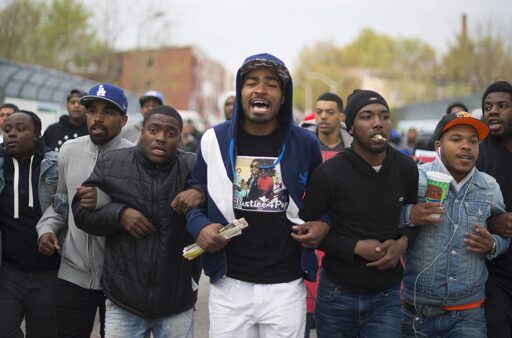
On August 8th at the Real News Studio, a screening of the new documentary Beyond the Wire—directed by filmmaker Dr. S. Rasheem—was followed by a panel discussion featuring seasoned conflict mediation organizers from the film. The participants explored their grassroots efforts to challenge the corporate media establishment’s heavy emphasis on crime—which drives city policy and the local economy—and redefine Baltimore’s historical present as a city of abolition.
Credits:
- Videographer: Cameron Granadino/David Hebden
- Editor: Cameron Granadino
Transcript
The following is a rushed transcript and may contain errors. It will be updated.
Speaker 1:
I’m going to be super brief. I largely just want to, again, thank everyone for coming out. I’m the producer of this film, but I’m sure you guys know you can’t do something like this by yourself, right? So I want to also thank the Baltimore Legacy Project Youth Crew who’s outside, who took your. I mean, they’ve just been really on point getting B-roll setting up. Really appreciate them a lot. Also, the folks that you saw in the film, thank you so much for trusting me with your voice, your story. I don’t take that lightly. And when I say you don’t do it by yourself, one of the. Oh, I also want to shout out. She’s not in here, but the narrator is actually here too. She’s part of Baltimore Legacy Project Youth Crew in the front. Her name’s Empress. Yep. But someone who is definitely in the thick of all of this with me is there’s several cinematographers, but there was one person who was the lead cinematographer, more or less the director of photography on this project.
They were also the editor who edited all of this. They also edited the trailer that I did, and there was a lot of back and forth. Do this, do this. I mean, that’s a person who I spent really most of my time with in terms of creating this. And I just wanted to give a few moments for him to just say a few words. His name is Imani. He’s making his way up here. His name is Imani. Imani.
And I’ll let you finish explaining.
Speaker 2:
No, great job, everybody. Thank you all for coming out. This was amazing, right? I mean, this was one of the best things I worked with. I’ll be real quick. My name’s Imani Mulayer. I was part of the production crew, but also the founder of the Baltimore Cinematic Universe. And for some people who know it, some people don’t, I can just let you know we are a film studio. We’re new in Baltimore with a core mission is to change division of Baltimore around the world to have a new perception of our city. Yeah. So yeah, I’m a TV producer, lifelong TV producer, two-time Emmy Award-winning. We have a whole staff of award-winning filmmakers. We have a whole advisory board of all the leading industry experts in the city. We launched in December thanks to Nancy from the Parkway. I think she was here. But yeah, there you go.
Thanks, Nancy. Yeah. Yeah, exactly. Nancy Froctor back there. And since then, we already have four TV shows, one feature film, one vertical series, either in active development or already shopping to major networks. And so I started working with Rashim because I was like, how do we offer this to the Baltimore community? All of our resources, all of our pipeline. So after the success of this documentary, I said, that’s what we can do. So today I want to announce that’s what we’re doing. The Baltimore Cinematic Universe is opening up our film studio to the city, to individuals, to organizations. If you have a story that you need to tell, we do everything from feature films, TV shows, web series, social media campaigns. More importantly, we produce and we distribute. We get it out. We promote and market it. So your video will be seen by the people who need to see it.
And we work at all production levels, all budget levels. We just want to continue our mission to get that real Baltimore out. So feel free. You can contact me directly. I’ll be here for the rest of the evening. We’re online, baltimorecinematicuniverse.com. My email, Imani, I-M-A-N-I at baltimorecinematicuniverse.com. All social media, all that. But yeah, yeah, we’re here to stay. We’re going to make a difference in the city. So hopefully we can do it with y’all. Thank you.
Speaker 3:
All right. If you are a panelist, come on up to the stage. Beyond the Wire. One of the things that I’ve said, and y’all have heard me say versions of this in other premiers, that one of the beautiful things about this film is that I think it gives words, images, narratives to a feeling, to an instinct, to an inclination that I think a lot of people had, but just put words and the images to it. And one of the things that when I talk in general in policy arenas about the work of violence prevention, like the work of it, I think for a lot of people, it’s rather abstract. A lot of people don’t know the work. So what I’m going to first ask each of you to do is to introduce yourself, your organization affiliation work, and then answer this question. When a lot of people think about public safety, they think about the courts, thinking about police, think about jail.
And that’s not what any of y’all do. So in your introduction of yourself, if you can talk about your own contribution to declines in violence and homicides in Baltimore, talk about your work and your contribution to it, because it’s important for the audience to have a concrete sense of what the work is. So I’m going to start at the end with Brother Anthony and then come down this way.
Speaker 4:
I like
Speaker 5:
The plane. Thank you. Good evening, afternoon, everybody. First and foremost, I want to thank God for this opportunity. Of course, giving him all of the honor, all of the praise and all of the glory. I also want to begin by, of course, thanking Dr. Rashim for this amazing opportunity and the great work that she has done and continue to do with this project and helping us control the narrative about the real Baltimore, as we say. So I want to begin with a quote here that kind of just set the tone for me. And those who do this work will already know where this quote is from. And those connected with this facility absolutely will know where this quote is from.
Do your little part. Do whatever you can to help change these conditions because we’re moving into a critical period in history, not just for poor and oppressed people, black people, but for humanity itself. Do whatever little you can, but you need to do something. That quote is from one of my elders, one of my mentors who helped mold and shape me to be who and what I am today. The late great Eddie Conway, Eddie Marshall Conway. And so I’m honored to be here at the Real News Network where his influence is still alive and well in the work that we do. I also want to thank all of these amazing panelists here who are literally the boots on the ground and doing the work that we do. I’m honored to just share space with them anytime we get the opportunity, especially Ms. Erica here. The other two I’m with every day, practically seven days a week.
But Ms. Erica here, we have the lived experience at doing this work. She literally did the victim offender mediation in my own case, who set me down with the families of the victims in my own case, literally. So anytime I have the opportunity to be in the same space with her is a blessing because that got me off to doing the work. I couldn’t engage the work without doing that first after my own release. So right after that, that kind of gave me the license, the permission to do what was in my heart to do anyway, which was kind to help other young 15 year olds in Baltimore City not make the same horrible decision that I made at the age of 15. For the last four years, I’ve had the great honor and privilege of serving as a community engagement specialist for We Are Us where we literally boots on the ground, door to door, block by block, street by street, engaging the people in this city that most people don’t want to engage.
But we’ve been up to that assignment and that task over the last two, three years. As of August 1st, I’ve kind of moved into a new space. I’m now the director of reentry services for the We Are Us organization where I have the opportunity to work more hands-on with the people behind the walls who are preparing to come back home into the community to kind of get their mind, their heart, their spirit right, to let them know that they have a debt to pay as well even after and beyond their release from incarceration to kind of fix some of the stuff that we kind of messed up in our communities. So that reentry space and work is what I’m headed into now. And I’ll leave it at that.
Speaker 6:
Hi everybody. So I’m Erica Bridgeford. And I just got to say out loud, I just now over there realized who he was. I mean, I’ve been engaging with you in community. We’ve been hugging. I did not realize he was the same person in that mediation because the work that we do at the Baltimore Community Mediation Center is confidential work. So from the mediator side of it, we had permission from Anthony and the person that he was in mediation with. A part of what they talked about gave permission for him to tell his story about their conversation and for us to tell the story. But I’ve always told it in anonymity. So I never remembered what his name was. I remembered he was 15. I know what happened, but I never remember what his name was or what he looked like. And this is my third time seeing the film and it just hit me.
I was like, “What he talking? What?” And so over there I had to like. So okay. So I’m just blessed and amazed and shocked at my own ADHD and menopausal brain right now.
But a piece of that too is that I literally meet thousands of people a year. I have trained thousands of people at this point to be mediators and in conflict management. I’ve done hundreds and hundreds of mediations. So I’ve been in person and during the pandemic, it was during the pandemic. So we did it on Zoom, but in person, helping people resolve their conflicts, mediate things. We say it’s never too early and it’s never too late for people to sit down and have a conversation about what’s really going on between them. And so even after there’s been harm, even after people have filed assault charges, they still have the power to make the decisions about what does justice look like to them? What does resolution look like? All of that stuff. And so I have been, before I got involved in mediation, so I’m turning 54 years old this year and that’s when y’all ppose to say, “Girl, you look good.
Okay.” My favorite thing to do on any panel because I almost didn’t survive birth, but that’s a different conversation. So for at this point, over 30 years of my life, I’ve been doing something in this city to help nurture Baltimore’s peace and Baltimore’s joy. And so to Dayvon’s point, all of the things that my contribution has been taking the pain of my brother being murdered in the streets of Baltimore, my stepson being murdered, two of my cousins who were brothers being murdered and years apart from one, just since I was 12 years old, seeing people die in the streets of Baltimore, taking that pain and letting it remind me of the purpose that God gave me as my parents called me into being. And anywhere that I go saying, “Oh, if there’s something I don’t like, what is my soul calling me to do about it?
What is my part to do about it?” So I became a mediator in 2001. I became a trainer in 2002. I helped lead the 300 Men March movement. Now Baltimore Peace Movement, which was Baltimore Ceasefire. Funny story. When I left 300, I said, “Y’all not going to get me to lead a movement.” So I don’t know how I ended up leading a movement. I also, when I became a mediator, I was like, “Oh, executive director, that don’t look like the fun job. I’m never doing that job.” And now I’m the executive director at that same place. And so I’m blessed to be standing in my purpose and doing my purpose work. And I know that it is not a mistake that I was born at this time in history in Baltimore City to parents who were teenagers who said, “Let’s have a child that’s going to change the world.” And they intentionally named me after people who they believed were changing the world.
And then they nurtured me as a Black girl born with one hand in West Baltimore. They nurtured me to be everything I could possibly be. I scare them to this day.
I’ve been talking since I was five months old, so they never knew what was going to come out of my mouth. They always had to go meet with teachers because I was challenging authority. My children worry about me. It’s not safe to be in the streets after a murder happened. And that’s when I’m going. And so they nurtured me to not just be physically who I’m supposed to be, but spiritually to walk in strength and power and to not look at it like, “Oh, it’s dangerous.” I look at it like, “Oh, I’m covered. I got a gang of angels, ancestors, spirit gods.” Everybody walking with me. So it never occurs to me that I’m in danger. All it occurs to me is that people are hurting and I’m showing up with love. And I hope that people are open and allow me. I’m grateful that people allow me into their neighborhoods to just give them any little bit of love that they might need in those spaces.
And so like I was saying in the film, and I will keep saying, it doesn’t matter who is in office and what they do in their four or eight years that they have, that time is not enough to see what we are seeing happening right now in this city with these drastic drops. It is decades of work before them. It is people who kept saying, “We love our city. We’re not giving up on our city.” While the narrative is throw Baltimore in the trash, we kept saying, we going in the trash. You see trash, we see gems and value. And we kept pouring love into our city because our city is us. You can’t separate yourself from where you live. If you say, throw the city in the trash, where do you think you going there? I mean, you living in dumpsters now? And so a big part of my part to what’s happening right now is I am aware and I’m grateful that when people see my face, they see a symbol of hope.
When people see me and I say, “Oh, I look broken, but I’m whole, just like Baltimore looks broken and it’s whole.” I’m grateful that one thing I get to be at this time in history is a symbol of hope and hope in action, not just hope in theory.
Oh, that’s right. We’re used to passing mics down. We have our own this time.
Speaker 4:
It’s on. Okay. Well, what is it? Good afternoon, good afternoon, good afternoon. Well, I’m Ebony Harvin. I’m a pastor of New Solid Rock Church, which is located in the Pigtown area. I first want to just give honor to God. Honor to God, honor to God, honor to God. Thank God for all of you guys here. The great doctor that wrote this and put all of us together. I work with We Are Us, and I’m the project manager for the Thrive Academy. And Thrive Academy, I deal a lot with young people. And that’s my passion. I love young people. When I say I love young people, I love young people. And when I see young people, I see me. I see my children. I see nothing but greatness. And I’ve been doing this work for over 25 years. And when I say over 25 years, over 25 years.
Pastor, on Sundays because I’m a talker, I can talk, talk, talk. But this work right here, it’s about doing the work. And doing this work in these streets, as our brother Anthony mentioned, I’m with these two, like six days a week. I’ll say that we can be more in Baltimore City and there’s so much greatness in our city. We have to see beyond what we see. And I was a teen parent. I was a teen parent. And I thank God that I have an attorney. I have a school teacher. I have an entrepreneur. I did lose one of my sons to gun violence. It’ll be eight years on August the 15th, but God, but God, but God, but God. So before that happened, I was doing the work. And after it happened, it slowed me down a little. But now I just work extra harder.
I’m out there doing whatever I can to let another mother know that we’re going to do what we can to save life. We’re going to educate our young people. We’re going to make them see different and see that you can be more in Baltimore City. Some of the other things that I have done, have a used car dealership in Glen Burnie.
Speaker 6:
Come on, hustle.
Speaker 4:
Yes, yes, yes. I’ll say this, you guys. So sometimes when I get this mic in my hand, I’m like, look, let me just be quiet because I’m a little all over the place. But my most important gift, you guys, is just truly loving on our young people and loving Baltimore City. And when I say I love Baltimore City, my children say, Ma, you have so many children. What’s going on? I say, yes, the entire Baltimore City youth, they belongs to me. They belongs to me. So if y’all have any problems with the good, just, hey, let me find Pastor Ebony. So I’m not going to talk too much. I’m going to pass this mic on. But yes, you guys, just always remember this, that this city is so powerful. We’ve been through so much, but the strength, when I say the strength that this city have, the strength.
Baltimore City. And listen, five years from now, every other city that experienced some of the things, the heartache, the pain that we did, they’re going to say, wait a minute, we want to be like Baltimore City. Everybody came together on one accord because guess what? And community is unity. But once we come together, we’re going to be that change that guess what the world need to see. Not just other city that the world needs to see. So you guys, I’m going to pass this on to. He said, don’t pass the mic. I’m passing the mic. Okay. Listen, listen. I said I’m going to pass. I’m going to be quiet. Okay. I’m not passing the mic. Go for it.
Speaker 7:
Hey, good afternoon. My name is Delmont Player. I’m a lot of things. So I’m We Are Us. I’m ICAN. I’m LEC, which is Lived Experience Committee under Carolyn Shrugs. I’m AVP, Alternative to Violence Program. Absolutely. But in a nutshell, I’m the youth that you see out here. So quick story, I went to prison when I was 17 years old. I couldn’t read. I couldn’t write. I became one of Maryland’s most violent and disruptive prisoners. I was sent out of state. I did Fed Time. I’ve been in and out of Supermax. I’ve been beat by the police, rives broke and everything. I was probably one of the worst prisoners in Maryland State history. And I don’t say that. I say that humbly because I want you to understand the pits that I climbed out of. But at one point, something clicked, something changed, because the more you know, the better you have to do.
I’m a Muslim. I’m an FOY, so I’m a husband, I’m a brother. But what I often like to say is that for me, the work really began to resonate for me when the gang culture really ushered into the prison system. I didn’t come in under the gang culture. When I came in, it was man everybody for every man for themselves. But at some point, the gang culture began to usher into the system. And I’ll never forget, I came into the day room one day. And I’m not saying to say this is like when the change started because for a couple years I was already fighting with who I was becoming and who the world had been telling me I was, who the system had been telling me I was, who the court systems told me I was, who the streets told me I was. But I came in the day room.
It was the older guy. They were one of our pioneers from back in the day. And when you get old in the system, it tend to chip away at you. So he wasn’t as active, as agile as he used to be. And I came to the day room and he said, back then they used to call me by my last name. He said, “Lord Player, they won’t let me get on the phone.” And I was like, “What you mean?” He said, “Man, they saying because they was clicked up. This click had this phone, this click.” So what I did, I walked around the day room. I went to everybody on the phone because I get it in. And I said, “I’m at the U. I’m out of you.” So they clips begin to end. Yeah, I’m stealing. So I would hang the phone upside. That means ain’t nobody on it, but don’t touch it.
Let the phones hang. So at some point, about three, maybe four phones was hanging. Somebody came to the day room and said, “Man, I’m trying to get on the phone. Who on the phone? I’m still at the microwave cooking.” Somebody say, “Lord, player.” So he come over to the phone. “He said, Lord, player. “He turned and me say,” Player, “he said,” Player, you on the phone? What phone you getting? “I said,” I’m getting on all of them. “I said,” Yeah, I’m getting on all of them. And I’m with all the dumb, whatever. We can do whatever. “And like I said, God had a plan. Allah had a plan for me because really I suppose died behind those walls. But I noticed that the young brothers from various different organizations was willing to follow me in my ignorance and in my stupidity. And I realized at that time that I’d had about 17 years and nothing had changed.
All the work I continuously put in, it never stopped the next kid or next man from rising to think he can take the throne. So it never really stops. So the next day, what I did was I called a group of little young brothers in the yard and I grabbed a book called Mine is the Master by James Allen. It’s a compilation of all the books he ever wrote. He wrote a lot of people know him mostly for as a man thank you. And I just would read little parables out of that book to them, and then we would just build on it. And from there, it just trickled in my teachers from Moss number six, all that. And it continued to trickle. And then I started hearing about what different organizations was doing in the streets, Peace Movement, We Our Us, Baltimore Brothers, Uncle T Channel for Change.
So what I did is I got all the good men that was in the institution that I was in, and we went to all the various organizations, BGF, Blood, Crip, Murder Inc. DMI, whatever. And we brought them onto a board in a commission. This is how I met Carolyn Shruggs. We brought them onto a board under a program that we ran called GRIP. We would’ve overseas and GRIP was gang response intervention program. And what we did was every time a beef happened, we went on the compound and brought all the gang leaders into a room to squash it. And then there was meetings that took place in the chat when the Nation of Islam chat where I would stand between two knife slingers essentially and tell them that, man, your guys can’t move and they guys can’t over. That’s what I talk about, putting our lives on the line.
So I was mediating conflict behind a wall that spills out into the community. One of my biggest supporters to this day is the men and women that I left behind the prison walls. I still mediate conflict so it don’t spill out here into society. So that’s who I am in a nutshell. And that’s my portion.
Speaker 3:
And again, for me, it’s important for people to hear those stories and hear that context. You know what I’m saying? Because it’s important, I think, to normalize the fact that this work is happening and what it takes. And what I hope people get from these responses is that this is work. Each of the people on the stage, they’re the ones that got to do it, the work that they’re doing. It takes a certain kind of person, pedigree, perspective to do it. Pastor Ebony, you talked about the importance to you of young people and really loving on young people. Could you talk about what are some of the misconceptions that people have when it comes to youth, particularly as it relates to gun violence? What are some of the things that for you, you think it’s important for this audience to know about young people and gun violence in Baltimore City?
Speaker 4:
One thing, we have to stop judging young people from what area they’re from. We have to stop judging them because of their family members. A lot of our young people are judged and truly you don’t even know them. We have to learn how to understand that none of our young people are born murderers. None of them are born criminals. Some type of trauma happened in their life. A lot of our young people are on survival mode. But if you get a chance just to know them, not the costume that they have on, because guess what? I’m going home. I’m 10 years old and I’m going to a house where my mom is out there getting high. I got to take care of a seven-year-old and a five-year-old. I don’t know where my father at. So instead of us judging, how about we just have a conversation with them?
See what they need. How can I help you? Because a lot of times these young people just need some love. They need some support. But as long as we look at them, they coming outside, that little boy bed, that little girl, look at her. But you don’t know their story. So we have to help them rewrite their story. And I’m going to say this real quick. I received my honorary doctorate degree. And at first I was sitting up there like, wait a minute, me? My son went to school all these years. And my son, he said, Ma, let me explain something to you. When I was up there, sitting up there studying at night, you was at a hospital where a child was shot. He said, when I was sitting up there worrying about a test, you was up there praying because guess what? Some little girl or somebody, something just happened to him.
He said, For 25 years, I’ll watch you work hard. And when I said work hard, work hard. He said, when I was sitting up there saying, I’m going to pass this test. He said, look, the test that I thought that I was going to pass, you was up there making things happen, relocating families, relocating young men that got caught up in mess. He said, so you deserve it. So I say on today, you guys, I didn’t. I was sitting up there like, wait a minute. Do I really deserve this? I do. I do. I’ve done over 300 funerals in Baltimore City, but God, but God. So I was able to help that family or help them in the midst of their pain. So I say this back to your question, I’m a little all over the place, so y’all mind me. Okay? All right, y’all got to get a Sunday morning message.
But no, no, no, no. So let me get real back. One thing, just please, please stop judging our young people from where they live. Stop it. When you get to know these young people, you’ll say, My God. Some of these young people have been through some things that in my 50 years I haven’t experienced, but God. And when I say but God, but God, I have a young man, and I’ll say this, he lost his mother and his father. He was 15 years old. He got himself in some trouble. His grandmother said, “What did you do to my grandson?” I said, “I listened to him because a lot of times we got to get to the root of the problem in order to fix a problem.” She said, “Wait a minute. I sent him to this therapist. I sent him everywhere.” I said, “He needs somebody to experience some things.” I said, “See, I’ve been through some things.
Amen. So I can listen. I can relate to him. Okay?” I said, “So instead of us you guys judging our young people, give them a chance.” And when I say give them a chance, just give them a chance. Just listen to him. When you see them young men on the corner, don’t walk past them. Say, “How you doing?” When I see young men, guess what I don’t say? I don’t have to say, “Pull your pants up.” Oh, that’s past Ebony right there. They’re going to pull their pants up because it’s about the relationship. And I’ll say this, when you’re doing this work, I fear nobody but God. I’m not afraid to go to East Baltimore, West Baltimore. And I grew up in Charli Hill. Love Cherry Hill. Amen. When I say love Char Hill, love Cherry Hill. So you guys, just one thing. Just always that young person want.
They want to know that, hey, somebody care about me. Somebody love me. How many want to feel loved? How many want to feel loved? That’s it right there. And that’s All they want. They just looking for someone to love them. And I’ll say this, I love on our young people too. I love the hell out of them. That’s it. There we go.
Speaker 5:
Davon, can I add something to that? You
Speaker 4:
Answer while I’m passing the mic. Okay, let me stop passing the mic.
Speaker 5:
Can I add something to that on the young one of you?
Yes, sir. We took a group of young people to Dr. Rashim’s facility about two weeks ago, about 25 of our young people in the Baltimore Brothers Program to help Dr. Rashim with another project specifically towards youth that I hope she’ll share some more information about. But she started, when we brought them in the room, she started them off with a question that I’m going to ask you. She asked the young people that we brought to her, “What percentage do you think of young people in Baltimore City are involved in crime and violence?” And we heard all kinds of numbers, didn’t we, Doc? One said like 90%. One was like 99%. All kinds of numbers. But the actual facts, the truth is less than 5%.
But there’s a narrative that’s prevailing, that’s pervasive, that young people are not just inherently criminal, but pervasively involved in crime and violence. There’s just not no truth in it at all. And what troubles me the most about the narrative is not just the projection of the narrative, is that some people will allow themselves to be used as vehicles to portray the narrative. I’m talking about people in positions of leadership, authority, and power who make comments about young people that are just not rooted in facts, who take isolated incidents involving young people and allow themselves, their office, their position to portray narratives as if all young people in Baltimore City are doing this. I just wanted to add that to that answer.
Speaker 3:
I appreciate that. No, it’s good. So Erica, one of the things that I think in this kind of Western civilization, Eurocentric cultural environment, oftentimes spirituality gets marginalized. People tend to marginalize it. And a lot of what you talked about in the film and even what you’ve talked about a little bit on this panel so far, the importance of spirituality. And again, that’s another one of those things that for some people can feel abstract. Can you speak to the spiritual impact that the work has had and why that’s such an important aspect of the work?
Speaker 6:
Okay. So I’m going to try to describe it in a simple way, like how I would describe it to children. I used to be a preschool teacher and an elementary school teacher, so I think. Okay. All right. And what you’re talking about is what I call colonizer reindeer games. Y’all like that? Free to use it. Trademark archabrish boy. Okay. Where like, yes. Okay. So we are all more unseen than we are seen. And this is not about religion or who you call God or any of that. It is just a scientific fact. Human beings, what you are as a being, you are more unseen stuff than you are seen stuff. If we remove all of the space out of your human body, your physical mass would fit on the tip of a pen. And I mean, not a writing pen, I mean like a needle pen.
So there’s this physical aspect of there’s more to us than what we can actually see and touch, which means there’s much more going on with us.
And so if you ever wonder if that’s true, if there’s way more of you that’s unseen, your thoughts are an unseen realm. You’re right now having a gazillion thoughts that can never be physically spoken, heard, manifested. But they are a part of how you feel right now. They are a part of how you’re experiencing this. We’ve all been saying the same words to everybody in this room, but everybody in this room have not heard us say the same things because of the unseen part of you that is so vast and that influences the experience you are having as a human being. And so what we do with that unseen part of us that whispers quiet nudges to us about what we could do, what we should do, what we shouldn’t do, make this right, make that left, don’t answer that email. Ignore that person. Call your cousin and apologize.
Y’all know the shit y’all be ignoring.
There’s so much about who we are that when we just manifest a little bit of it, it changes things. And here’s the very elementary example that I used some years ago when the Baltimore Ceasefire Now, the peace movement started that it just occurred to me recently we’re seeing now. So in 2017, people were being killed every 19 hours in Baltimore. And Baltimore had more murder than it had ever seen in its history. And people were saying there’s nothing we can do about it. So murder is this vibration. So I’ve just got finished talking to you about how much you are vibration. So there’s this vibration about murder that makes you feel like you as one person, there’s nothing you can do about that. But there’s this unseen part of you that says, “But I want to do something. I feel like if I was just more kind to people because you don’t know what people are going through.
I feel like if I just shared that post that I saw that was positive so I could add to positive algorithms and the interwebs that are also vibration.” And so I compared it to an ocean because that’s what people would say. “Oh, y’all just spitting in the ocean. This little bit of stuff y’all doing, it’s not going to work. Y’all just spitting in the ocean. “So I was like,” They right. I’m just spitting in the ocean. “But if the ocean is red and the unseen parts of me are nudging me to go take a little dropper full of blue ink and just start dropping it in that ocean, somebody’s going to say,” She crazy. What is she over there doing? “Just like they told Harriet Tubman.
It’s crazy. It’s dangerous. The tide going to come in and take you away. People going to come and try to take your dropper away from you like I can’t go find another dropper and find some more blue ink. You know what I mean? Okay. And while people saying that, somebody is going to say, but that little part where she at is starting to turn purple, it looked like. Right? And somebody else is going to say, I always wanted to put some blue ink in the ocean and they going to come and put their little blue ink. And more and more people are going, they’re putting their little drops in the ocean. And before you know it, the whole ocean is turning purple like it started doing in 2023 when the murder rate was 20% less. And people was like, wait a minute. Something is happening.
And we was like, I’ve been over here at the ocean. Before y’all could see it start to change, I’ve been following my spirit. I’ve been following the calls on my heart. I’ve been healing the things inside me that need to be healed that I know are standing in the way and blocking more of my power, more of my authority, more of my confidence in whatever it is that I’m supposed to be doing in this world. And I’m over here working on me while y’all calling me crazy and my blue drops are blessed. And they call more people who say, uh-oh, well, I want to be a blue dropper too. And now that the ocean is purple and looking more blue, people that’s been talking trash about Baltimore want the credit. People that just want to lock everybody up in Baltimore want you to think it’s their policies that’s changing things.
And so the spiritual aspect by science, by universal law, when you are focused on something with strong emotion, you have no choice but to manifest into your physical experience, that thing. That is just how it works. That’s how creation works. And so we have been focused on Baltimore’s joy with strong emotion. We’ve been focused on Baltimore’s love, Baltimore’s value, Baltimore’s gangster with strong emotion. There was no choice but for us to start experiencing in our physical realm, all of the things that we know God created us to be.
Speaker 3:
So Brother Delmont and Brother Anthony, this next question is for the two of you. Both of you mentioned both on this panel and in the movie, the importance of doing work behind the walls and its influence on the work that’s happening in the streets of Baltimore. Can you talk a little bit more about the importance of, and walk through some of the mechanics of the work that happens behind the walls and how that translates out into the streets in terms of the work to reduce violence?
Speaker 7:
I knew he was going to do that.
Speaker 2:
Fight, fight, fight, fight.
Speaker 7:
So growing up in the juvenile justice system, I did Skid Straight. I did Big Brother. I did Choice Program. I did Big Brother. So I did all the youth programs, but none of them worked. The reason why they didn’t work because I didn’t sit in front of men that I resonated with. So the people they would sit me in front of was guys who was nothing like me, had experienced nothing like I experienced, who didn’t have brothers that was in and out of prison, cousins that was in and out of prison, mothers and fathers who were strung out on drugs. Everybody, guys that they hung around with 10, 15 years they sent you. So that’s the one thing that I think make us so impactful with the young men. But to be more specific is without saying names, I’ll give you a scenario of an entire family.
So a father gets locked up when me and my guys basically growing up. His father goes to jail for shooting somebody a couple blocks over. Both of them got sons. So before we even encounter each other, our families is already telling us that we don’t get along. We don’t deal with them. We don’t really know what the whole situation is about. We just inherit a beef. So now we grow up and we condition that we just don’t like these guys. So any little thing triggers the beef. Now a kid goes to jail. A father is already in jail. He goes to jail for somebody that’s involved in his family. So now he got to what we call home field advantage because the father’s already been on the scene 15, 20 years in the prison system and he considered a soldier. So now a young man has to walk into a prison system at 16, 17 years old and contend against grown men who are hardened criminals, who have been serving time for 15, 16 years, who have all kind of connects through the prison system.
So now he has to rise up and rise to the occasion. So situation like this, so now he get in, he has no uncles. He has no big cousins on the yard. So in response to that, since you did that behind the walls, and that’s my homeboy and we out here, we going to address it out here. So since you did that and we can’t get you and you got the prison system and he can’t do nothing to you, we’re going to touch your peoples out here in the street. So we going to send you a message from out here. Every time something happened, we going to hit one of yours out here. So stepping in between it, it don’t really seem like much. But the ripple effect of a lot of people in a lot of those murders, a lot of that stuff come from behind the prison walls.
Orders, hits, because somebody get touched on a yard and they feel like they can’t do nothing. So I’m going to send somebody out there to do something to your mother. There are tapes and phone recordings where they have men on the phone because somebody took somebody off for some drugs behind the wall and say, “Man, go to that house and do something, beat his mother up.” Because since he won’t act like he ain’t playing, people get on the phone, they call people parents and tell them, “If you don’t pay that money, we going to do X, Y, and Z to him.” And so how do they children respond to that? So mediating conflict behind the wall, it has a profound effect. And not just mediating conflict from behind the wall, but mediating conflict from this side. When I was speaking at the situation what happened with one of our elders and I was just saying people so quick to, like Pastor Ebony said, throw the youth away.
And the brain science is real that the brain doesn’t fully develop until the age of 25. That is a true thing. It’s not that. No. Am I saying that I didn’t know that I was doing right from wrong? Hell no. I definitely knew that.That’s why I tried to put on black to try to disguise it. But what I’m saying is you did not know the magnitude of the prophetic effect it was going to have and the ripple effect on yourself, on your family. So when something like that happened with a youth out here, that man got family on the inside. So now we got to be on the phones mediating conflict because if those young men get caught and go behind those walls, they got to stand on business. So it’s somebody back there that want to address that. If just for no reason, just because he got on the phone and heard his mother say, “Yeah, they out here doing that.” He say, “Yeah, when he come back, I’m going to knock his head off just for GP.” So yeah, it’s very important that we are mediating conflict on both sides of the fence because I’m telling you, the ripple effect that it has when somebody is stabbed behind those prison walls or somebody is shot out here on the streets, whether they’re part of organization or whatever, it spins behind those walls and vice versa.
It spills out into the streets.
Speaker 3:
And Brother Anthony, let me add to the question because I think the other thing that I’ve heard you address that I think is important for this audience to hear is WeRS has the Stop the Beef hotline. No law enforcement involvement in that process. Can you talk about the importance of that? Because I think there’s some people who can’t fathom why it’s important in that particular context for law enforcement to not be involved.
Speaker 5:
Absolutely. I’ll say this, right? There’s so much that we do on the Stop the Beef side of this work that you’re just never going to hear about. You’re never going to read about. You’re never going to see on Instagram, Facebook, that part of the work. Because it involves a level of confidentiality where if the individuals involved don’t trust us, not only do you not stop the beef, but you potentially put yourself in harm’s way, as he articulated in the documentary. So all of the people, all of the parties involved have some sort of connection to the criminal legal system. So traditionally, that’s just not going to work with law enforcement in the room. Not only is it not going to work with law enforcement in the room, but we’re never even going to get them to the mediation. If they believe in the slightest way we have any connection to law enforcement, that we cooperate with law enforcement in any way, they’re never even going to be in that room.
That’s just not going to happen. That’s the reality of it. So that’s not to say that law enforcement doesn’t have a role to play in solving crime and violence in the community. That’s separate from mediating conflict, completely separate from resolving beefs and disputes, especially where blood has already been spilled.
So involving law enforcement from that perspective makes no sense at all for us. And you’re never going to hear about that. You’re never going to see two people that called their hotline, that called one of the mediators and said, “Bro, they shot my brother. I’m going to burn half of East Baltimore to the ground.” You’re never going to hear that. And you’re never going to see our response to it. You’re going to see our public response to mass shooting events. You’re going to see that. You’re not going to see what we do behind the scene in terms of who we calling, who we talking to, what we talking to them about. Because that confidentiality has to be there and that level of trust has to be there between us and them. So that’s the reason for the no police involvement. But for this audience particularly also, according to the Department of Justice statistics, over 650,000 people are released from prison throughout America every year.
650,000. I want that number to sink in. These are the number of people that are coming home from prison every year, according to the federal government. In that same report, they said that here in the state of Maryland, almost 10,000 people are in this revolving door of going into prison, coming home from prison every year, right here in the state of Maryland. All of them are coming home to a community near you.
So it only makes sense that we put some effort into rehabilitating the 2.2 million people that we have locked up behind these prison walls. We incarcerate more people in this country than any nation on the planet. There are some states that incarcerate more people than any other civilized nation on the planet. But as a society, we give zero thought. Zero though to the fact that these two million people, the majority of them at some point are coming home. And if there is nothing done to help repair them, then it leads, it produces a cycle of crime and violence that continues. So we got to get to this tendency, the orientation and the mind to return to criminal behavior and conduct. And that don’t stop when they’re released. It actually starts when you send them there. We have to be involved in that. So that’s the part I’ll add to the incarceration piece.
Can I say
Speaker 8:
One thing?
Speaker 3:
So I’ll let y’all say two quick things. After they say what they’re about to say, we’re going to do Q&A and we’ll pass a microphone around. So if you have questions, you can raise your hand. We’ll bring a microphone to you. Go ahead. I
Speaker 4:
Just want to say one thing. When it comes to the Stop the Beef team, in order to stop a beef, you have to have a relationship. And when I say have a relationship, have a relationship. And I deal a lot with young people, you guys. They have to trust you. And when I say trust you, trust the fact that I know that they care about me, they want the best for me. So it’s all about the relationships. So if we are us have a situation, they can reach out to other organizations that’s trustworthy. And one thing I thank God for the organizations that we all work for, we don’t have a foot in and a foot out. Got to be real about this thing. It’s no halfway thing. Either you’re going to be real or you’re going to be fake. And when you are in that position, these young men and young ladies, because there’s a lot of young ladies now that’s carrying guns, you have to be able to put your life on the line.
There’s many a times that our lives just there. Not knowing if we’re going back home, but God. But one thing, relationship, keep that. You have to have a good relationship. And I’m going to be quiet, okay? There we go.
Speaker 6:
About the reentry part, just how important it is to. Just listening to Delmont talk, it’s like, oh, he’s somebody that society would’ve been like, oh, throw him away. You one of the most dangerous and we can’t control you and the choice program ain’t even work. And they’re saying like, okay, throw him away and look at what we have. And so all of the research shows that what happens in the first 48 hours when somebody comes home from prison determines where they’re going to be three and six months later. And so if they come home and they have not resolved conflicts, if they have not rebuilt relationships with the people who’ve been raising their children, if they have not really gotten clear about what does getting a job look like when I come home, I know I’m going to go live with my aunt, but really what’s going to happen when I go there?
If they have not had hard conversations with people who they believe have harmed them. And so when we do reentry mediation and people can two years before they come home, we go into the prison. Whoever they said they wanted to talk to comes in. It took a lot to just build a relationship enough with the Department of Corrections to get them to let us be in rooms with the person who’s incarcerated and who they want to mediate with and no COs can listen and no COs are in the room.That was five good years of Lord Charcotian banging her head against brick walls to be like, no. Because nobody is more institutionalized than people who work within those systems. So all of those people kept saying to us, oh, if y’all come into prison and work with them, they going to be tricking y’all into sending them money and sending them drugs.
And I’m like, boo, it’s just y’all just bringing the drugs in here. I don’t know what y’all talking about.
But when people are coming home, if they have not built strong relationships, if they have not rebuilt trust, if they have not resolved conflict, if we don’t understand that there is no such thing as an offender who has not first been a victim of a lot of things, sometimes it’s a mediation between the son who one of the things he went to jail for is he kept stealing from his mother while he was selling and using drugs. And him and mom are now in mediation before he comes home. So you would go in thinking, oh, he’s the offender, she’s the victim. And we go, okay, what do you all want to talk about? And the first thing out of his mouth to his mother is, how come you always put men before me? And that’s where we’re starting the conversation. And so whatever it is that can be.
And getting into prison is very hard work. It’s as difficult as getting into schools. So just the comparison is crazy. But to get in and be able for people to really have real conversations where there’s no CO presence, there’s no police presence, there’s nobody that works in the prison. There’s just the grassroots volunteer mediators and the people who are having the conflict and need to work it out and make plans about what does a smooth transiti
You must log in or # to comment.