

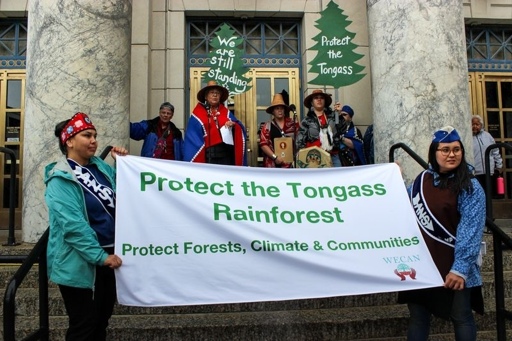
Aug. 25 is a National Day of Action to support U.S. national parks and public lands. One focus of the event is the U.S. government’s intention to rescind a rule that bans road construction and industrial logging across more than 23 million hectares (57 million acres) of national forest land. The 2001 Roadless Rule, has helped protect some of the country’s most wild public lands, including Alaska’s Tongass National Forest, the world’s largest intact temperate rainforest and the ancestral homeland of several Indigenous peoples. “A rollback on the Roadless Rule means cultural genocide for our people,” Yolanda Fulmer of the Tlingit Indigenous nation and a Tongass representative with the California-based NGO Women Earth and Climate Action Network (WECAN), said in a statement. “Every part of our culture is intimately intertwined with the Tongass Forest, our traditional homelands.” The Tongass spans 6.8 million hectares (17 million acres) of mountains, rivers, rugged coastline and old-growth forest. Nicknamed “America’s Climate Forest,” the Tongass holds 20% of all the carbon stored in the country’s national forests and provides habitat for some 400 wildlife species including bears, wolves and moose. It also supports roughly 40% of North American bird species. If the Roadless Rule is rescinded, roughly 3.6 million hectares (9 million acres) of the Tongass could lose protections against new road development. Nationwide, 18 million hectares (45 million acres) of national forest system land could be affected. In an Aug. 18 statement, the U.S. Department of Agriculture, which administers national forests through the U.S.…This article was originally published on Mongabay
From Conservation news via This RSS Feed.