

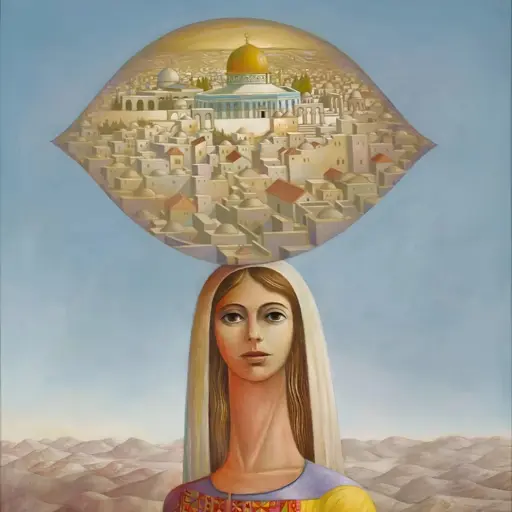
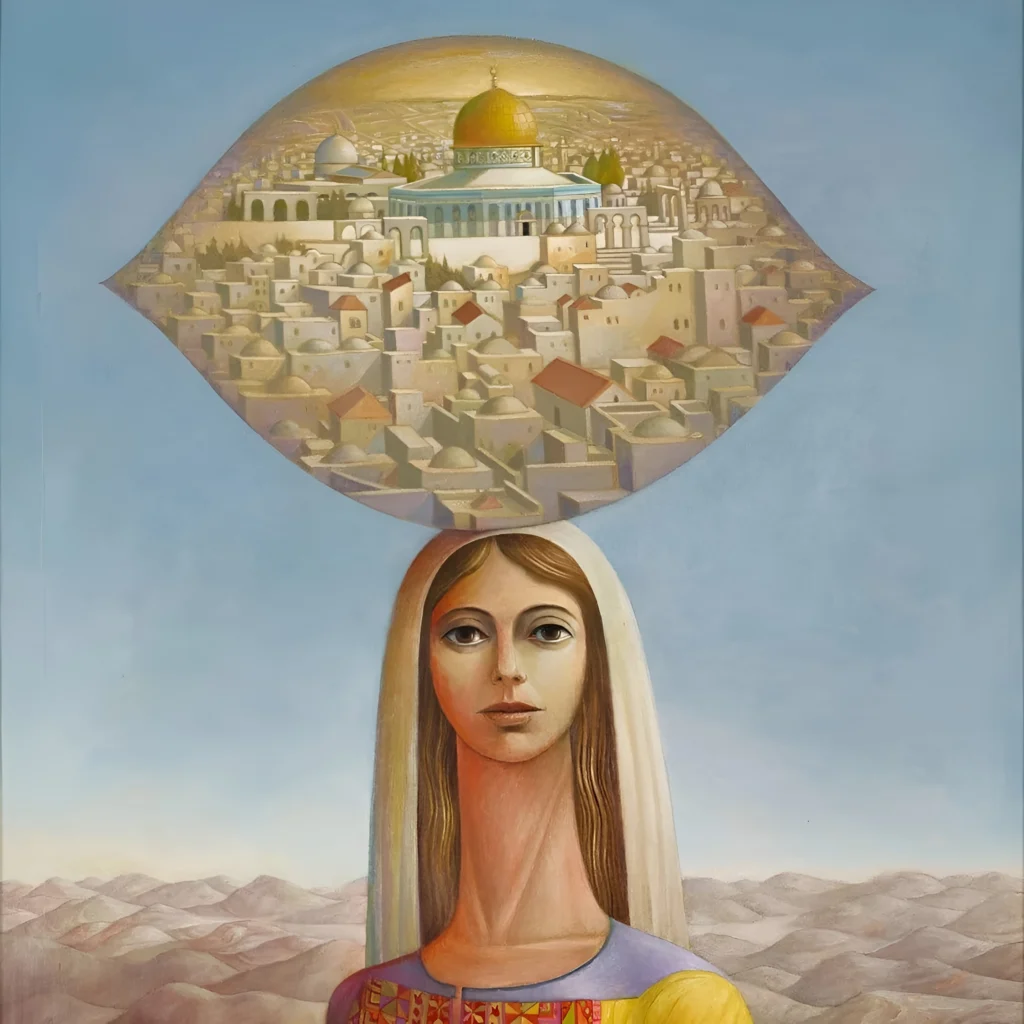
A look at the life, works, and anti-colonial legacy of the master painter of Palestinian steadfastness.
Sliman Mansour, a prominent Palestinian artist of the modern era, died on August 24, 2026, at age 79. Throughout a career spanning more than five decades, Mansour developed a visual language that defined the Palestinian struggle for self-determination.
RELATED:
Over 1,300 Artists Pledge Boycott of Israeli Film Institutions as Gaza War Escalates
Through paintings, sculptures, and community organizing, Mansour’s work captured the reality of life under military occupation while preserving indigenous Palestinian culture.
Mansour was a central figure in the Palestinian cultural movement, co-founder of major artistic institutions in Jerusalem, and led collective art initiatives during periods of intense political unrest.
Mansour’s art moved beyond simple aesthetic expression to become a symbol of Sumud, an Arabic concept meaning steadfastness or perseverance.
By focusing on ordinary people, agricultural traditions, and the physical land, Mansour helped shape how Palestinians view their own identity and how their story is understood internationally.
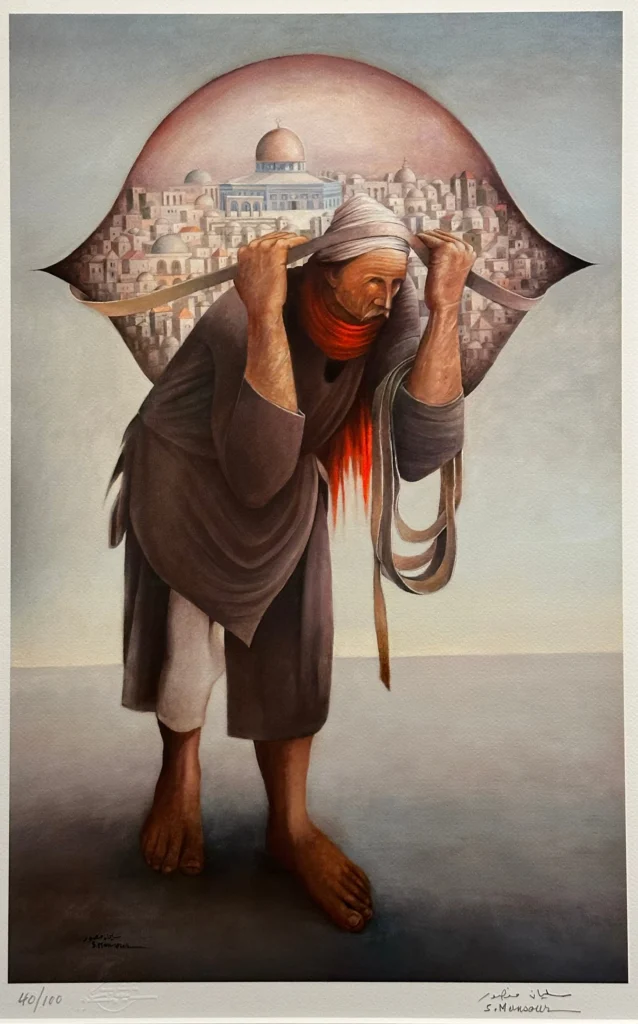
The camel of the loads. Oil on canvas. (1973)
Early Life, Education, and the Impact of the Nakba
Sliman Mansour was born in 1947 in Birzeit, a town located north of Ramallah in the West Bank. His birth occurred just one year before the 1948 Arab-Israeli War, known to Palestinians as the Nakba.
During this period, more than 700,000 Palestinians were displaced from their homes, and hundreds of villages were depopulated.
Growing up in the aftermath of these events, Mansour’s childhood was defined by the collective trauma of exile and loss, themes that later became central to his artistic output.
In 1967, following the Six-Day War, the Israeli military occupied the West Bank, East Jerusalem, and the Gaza Strip. That same year, Mansour enrolled at the Bezalel Academy of Arts and Design in Jerusalem, one of the region’s leading art institutions.
Studying at Bezalel exposed him to Western art history and academic techniques, but it also highlighted a cultural divide. While European abstract art was popular in academic settings at the time, Mansour chose to focus on figurative social realism.
After graduating from Bezalel in 1970, Mansour committed his career to building local cultural infrastructure. In 1975, he joined other local artists to help establish the League of Palestinian Artists, an organization he later headed as president from 1986 to 1990.
During these years, Palestinian artists faced strict censorship from Israeli military authorities, including bans on displaying the colors of the Palestinian flag in artwork.
Despite these restrictions, Mansour continued his institutional work. In 1994, he co-founded the al-Wasiti Art Center in East Jerusalem, named after the 13th-century Arab painter Yahya al-Wasiti, to promote Palestinian art and literature. Later, in 2004, he helped establish the International Academy of Art Palestine in Ramallah.
Visualizing the Weight of Exile and Occupation
One of Sliman Mansour’s most recognized works is Jamal al-Mahamil, or The Camel of Burdens, originally painted in 1973. The oil painting depicts an elderly Palestinian porter in traditional clothing carrying a heavy, eye-shaped sack on his back.
Inside the porter’s sack is a detailed rendering of Jerusalem, including the Dome of the Rock. This artwork became highly popular in the 1970s and 1980s, with prints hanging in many Palestinian households.
The porter symbolizes the Palestinian working class carrying the heavy burden of exile, collective memory, and the physical weight of a displaced homeland.
During the First Intifada, Mansour painted Rituals Under Occupation in 1989. This piece illustrates a symbolic funeral procession for a Palestinian casualty. The body of the person is wrapped in a Palestinian flag, and the composition of the mourners and the deceased evokes the shape of a cross.
By integrating national symbols with Christian iconography, Mansour documented the shared experiences of military rule and highlighted the cross-sectarian solidarity between Palestinian Muslims and Christians.
Mansour also focused on the intergenerational transfer of identity. His 1976 painting Patience and Hope features three figures: an elderly man representing historical roots, a youth holding a banner, and a woman symbolizing cultural renewal.
Through this composition, Mansour visually explained the concept of Sumud, showing how the commitment to the land is passed down across different generations of Palestinians.
In the 1990s, Mansour’s materials shifted to reflect changing political realities. In 1996, he created The Shrinking Piece, an artwork made of local mud and clay applied to a wooden board. The piece was designed to dry, crack, and physically peel off the board over time.
Art historians and critics have documented this work as a direct visual critique of the 1993 Oslo Accords, using the eroding mud to represent the ongoing physical loss and fragmentation of Palestinian territory.
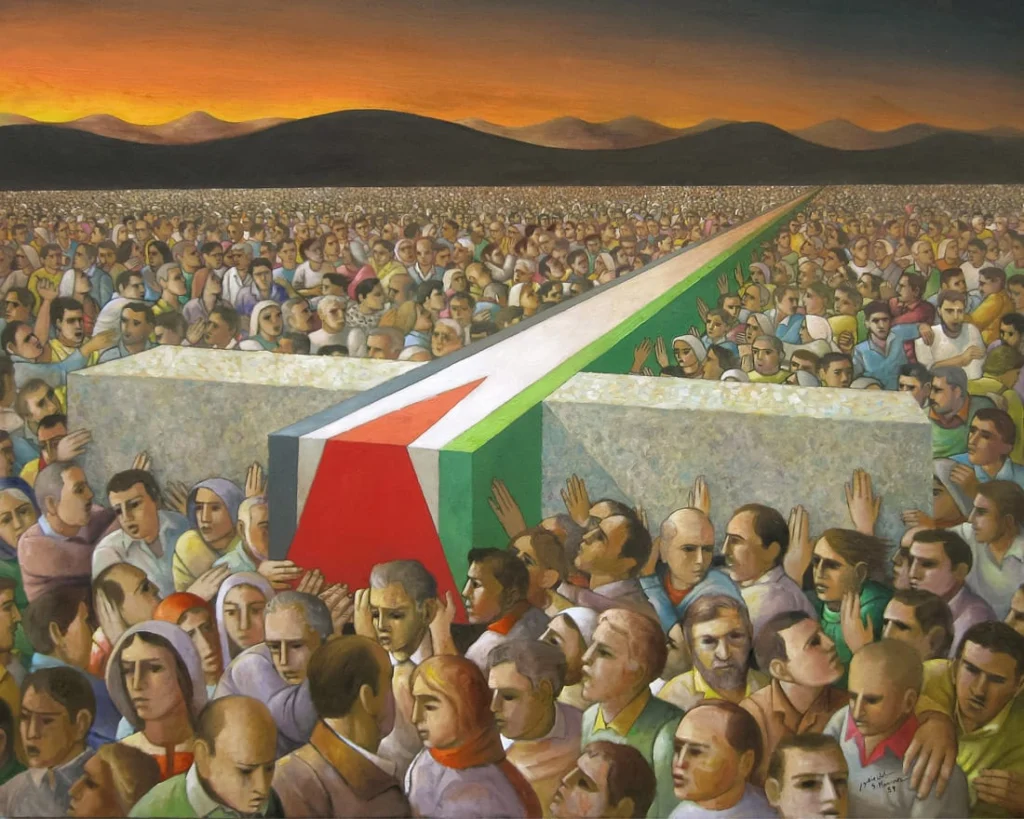
Rituals Under Occupation. Oil on canvas. (1989).
Highlighting Palestinian Culture
Beyond direct political commentary, Sliman Mansour’s art functioned as an archive of traditional Palestinian culture. A central figure in his portfolio is the fellah, or the Palestinian peasant farmer.
By placing the rural agricultural worker at the center of his canvases, Mansour emphasized the indigenous population’s deep historical and economic connection to the soil. This focus on agrarian life served as a factual counter-narrative to claims that the land was empty before 1948.
The olive tree is another consistent element in Mansour’s visual vocabulary. Because olive trees can live for centuries and survive in harsh environmental conditions, they hold significant economic and cultural value in the region.
Mansour frequently painted scenes of families harvesting olives, positioning the tree as a symbol of endurance, economic autonomy, and resistance to land confiscation and environmental uprooting.
Mansour also meticulously documented traditional Palestinian clothing, specifically tatreez, the traditional cross-stitch embroidery. In paintings such as Desert Melodies (1977), he accurately rendered the specific geometric motifs and colors associated with different geographic regions, such as Ramallah and Hebron.
By detailing these garments, Mansour highlighted the role of Palestinian women not merely as subjects of art, but as the active guardians of national heritage and local history.
Furthermore, Mansour recorded the architectural heritage of historic Palestine. His works frequently feature the limestone structures, ancient stone terraces, and traditional archways characteristic of Old Jerusalem and rural villages.
Identity, Resistance, and the New Visions Collective
During the First Intifada, which began in 1987, Palestinian visual culture became a direct form of political expression. Israeli military orders banned the display of the Palestinian flag and its national colors, red, green, black, and white.
In response, Sliman Mansour and other local artists used symbolic alternatives, such as painting sliced watermelons or using natural motifs, to maintain visual representations of national identity in public spaces.
The political unrest of this period led to a fundamental shift in Mansour’s materials and artistic methods. In 1989, Mansour co-founded the Al-Ru’ya Al-Jadida group, known in English as the New Visions collective, alongside Palestinian artists Vera Tamari, Tayseer Barakat, and Nabil Anani.
Instead of traditional art supplies, the New Visions collective turned to the land itself for raw materials. Mansour began experimenting with mud, clay, henna, straw, wood, leather, and natural dyes sourced directly from the Palestinian environment.
Using earth as a medium transformed the material meaning of the artwork. The natural mud surfaces developed deep cracks as they dried over time, creating a physical texture that mirrored the landscape.
Mansour noted that using mud allowed the soil of Palestine to physically form the canvas, turning the medium itself into a statement of attachment to the land and a form of economic self-reliance during the uprising.
Influences, Technical Methods, and Legacy
Sliman Mansour’s artistic style drew from a wide range of global and regional traditions. During his studies and early career, he examined Byzantine icon painting, which influenced his use of flat compositional planes, gold tones, and solemn figure poses.
Mansour also integrated elements of Levantine folk art and political cartooning to ensure his imagery remained accessible to working-class audiences.
In addition, Mansour was influenced by Mexican Muralism, studying the works of painters such as Diego Rivera and David Alfaro Siqueiros.
Like the Mexican muralists, Mansour sought to create public, socially conscious art that depicted the struggles, labor, and history of ordinary citizens rather than elite patrons. This combination of traditional religious iconography, regional folklore, and revolutionary realism formed the foundation of his visual approach.
Technically, Mansour moved fluently between figurative oil painting, graphic design, and mixed-media sculpture. His early paintings relied on precise brushwork and balanced color palettes to create clear, narrative scenes.
In Mansour’s later career, his focus shifted toward tactile surfaces, manipulating mud and clay to build three-dimensional textures that interacted with light and shadow in exhibition spaces.
Sliman Mansour leaves behind a significant legacy in Arab and global modern art. By combining traditional Palestinian iconography with local materials and community institution-building, he documented the social history of his people through five decades.
Sources: Sliman Mansour Page – Zawyeh Gallery – Hirbawi – historia-arte.com – Boveri Juan Carlos Pintores Blob – TRT World – Al Jazeera – Press TV
From teleSUR English via This RSS Feed.