



Jacobin has done it again. True to form, the publication that brings us endless dispatches explaining why Karl Kautsky was actually right—and occasional articles on China that somehow manage to earn warm praise from the Victims of Communism Memorial Foundation—has now delivered another wearying article by Ben Burgis, whom I affectionately call “Logic Boy” ever since our 2020 debate about Chomsky.
In his latest piece, Burgis delivers a stern scolding to a movement that he believes has finally reached “prime time.” His core lecture: socialism is now visible in the bourgeois press, and to capitalize on this, the movement must abandon its “wilderness” habits—namely, its penchant for moralistic purity and maximalist demands that alienate the broader public.
All of his policy prescriptions have already been tried and tested by the German Social Democrats in the 1920s and 1930s, as meticulously documented in Donna Harsch’s German Social Democracy and the Rise of Nazism. Instead of treating that history as a warning, Burgis appears to be treating it as a how-to guide.
What Is to Be Done? (Not Appearing on Fox News)
Logic Boy begins his manifesto with a cute journalistic “experiment”: open the New York Times, the Wall Street Journal, the New York Post, or the Washington Post and time how quickly you spot the word “socialist” in a headline. Because it’s August 2026, he finds it right away, concluding that socialism is suddenly visible in the mainstream media.
The entire premise concedes the wrong terrain and inverts the foundational priority established by actual historical winners like Lenin in What Is to Be Done? Lenin didn’t advise revolutionaries to measure how often the word appeared in the Tsar’s legal press or to optimize their performance for the gendarmerie’s talk shows. He insisted that socialists must build their own independent organs precisely because the bourgeois press can never be the vehicle for developing class consciousness.
As Lenin famously explained, a revolutionary newspaper is not merely a propagandist and agitator, “it is also a collective organiser”—functioning like the scaffolding around a building under construction to mark contours and coordinate the builders. Training strong political organizations can happen through no other medium.
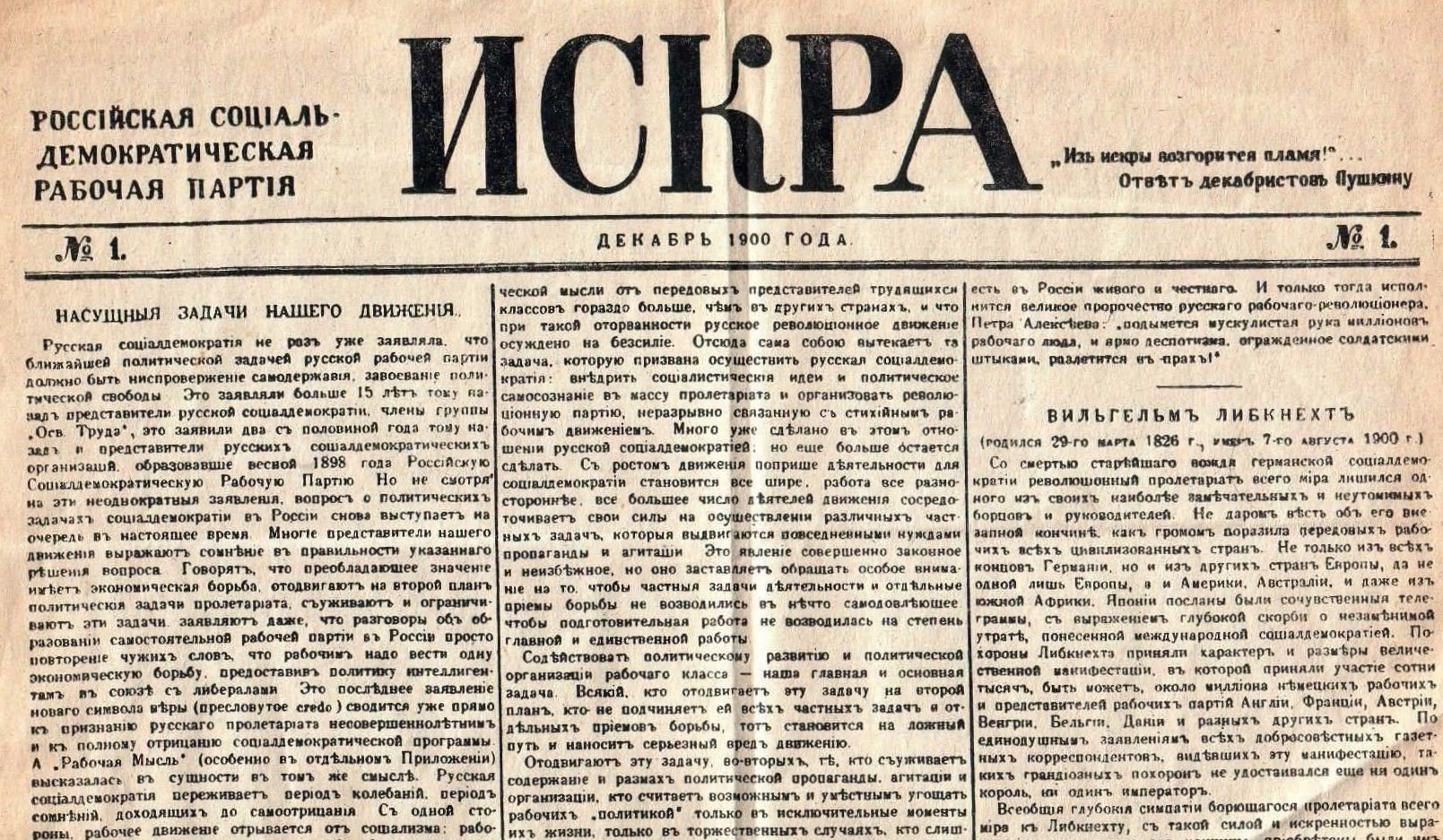
Iskra — one of the first all-Russian working-class newspapers
Later, he expands on this logic, arguing that socialists should cheerfully hop onto Fox News or anywhere else to defend bold demands—provided we don’t let our enemies lump them together with “murkier and less defensible demands.”
Treating a carefully calibrated appearance on the enemy’s platforms as a serious strategic goal isn’t a masterclass in rhetoric; it is something to be embarrassed by, not optimized. If you want to build actual power, it helps to take your cues from someone who actually overthrew a state rather than someone trying to optimize their hit rate on mainstream news. The bourgeois media is not a neutral playing field where socialists can win through clever framing; the real work remains building independent working-class media and organization to forge solidarity and raise political consciousness on our own terms.
The SPD leadership, facing anti-Semitic attacks that tied them to the Sklareks and to Jews more broadly, chose silence on the anti-Semitic core of the charge. They calculated that robustly defending the Jewish community (or even naming the racism) would associate them with something “murkier” and politically costly. Vorwärts avoided the issue so as not to lend credence to the right-wing claim that the SPD was “the party of Jews.”
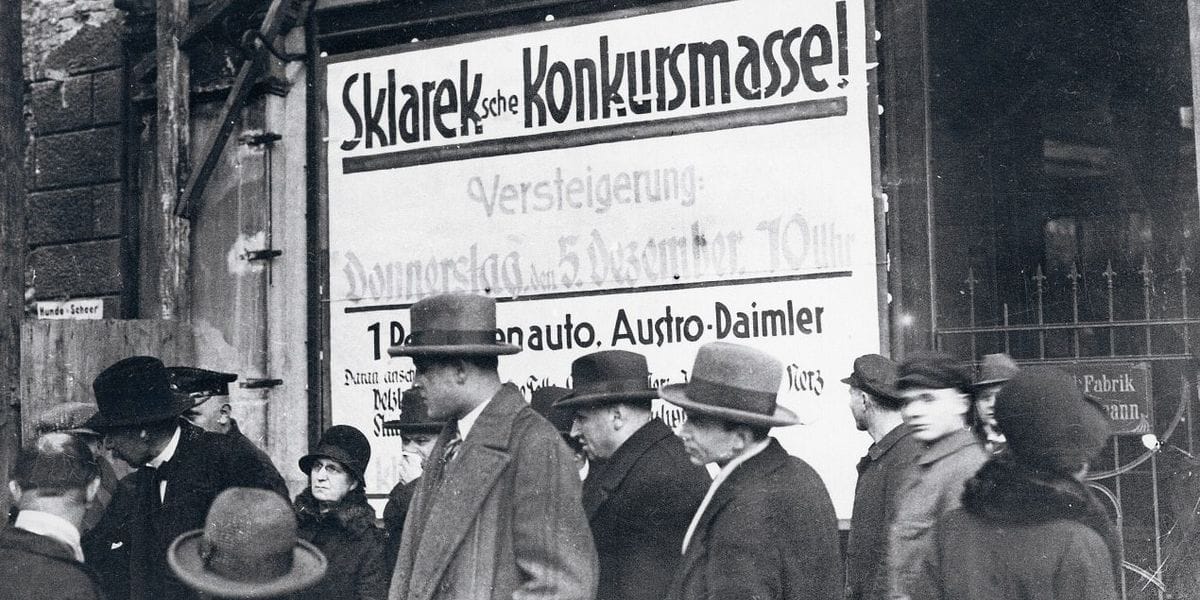
Spectators outside the Sklarek bankruptcy auction (Berlin, 1929), fuel for the rising nationalist and antisemitic press
That is the exact logic Burgis is recommending: do not let your positions get packaged with anything that might be portrayed as harder to defend to the bourgoise. The historical result was that the largest workers’ party in Germany refused to confront fascist anti-Semitism head-on in order to protect its own respectability.
Logic Boy Fails Logic 101
Ben Burgis — a man with a PhD in Philosophy from the University of Miami (2011), specializing in the philosophy of logic. His dissertation, Truth Is a One-Player Game: A Defense of Monaletheism and Classical Logic, and his later book Logic Without Gaps or Gluts, defend classical logic against non-classical approaches to the semantic paradoxes. In other words, this is someone who has staked his intellectual career on the claim that logic matters — that validity, soundness, and the avoidance of fallacy are non-negotiable standards of reasoning.
And yet here is how he frames the issue:
“Similarly, if we’re trying to argue that the failures of authoritarian state socialism in the twentieth century shouldn’t mean that capitalism is the best humanity will ever be able to do, and that a better form of socialism is possible and desirable, we don’t do ourselves any favors by refusing to say anything too negative about left-wing dictatorships targeted by US foreign policy.”
In this book, “Give Them an Argument: Logic for the Left,” Logic Boy instructs his readers that, “even valid arguments are only as good as their premises” (Post script 4). But unfortunately, he ignores his own advice by building his case on the faulty premise of calling 20th century socialist states “failures” and labeling them “authoritarian.”

Logic Boy’s unsound Argument
Any cursory examination of the material record record of these states proves that they are not failures. The actual historical record—not the Cold War pulp fiction—tells a different story. These were systems that delivered massive leaps in life expectancy, universal literacy, the eradication of smallpox, and rapid industrialization from conditions of feudal poverty, all while facing decades of imperialist hostility. Taking a country from 88 percent illiteracy and extreme poverty to the elimination of mass illiteracy, the defeat of Nazism, and the capacity to send people into space is not a “failure.” It is among the most significant civilizational achievements of the twentieth century. We should be proud of it, not apologize for it.

Literacy Rates in the Soviet Union
When repeatedly polled, people who used to live in these former socialist states say that life was worse off after the collapse of communism. The nostalgia for that era runs so deep that nursing homes in Eastern Germany have begun recreating elements of daily life in the old GDR as a therapeutic tool for dementia patients. Far from the cartoonish wasteland depicted in Western pulp history, for the people who actually lived there, the material reality of that social fabric provided a sense of security, community, and comfort so profound that stepping back into its symbols can unlock memories when everything else fades.
A political project that eradicated mass illiteracy, defeated fascism, reached the stars, and left behind a social fabric so deeply missed that its people recreate it for comfort at the end of life is not a failure. It is a monumental blueprint of what human society is actually capable of achieving.

Yuri Gagarin in Space
Having dismissed the systemic achievements of these states, he next brands them as “authoritarian” — which brings us to the practical content of his incorrect premise. In practice, what does that demand usually require? It requires treating the imprisonment of fascists, collaborators, and war criminals as the central moral failures of twentieth-century socialism.

The Victims of Communism Memorial Missing Actual Victims
Consider the so-called “Victims of Communism” memorial in Canada. The original plan was to inscribe the names of supposed victims. When the list was examined, it turned out to be heavily populated by Nazis and Nazi collaborators—including figures associated with Ante Pavelić’s Independent State of Croatia, a regime so brutal that even some Wehrmacht officers expressed disgust. Over time, the proportion of collaborators and fascists on the list became impossible to ignore. The names were eventually scrapped. What remains is a monument that, by the project’s own research standards, memorializes a grand total of zero verified “victims of communism” in the sense originally claimed.
Or take Archbishop Alojzije Stepinac. Long promoted for canonization, his Catholic Action networks functioned as a recruiting ground for the Ustaše, whose members operated under the slogan “Kill the Antichrist, in the name of Christ” against Serbs, Jews, and Communists. This is the caliber of figure that the “Victims of Communism” project was prepared to elevate.
The standard caricature of an absolute, top-down totalitarian dictator also evaporates the moment we look at how power was actually conceptualized. Addressing the Eighth Party Congress in March 1919, Lenin explicitly rejected the idea of blind obedience, explaining that decrees were merely practical instructions for mass work rather than “absolute injunctions which must be put into effect instantly and at all costs,” acknowledging that much in them might be useless or unimplementable.
Yet, critics love to project nightmarish visions of state terror onto the Soviet experience—ironically painting routine historical policing in terms that often look milder than everyday reality in the capitalist core. Even iconic anti-communist accounts like The Gulag Archipelago describe the mechanics of an arrest as a frantic scramble of “trembling hands packing for the victim—a change of underwear, a piece of soap, something to eat”—a human, procedural scramble that stands in stark contrast to the flashbangs, broken doors, and violent subductions of a modern midnight SWAT raid in contemporary America.

Contrast the Gulag Archipelago Description with Virginia State Police Arresting a Protester
Having dismantled the myth of these states as “authoritarian failures,” we are left with a critical question: Where on earth does the DSA Gatekeeper get the idea to repeat these talking points in the first place?
The source of this narrative is not neutral data or rigorous historical analysis. It is the ideological output of the bourgeois press, the State Department, and a centuries-old network of anti-communist propagandists—including actual Nazi collaborators whose postwar fabrication found a comfortable second home in Western intelligence archives.
We can see how this machine operates in real time by looking at how it treats targets that pose zero existential threat. The DSA is a loose collection of mostly young adults and college-age activists. They have no state machinery, no industry, no nuclear weapons. They hold meetings and run local campaigns. They are, by any reasonable measure, a minor annoyance to the American ruling class. And yet the New York Times and the mainstream media systematically defame, distort, and marginalize them.

An Old Cartoon Depicting Media Bias
Now apply elementary inductive reasoning. If the New York Times goes to these lengths to distort a powerless group of socialists, what is it going to do when confronted with an actual socialist state that held real power—a state with industry, state machinery, and nuclear weapons?
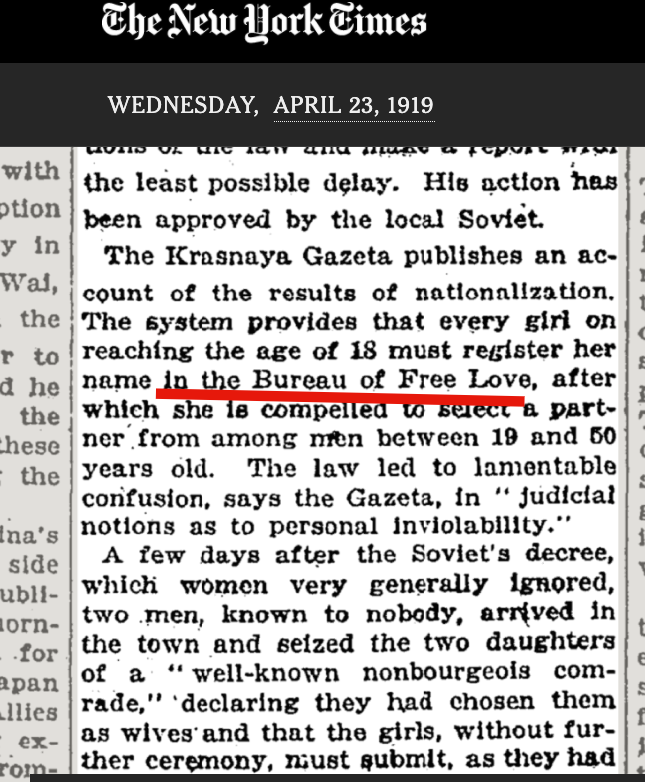
The historical record answers the question. The same media that smears the left today is the direct descendant of the outlets that breathlessly manufactured anti-Soviet hoaxes from day one—such as the New York Times reporting in 1919 that the Bolsheviks had nationalized women through a mandatory “Bureau of Free Love,” a pure fabrication conjured out of anti-communist fever dreams. From inventing fictitious state atrocities to laundering the self-serving memoirs of defeated fascists and intelligence assets, the default mode of the Western press when covering workers’ states has always been fabrication. And that fabrication scales directly with the threat.

From hysterical 1917 reporting on Bolshevik “peace schemings” to inventing state-mandated orgies, the paper’s default mode when covering real workers’ states has always been fabrication. And it scales with the perceived threat.
When left-wing intellectuals like Burgis swallow this narrative whole, they aren’t engaging in materialist critique; they are regurgitating the ideological downstream output of the State Department and Cold War intelligence operations—the very same apparatus that relied on Nazi collaborators to pad its statistics on the "evils of communism. To build an argument on that foundation is to abandon logic entirely.
Any first-year logic student knows you cannot derive a sound conclusion from a contaminated premise. Burgis’s premise is not merely contaminated. It is radioactive. Building an argument on it does not make you a rigorous thinker. It makes you a dupe.
Sure, a better form of socialism is possible—nobody is arguing we should blindly copy every historical contingency of the twentieth century. But notice the bait-and-switch he pulls immediately after. He pivots away from historical socialist states entirely, insisting that “we don’t do ourselves any favors by refusing to say anything too negative about left-wing dictatorships targeted by US foreign policy.”
That is a glaring non-sequitur followed by pure ideological idiocy. He tries to justify this by claiming that our reluctance to condemn these targets comes from a fear of “conceding” to neocons, and that criticizing them is somehow necessary to prove our commitment to democracy.
This completely turns reality on its head. Once you accept those premises, you are trapped in a moral corner. As we see whenever liberal critics try to oppose foreign intervention on purely bureaucratic grounds—objecting to a lack of UN mandates or preferring sanctions to bombs—procedure is never a substitute for principle. If a targeted leader really is a cartoon monster sitting atop a regime of pure terror, then opposing their overthrow becomes morally incoherent.
To refuse this script is not to practice uncritical apologetics; it is to demand materialist honesty. When you look at the actual record of states targeted by US hostility—such as pre-invasion Iraq, which allocated roughly 20% of its budget to education and successfully alleviated mass poverty—the contrast with what follows is brutal. What replaced those targeted states was not freedom or democracy, but the devastation of Western privatization, structural austerity, mass death, and infrastructure collapse like cholera outbreaks.
And why, exactly, are we supposed to prove our “commitment to democracy” to neocons in the first place? These are open advocates of regime-change wars. They have demonstrated, repeatedly and in blood, that they have no commitment to democracy whatsoever. If they actually valued democracy, they would not spend decades destroying countries while waving its banner. Demanding that socialists perform loyalty to democratic principles for the approval of people who treat democracy as a propaganda slogan is not serious politics. It is a humiliation ritual.

Regime Change efforts by the US
To join the chorus condemning these targets just to soothe the liberal conscience is not rigorous logic. It is intellectual surrender. It is accepting the empire’s moral hierarchy and then pretending the resulting argument is still socialist.
The warmongers will always call you an apologist. That is their job. The only real question is whether you let that accusation dictate your reasoning. If you are more terrified of being labeled a “stealth supporter” than you are of the actual destruction of a country, you have already abandoned the method you claim to defend. You are no longer doing logic. You are doing public relations for the State Department while still calling yourself a socialist.
That is not a minor tactical error. It is the complete collapse of the standards Burgis pretends to uphold. A philosopher of logic who builds his case on radioactive premises and then demands the left repeat them is not offering strategic advice. He is demonstrating exactly how not to think.
Continue to part two
If you’ve made it this far, and found our article illuminating, please remember we are 100% reader supported. If you think this work matters, throw us a few dollars so we can keep going. The empire certainly isn’t funding us.
From Historic.ly via This RSS Feed.