

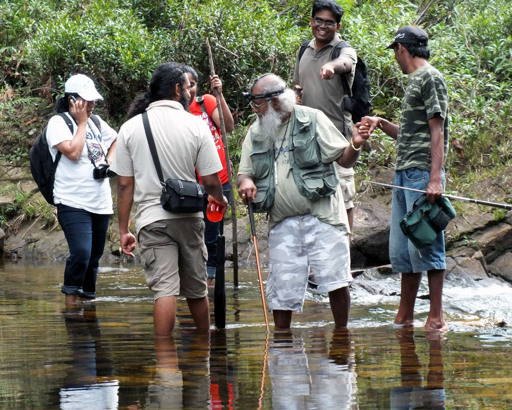
COLOMBO — Sri Lankan-born conservation biologist and National Geographic explorer Ruchira Somaweera is internationally recognized for his award-winning wildlife research, photography and storytelling. Despite his global achievements, Somaweera treasures an old journal copy containing a prophecy. When he was 13 years old, Somaweera received a copy of the research journal Lyriocephalus with a handwritten note which read: “One day you will be a great herpetologist,” signed by Anslem de Silva. “Almost 30 years ago, I got hooked into herpetology after reading a series of newspaper articles written by de Silva on Sri Lankan snakes in a local science publication. Those articles inspired me to prepare a small booklet on snakes as my school science project. Most of the herpetologists of my generation were groomed by de Silva, and hundreds, if not thousands, of students have been inspired by him, just like I was,” Somaweera told Mongabay. In 1995, Ruchira Somaweera received a copy of the research journal Lyriocephalus from Anslem de Silva with the signed inscription: “One day you will be a great herpetologist.” Image courtesy of Ruchira Somaweera. Anslem de Silva is widely regarded as as the father of modern herpetology in Sri Lanka, having dedicated more than six decades to studying the island’s reptiles and amphibians. His pioneering research, publications and conservation efforts have transformed scientific understanding of Sri Lanka’s remarkable herpetofauna. Sri Lanka’s herpetofauna represents the island’s extraordinary diversity of reptiles and amphibians, including snakes, lizards, turtles, crocodiles, frogs, toads and caecilians, with many species found nowhere…This article was originally published on Mongabay
From Conservation news via This RSS Feed.