

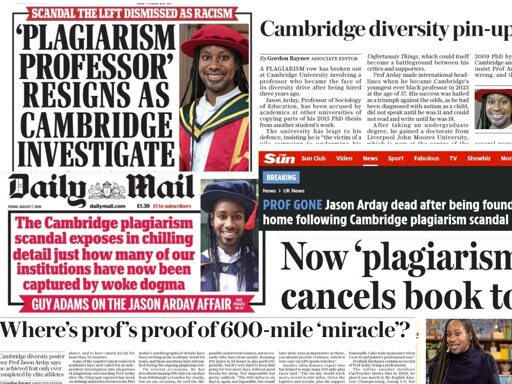

Analysis by news monitoring site Newscord has exposed the cynical pile-on by UK ‘mainstream’ media that drove Black academic Jason Arday to his death – and the equally cynical way the media lost interest after killing him.
Arday died after being hounded by the media following accusations of plagiarism by white-supremacist ‘racial scientist’ Nathan Cofnas. Cofnas believes Black people are innately less intelligent than whites, especially Jews. He has been suspended by Ghent University after the Canary exposed a dossier by Ghent academics detailing his unfitness for his role there.
When you suggest to a member of the British press that maybe the excessive coverage given to Jason Arday was racially motivated. https://t.co/v5xtiYyNEz pic.twitter.com/Kht0XYpMLb
— Plutôt la Barbie (@plutotlabarbie) August 24, 2026
Nine-day windows across coverage of Arday
As Newscord notes, the analysis:
compares two nine-day windows across the same fifteen outlets: his last nine full days alive against the nine days after the news broke, outlet by outlet, byline by byline, regulator by regulator, and headline register by headline register.
Its findings are not shocking – the racism-driven feeding frenzy and the sudden loss of interest that followed it are appalling. But nobody who pays attention to UK media and the political landscape in which it operates will be shocked, or even surprised. This includes the near-silence of many of the ‘MSM’ hacks, who had eagerly joined the lynch-mob, after Arday was found dead on 14 August:

The data show how spread across the ‘mainstream’ spectrum the mob-mentality was – and how interest among most of the same outlets ebbed by comparison after Arday died. This no doubt reflects the sudden hands-in-pocket, whistling-and-kicking-stones, ‘nothing to see here’ attempts by the perpetrators to distance themselves from the scene of the crime:

Sham ‘regulator’
IPSO is the “sham” regulator set up by corporate papers after the phone-hacking scandal to allow them to ‘regulate’ themselves – or, in simpler language, to mark their own homework and avoid actual, Leveson-compliant regulation. Unsurprisingly, Newscord found that IPSO publications were the worst offenders in the pile-on – and dumped Arday the fastest after his death.
But on a par with them was the Guardian. The self-regulating paper was down in the slime with the worst of them:

And the Guardian was up alongside the right-wing rags in terms of individual journalists filing stories about Arday: two out of the worst five.
When Arday died, the tone of the articles flipped suddenly as the hacks tried to distance themselves from responsibility for his death. And they lost interest precipitously. While Arday’s loved ones and friends had to continue to come to terms with his loss, the papers published only ten articles across all publications in the final third of the nine-day period.
Self-justification
Newscord also notes that, of the paltry ten articles in the last three days, one was the Guardian’s attempt to exonerate itself. In a statement titled “What this page says about the Guardian, and what it does not”, the analysis states that:
The [Guardian’s] statement condemns as false the claim that the Guardian’s coverage was driven by a personal conflict with Professor Arday. This page has never made that claim and does not make it now. It says nothing about why any journalist wrote anything, and nothing about the cause of his death, which is with the coroner.
What it does report about the Guardian is arithmetic anyone can check: 17 articles in his last nine full days alive, 10 in the nine days after the news broke, and no external press regulator to ask about either. Every one of those articles is listed with its URL in the table below.
On the harassment the statement describes, our position is plain. Abuse of individual journalists is wrong, racialised abuse most of all, and nothing on this page is an invitation to it. Our argument is with what newsrooms chose to publish, which is a matter of public record, and never with the people who work in them.
One disclosure, because this page counts what outlets publish. The statement is itself one of the Guardian’s 10 items in the after window. It is a press office statement rather than newsroom copy, which leaves 9 newsroom items, and the register layer classifies it as justifying the media.
The Canary was the first publication to reveal that the Guardian had been warned that its hounding of Arday was putting him in danger. His warning – including relating Arday’s own words that a Guardian journalist was driven by ill-feeling after an earlier row – was ignored. When the Canary published the emails, the Guardian sent legal threats demanding a retraction.
The Canary refused to be intimidated and stood by its reporting.
Read the full analysis here.
By Skwawkbox
From Canary via This RSS Feed.