



Erin In The Morning is a reader-supported publication. To receive new posts and support my work, consider becoming a subscriber.
Amnesty International UK seemingly filed a copyright claim against a Harvard Law instructor who had shared its since-deleted anti-rights reports naming “gender critical” (anti-trans) groups in its analysis. This resulted in the reports being removed from her Google Drive. A webpage hosting the documents were also wiped from the Wayback Machine; however, alternate links to the report still exist within the web archive. This comes after billionaire Holocaust denier and TERF activist JK Rowling threatened to sue organizations who called anti-trans groups “anti-rights.”
Alejandra Caraballo, a civil rights attorney at Harvard’s Cyberlaw Clinic, uploaded links to the documents to her social media, only to have them deleted—at the request of Amnesty International UK, evidence shows.
“This is an organization that has gone to bat against murderous dictators, genocidal governance, and all kinds of the most evil, dangerous people in the world,” she said.
It began in July, when Amnesty International UK issued a report focusing on anti-rights organizations—among them was Beira’s Place, a women’s shelter founded by Rowling. The shelter is specifically designed to turn away trans women, who experience the highest rates of domestic violence of any gender group.
It was one of many “LGB” groups—an anti-trans buzzword, indicating the exclusion of trans people from equality measures—named in the report. This offended Rowling, who offered to finance all of these trans exclusionary groups should they want to sue Amnesty International UK for defamation. In essence, Rowling is acting as a one-woman anti-trans censor.
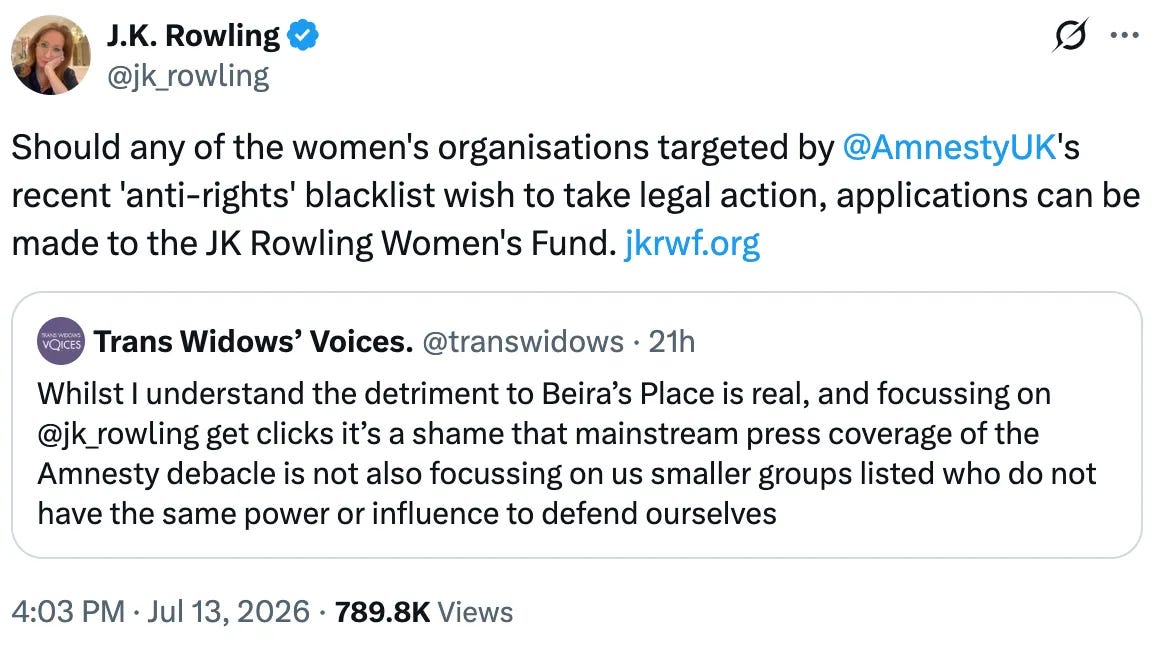
CAPTION: Screenshot from Rowling’s Twitter, where she offers to finance “women’s organizations” suing Amnesty International UK through her own charitable fund. She quote tweets a group of people who self-identify as “trans widows”—referring to cisgender people whose spouses or ex-spouses came out as transgender.
Amnesty UK caved. They agreed to launch an internal investigation, retracted the report, and struck another one that was critical of JK Rowling and TERFs, saying they were not reflective of their institutional values; that they had not gone through proper review. The reports, titled “A growing threat: the anti-rights movement in the UK” and “Like a snowball: the growth and impact of the gender critical movement in the UK” were subsequently pulled from the Amnesty website.
Caraballo posted about the situation, uploading a PDF of the report to Google Drive and sharing the link with her over 200,000 Bluesky followers. But within a day or so, the reports had been removed from archival caches online, and it had been stricken from Caraballo’s Google Drive.
Through emails Caraballo received from Google, cross-referenced with data from Lumen, she was able to determine it was taken down from her Google Drive due to a copyright violation claim. And the actor who issued the complaint appears to be none other than Amnesty UK itself.
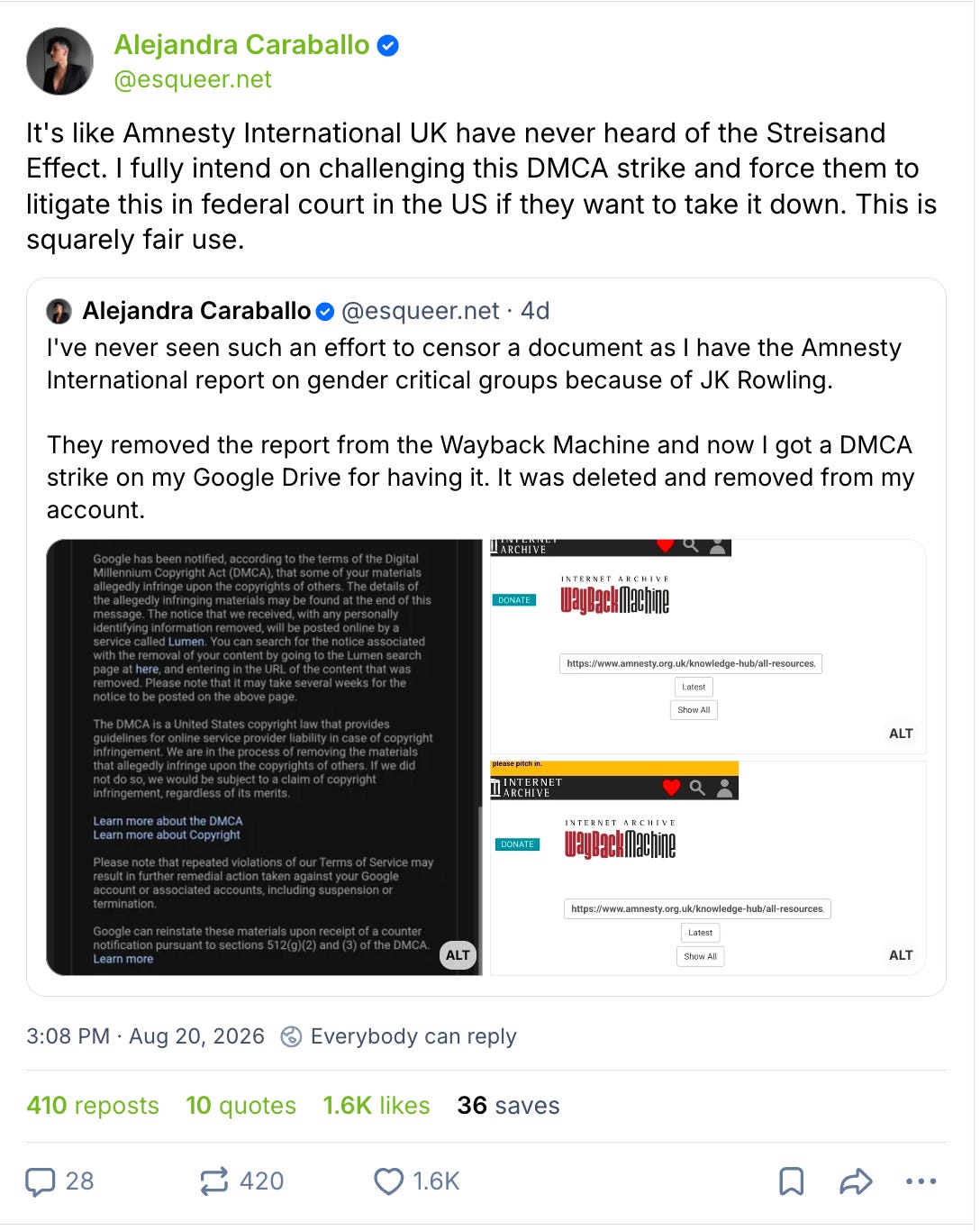
Caraballo is in the United States, which has more robust free speech protections (at least on paper) compared to the United Kingdom. The material was also taken down under the DMCA, a US, not UK, copyright law. And it doesn’t even apply in this case, Caraballo said; sharing the document in its entirety for commentary and critique is squarely fair use.
So if Amnesty UK won’t fight censorship in court, Caraballo said she will.
“Being silenced and targeted is meant to send a message: You cannot criticize JK Rowling, or her gender critical friends, or she will bankrupt you with lawfare,” she said.
The situation has also sparked ire from other civil society groups.
“Individuals and organizations should have wide latitude to publish reports and criticize movements and groups they believe threaten human rights or other important values,” said Aaron Terr, the Director of Public Advocacy at the Foundation for Individual Rights and Expression (FIRE).
“Organizations that believe they’ve been subject to false factual accusations that have harmed their reputation are entitled to sue for defamation,” Terr told Erin in the Morning. “But labels like ‘anti-rights’ are generally expressions of opinion, which can’t be defamatory. Debates over how fair those characterizations are should play out in the court of public opinion, not a court of law.”
Amnesty UK did not confirm or deny it was behind the DMCA claims, but defended its decision to back down from Rowling.
“We hold ourselves to the highest standards of evidence and rigour in everything we publish, and to accuracy in how we describe the position of any organisation or individual we name. This briefing did not meet either standard: it did not provide sufficient evidence to support its claims, and it described named organisations inaccurately,” a spokesperson told Erin in the Morning. “That is a failure of research quality, not a change in what we believe.”
Erin In The Morning is a reader-supported publication. To receive new posts and support my work, consider becoming a subscriber.
From Erin In The Morning via This RSS Feed.