

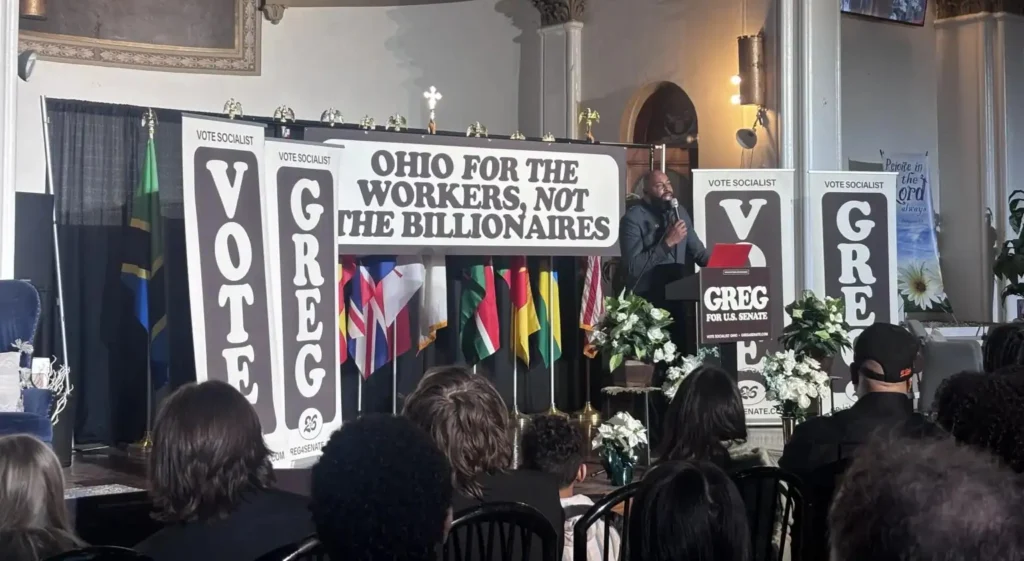
Greg Levy is an independent candidate for the U.S. Senate from Ohio and a leader of the Party for Socialism and Liberation (PSL).
On November 3, the United States will go to the polls for the midterm elections, in which the entire House of Representatives and one-third of the Senate will be up for election, along with governors, state legislatures, and other state and local offices across the country.
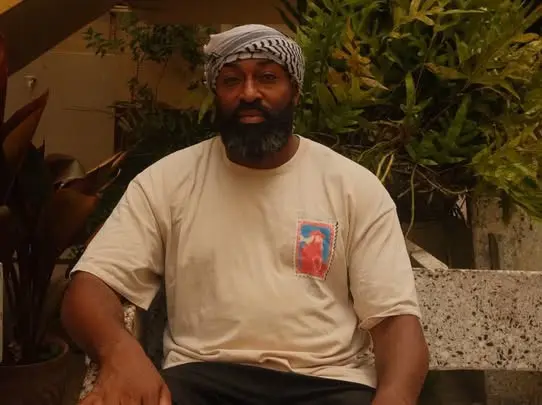
Following his recent visit to Cuba, we spoke with Gregory Levy, an independent candidate for the U.S. Senate from Ohio and a leader of the Party for Socialism and Liberation (PSL).
RELATED: Trump-backed Donalds and ex-Republican Jolly Win Florida’s Primary Elections
Levy was born in Akron, a city in northeastern Ohio with a history that is characteristic of the so-called Rust Belt: it was once a major center of the rubber and tire industry before undergoing a period of severe deindustrialization that continues to affect its population**. This year, Levy is running for office for the first time,** seeking to carve out space outside the two major parties at a time of growing interest in left-wing ideas and increasing questioning of the two-party system.
We’re not part of the establishment, Democrat or Republican. Ohio is ready for a SOCIALIST future
pic.twitter.com/sG2mq0bgbd
— Greg Levy (@GregLevy4Senate) August 23, 2026
—You were recently here in Cuba, and we would like to hear your general impressions. What is your assessment of what is currently happening on the island, at this particularly complex moment?
—It has really been an experience that has made a profound impact on me. First of all, there are the material conditions in Cuba as a result of the blockade and its current intensification. The harm being inflicted on the Cuban people is very real. It is something that is palpable: the lack of electricity, the inability to maintain the power supply, the fact that hospitals, power grids, and entire towns are left without electricity, some for long periods of time.
This is a very severe material condition being imposed on the Cuban people. And as a U.S. citizen, I have to take responsibility for the fact that the U.S. government is imposing these conditions on the Cuban people. I don’t want to let that slide.
The U.S. people need to be conscious of this situation, take responsibility, and respond accordingly: of the immiseration being directly caused by the actions of the U.S. government and U.S. imperialism more broadly.
But on a personal level, I was very encouraged by seeing and being in conversation with the Cuban people. I was very impressed by their resilience, their spirit, and their determination, as well as their very high level of organization towards doing what they can to meet the needs of their people. That is something very different from what happens in the United States: seeing people putting a genuinely human logic at the forefront of how decisions are made, seeing the mobilization that is happening to protect the Cuban people, and seeing that the Cuban people remain very loyal to this revolution and believe in its leadership.
The trip left a lasting impression on me: seeing a government that is actually working directly for its people, in every single way. That’s what I saw in Cuba.

—Despite Trump’s campaign promises to end wars, since he came into government we have seen an intensification of aggression against other countries, while inside the United States there has been a real crackdown on migrant communities. How do you perceive the reaction of U.S. society to this situation?
—I think, particularly at this time, the U.S. people are very attuned to the relationship between war-making and political expediency. The aggressions against Iran are very unpopular among the U.S. people.
The citizens can see that these aggressive actions have a direct effect on the U.S. economy and that they don’t actually benefit the people here. Not to mention the devastating and genocidal effects on the Cuban and Venezuelan people, just as we see with the Iranian people.
I think this is a particular time where U.S. citizens are kind of shaken from a slumber that has happened for far too long. For those of us of conscience, it is incumbent upon us to shout it from the rooftops: these aggressions and these war crimes being committed against the sovereignty of other peoples in the Global South, our neighbors, have a very direct and negative effect on all of us.
—There is a great deal of debate among political analysts, both on the right and the left, about the growth of left-wing ideas, particularly among young people. This phenomenon is reflected in a growing number of left-wing, or even socialist, candidates like yourself running outside the traditional parties. But within the Democratic Party as well, there are sectors that are further to the left than the party establishment.
Why do you think this is happening? And what has your experience been like in Ohio talking to workers?
—In the United States, the rise of fascism is a very real thing. We are seeing different brands of violence all around us. One example is workers being kidnapped by ICE. We are seeing ICE becoming a massive secret police force in the United States as we speak. In the face of these problems, we’re seeing a lack of message and deliverables from the corporate establishment, which leaves a void for answers.
People are gravitating towards the left because we actually talk about why this is happening. We’re surging because we have the answers that people need and the solidarity that people are looking to join in a way that is genuine, and not just a rhetorical phrase used to enrich ourselves personally, in the way that people have become accustomed to seeing because of the cynical nature of U.S. politics.
In our campaign, talking to regular working-class people across the state, we’ve had a very positive reception. There are challenges, of course, because we don’t have access to the kind of corporate microphone that exists in other cases. But when we’re able to get our message out there, people are ready, willing, and highly motivated. We’ve had good crowds, and people have been very enthusiastic about our message.
—Beyond a specific seat in Congress or the Senate, what do you think is at stake in these midterm elections?
—I think the race that I’m competing in is part and parcel of what’s happening all across the country. We have a right-wing candidate who is supportive of fascism. Enough said. We know where he stands as a Trumpian figure.
We also have a liberal figure who brands themselves as being pro-worker, but is also very tied to Zionism, very pro-corporate, and very toothless as far as being a part of the Washington machine.
And then, emerging in the middle of that, comes an independent candidate who is actually talking about solutions to problems that meet the scale of those problems. A candidate who can say out of his mouth that we need to cut the military budget by 90 percent and that, of course, we need a $30 minimum wage.
We need to stand on our principles and never backtrack. We need to have a fighting spirit, a willingness to fight for working-class people, and to thrust all of that into the imagination of Ohioans all over the state. This is very necessary because it helps to rekindle a socialist history that already exists in the state of Ohio.
We absolutely need this because it changes what people think about what politics can do. We can transform people from being passive voters into people who are actually invested, who have made themselves responsible for our society, who are real stakeholders in our democracy and in creating it. We need to totally transform our system from a system that works for capital to one that actually works towards the needs of the people.
—How do you see the role of mass movements and social movements within the United States in relation to the Global South?
—This is a necessary thing that we need to build, and I think that from the U.S. side, we really need to take responsibility for growing a movement that has an internationalist view, because that is something that the establishment has very systematically taken away from what is called the so-called left movements in the United States.
The movements that exist are very insular. They are very limited when it comes to having an approach that is internationalist, that is concerned about working people all over the world, that is concerned about the Global South.
So this is something that I take very seriously: growing that mass movement in the United States that is connected to the interests of working people here and abroad, and that embraces the necessity to be internationalist, rather than escaping into U.S. exceptionalism and these very pernicious forms of isolation that actually punish the rest of the world and allow atrocities and slow genocides like what has happened in Cuba to persist for 70 years.
We have to build a consciousness on the left that sets a standard that makes that impossible. And we have to build mass movements with a consciousness that is in line with these values and principles. That’s our duty to the left, to the global socialist movement, and that’s what we’re doing.
—You’ve been in Cuba, talking to people from different sectors. And you’ve also been traveling across the state of Ohio talking to the working class. When you speak to a working man from your city, how do you convey the link between his situation and what is happening in Cuba?
—In the United States, the establishment media often talks about fiscal responsibility. The thing is that U.S. citizens are not conscious of how the public purse is distributed. They don’t know what the war budget is in the U.S., and they don’t know that that’s where the vast majority of their taxes go.
If you add up so-called defense, which is really aggressive imperialist action, we’re talking about over a trillion, a trillion and a half dollars—that’s a conservative estimate. If you also add in local law enforcement, we’re talking about a huge portion of the total resources.
When people have the opportunity to learn these facts, to really understand what kind of system their labor reproduces, what has been taken from them and what it is being spent on, they find that if we cut the military budget by 90 percent, we can do all types of things.
We can move towards a much more generative conversation about how we meet the needs of the U.S. people; discuss what we can do to save the planet and to build dignified lives for people in the United States while supporting people all around the world.
From teleSUR English via This RSS Feed.