

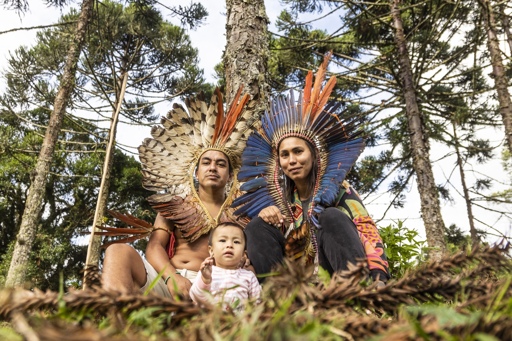
The Xokleng Indigenous people of Santa Catarina state of southern Brazil have planted nearly a 100,000 seedlings of a critically endangered native tree, Mongabay contributor Letícia Klein reported. The Brazilian pine (Araucaria angustifolia), or araucária, can grow more than 50 meters (164 feet) tall and has a straight trunk with a broad crown of branches near its top. Araucária pine forests historically covered large swathes of southern Brazil, but their range declined by roughly 97% in the last century. “Just as our pine is endangered, my people are also endangered, and consequently our language and culture are endangered,” Carl Gakran, executive director of the Zág (pronounced zā) Institute, told Klein. The institute was founded in conjunction with Isabel Gakran, his wife, to organize and expand the replanting effort. Carl Gakran began the restoration effort in 2016 after he learned that the Brazilian pine was listed as critically endangered by the IUCN Red List, the global conservation authority. He initially planned to grow just 10 trees on his own property. But the idea gained traction with the community, and they began the project the following year. Araucária pine trees produce edible nuts called pinhão, a staple food in the culinary tradition of southern Brazil. They are also eaten by at least another 22 animal species. Project organizers and volunteers harvest the seeds but leave at least 40% behind for wildlife. “Following our elders’ knowledge, we speak to the seeds, explain what’s happening, and perform harvest rituals. We harvest 60%, no more…This article was originally published on Mongabay
From Conservation news via This RSS Feed.