

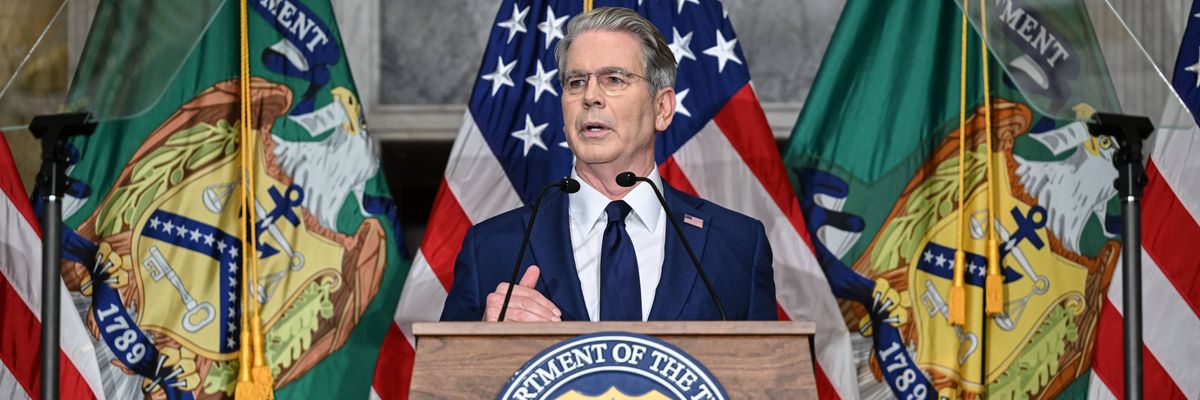
With the United States unable to militarily defeat Iran in President Donald Trump’s illegal US-Israeli war of choice, Treasury Secretary Scott Bessent on Monday escalated the administration’s economic attacks on Tehran, warning countries and companies around the world that continuing to do business with the nation could expose them to punitive sanctions.
“Let there be no ambiguity as to the position of the United States,” Bessent said during a news conference unveiling what the Trump administration is calling Operation Economic Outcast. “An economic engagement of any kind with this murderous regime will expose those responsible to the full reach of American power.”
The “economic D-Day” campaign targets five sectors—technology, gold, aviation, shipping, and digital assets—and is intended to choke off virtually every remaining source of hard currency for Iran.
Bessent warned that it is “no longer acceptable to operate in the gray spaces” of US policy. The secretary said he anticipates the announcement of sanctions against a major financial institution as soon as next week.
Asked if Chinese banks that do business with Iran would be sanctioned, Bessent replied that “no one is above the reach of US sanctions.”
While Bessent did not say which countries would likely be targeted, China, Türkiye, and the United Arab Emirates are Iran’s biggest trading partners.
The secretary was also asked why sanctions aren’t being imposed immediately.
“Well, we are giving everyone the opportunity to remedy bad behavior,” he replied. “Why would I want to blow up the global financial system?”
“We believe that it is important to level set and give people a cure period, but they should know that that will move very quickly and that we are serious,” Bessent added. “So we believe that a warning shot and a level set of expectations is appropriate, and if people do not want to meet our expectations, then we expect—and they should expect—that they will leave the dollar system.”
Iranian officials largely scoffed at Bessent’s “economic D-Day” threat. Deputy Iranian Foreign Minister Kazem Gharibabadi asked on social media, “Is this a victory or an admission of America’s failure!?”
“You say Iran’s military capability has been ‘dismantled,’ 100% of its military factories ‘destroyed,’ and its nuclear program ‘buried’; but for this very Iran, the ‘largest financial assault in history’ and the mobilization of ‘all US institutions and authorities’ have been necessary!” he mocked.
While Trump has said the war is “over” or nearly over dozens of times, Iran currently appears to have the upper hand, as shipping has overwhelmingly avoided the US-supported route through the Strait of Hormuz, with most vessels using a course set by Tehran or avoiding the waterway altogether.
Trump’s war on Iran is proving costly not only in Iranian lives and US taxpayer dollars, but in the increasingly strained budgets of American families. Disruptions to oil shipments through the Strait of Hormuz have pushed gasoline prices above $4 a gallon nationally—roughly a dollar more than a year ago. Trump has dismissed Americans’ concerns about high fuel prices, saying $4 is “not very high” and vowing to “never apologize” for the economic pain his actions are inflicting.
That pain doesn’t stop at the pump. More expensive gasoline and diesel ripple through the economy, raising the cost of transporting food and other goods while keeping inflation elevated.
The pain is far worse for the people of Iran. Trump administration’s escalation comes as Iran’s currency, the rial, has plunged to record lows amid an economic crisis largely caused by the war and years of preceding US-led sanctions.
However, the administration’s effort to force every country to choose between trading with Iran and maintaining access to the US-dominated financial system could have consequences far beyond Tehran.
At a Monday press conference in Beijing, Chinese Foreign Ministry spokesperson Lin Jian said that sanctions “lead to escalation" that "serves no one’s interests.”
“China calls on parties to act rationally and with restraint and avoid taking any measures that may further escalate tensions or deal a blow to global economic growth and financial stability," he continued.
The Chinese government “will closely watch relevant developments and do what is necessary to protect our legitimate rights and interests,” Lin added.
Operation Economic Outcast drew worldwide derision.
“President Trump, the ultimate gambler in geopolitics, is poised to double down on a bad hand on Iran yet again," National Iranian American Council policy director Ryan Costello said in a statement.
“We’ve been down the maximum pressure road with Iran many times," he noted. “What we’ve learned is that President Trump can impose extensive economic pain on Iran, but ordinary Iranians overwhelmingly bear the cost. The ruling elite in Iran remains largely insulated, while Tehran has repeatedly refused to capitulate to Washington’s demands.”
“Trump’s gamble is that this time, amid the destruction of war, and with the reinforcement of a blockade, time is on his side and ultimately Iran will be forced to concede defeat,” Costello added. "President Trump has proven unable and unwilling to stop his gambling on Iran that risks further undermining US and regional security and the global economy.”
Sina Toossi, a senior nonresident fellow at the Center for International Policy, said on social media that Operation Economic Outcast “is as much psychological warfare as economic warfare: Project Iran’s isolation as inevitable, convince markets Hormuz is being overcome, and amplify economic anxiety inside Iran.”
“But the bravado masks a basic problem,” he asserted. “The military option failed to compel Tehran, Iran still possesses substantial escalation dominance over the Arab Persian Gulf states, and ‘severing every economic lifeline’ requires countries like China to enforce a US strategy they openly reject.”
Washington “is effectively betting it can achieve through intensified economic strangulation what six months of war could not,” Toossi added. “And it is demanding unprecedented international compliance at a moment when US relations with much of the world are becoming much more coercive and transactional. The capacity to hurt Iran is clear. The path from pain to capitulation or collapse is not.”
Alan Eyre, a former State Department Iran specialist and current Middle East Institute distinguished fellow, argued that “the problem with Operation Economic Outcast is it continues the trend of making the US an economic outcast.”
Stockbroker and financial commentator Peter Schiff said on X that “because Trump failed to achieve his objective in Iran using military force, he has pivoted to using economic sanctions instead.”
“However, Operation Economic Outcast will not only fail,” he added, “but the economic noose that actually tightens may end up being the one wrapped around our neck.”
From Common Dreams via This RSS Feed.