

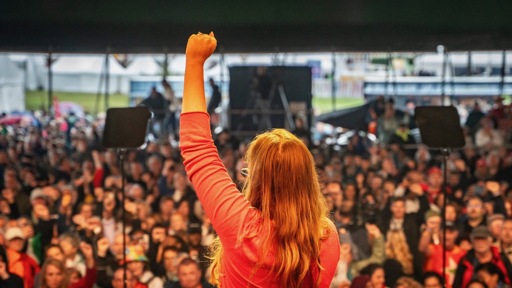

Left and progressive movements across Europe are shaping the agenda for the upcoming political season. Over the coming weeks, a host of festivals and other events will bring together activists, artists, trade unionists, and many others to translate their ongoing struggles into a concrete plan for the coming year. Among these gatherings are Potere al Popolo’s PAP Camp in Italy, La Fête de l’Humanité in France, and ManiFiesta in Belgium.
While recognizing local priorities, these assemblies share a common understanding: resistance to the growing far right must be countered by building mass movements rooted in popular struggles. They also aim to shape a much-needed alternative to the corporate-friendly, austerity-oriented agenda endorsed by liberal and center-left parties that form Europe’s mainstream political opposition.
Read more: Peter Mertens: “We have to restore people’s confidence in collective strength”
Announcing this year’s camp, Potere al Popolo emphasized how this double refusal – of the right’s hate-driven vision and the center’s austerity – was central to the most successful mobilizations of the past year. These include the Palestine solidarity movement and the campaign that pushed back against Prime Minister Giorgia Meloni’s judiciary reform. “But this desire for change risks being thwarted,” the left party wrote on social media, “because the ‘official’ opposition to the right is a center-left compromised by the same economic and international powers as Meloni, unable to mount a challenge or propose an alternative vision for society.”
An important space at the camp, taking place from August 26-30 in Paestum, southern Italy, will thus be dedicated to “thinking together about how to give strength to this desire for change, about how to spark – together with other labor, student, and social movements – a mobilization without which it is impossible to bring about anything new.” Fittingly, the event will feature speakers from the grassroots trade union Unione Sindacale di Base (USB), student collectives CAU and Cambiare Rotta, as well as migrant and feminist groups.
International solidarity also figures prominently in these season-launching events, drawing from recent solidarity trips to Cuba and permanent mobilizations against the ongoing genocide in Palestine. At ManiFiesta, taking place September 12-13 in Ostend, some of the discussions about solidarity with Cuba and Palestine will be held jointly, emphasizing the connection between different struggles.
Read more: Ulrike Eifler: ‘The workplace is a place where we have to fight against war’
ManiFiesta’s program will also zoom in on Europe’s militarization drive and its impacts on climate, women’s rights, and healthcare. “The same economic system that is destroying the planet is now fueling a new arms race,” organizers wrote in announcing the panel Fighting for the Climate and thus Also Against Militarization. “To preserve multinational corporations’ access to critical raw materials, markets, and trade routes, Europe is rearming and preparing to step up its military interventions.”
Regional rearmament will not only worsen the climate crisis – already experienced first-hand by hundreds of thousands as this year’s wildfire season brought devastation across Europe – but will also further erode labor and social rights. “We do not want massive military spending, low wages, meager pensions, the dismantling of social security, or the curtailment of our democratic rights,” warned speakers from Belgium, Italy, and Spain in announcing the Unions Against the Trumpization of Europe debate. Similarly, health movements hosting a discussion on militarization’s effects on health services emphasized the shift raises a crucial question: how are they to provide care “in a system that is shifting its priorities towards militarization rather than the actual needs of patients?”
Read more: ‘Ukraine is no longer a sovereign country,’ says sociologist Volodymyr Ishchenko
ManiFiesta 2026 positions militarization as an intersectional concern, impacting everything from youth to health organizing, while also highlighting its effects on relations between Europe’s core and periphery. “After serving as the industrial backbone of major German monopolies for a long time, Eastern Europe has now become a dual battleground – both economic and military,” recognizes the debate Eastern Europe: The Battleground of the European War Economy. “In the face of the European industrial crisis, military production is being touted as a promising engine of economic growth. As in Germany and in Belgium, the crisis in the automotive and steel industries is being used to push industry toward a war economy. This is a pan-European issue.”
In addition to artists like Manu Chao and Médine, the weekend in Ostend will feature a host of speakers including trade unionists Andrea Egan and Ulrike Eifler, well-known left politicians like Jeremy Corbyn, analysts Volodymyr Ishchenko, Hasan Piker and Jason Hickel, as well as the Tricontinental Institute’s Tings Chak and the International People’s Assembly’s Manolo De Los Santos. Belgian trade unions, youth movements, and social justice groups are also prominent in the program, along with speakers from the Workers’ Party of Belgium (PTB-PVDA), including the party’s president and general secretary, Raoul Hedebouw and Peter Mertens.
From BT News via This RSS Feed.