

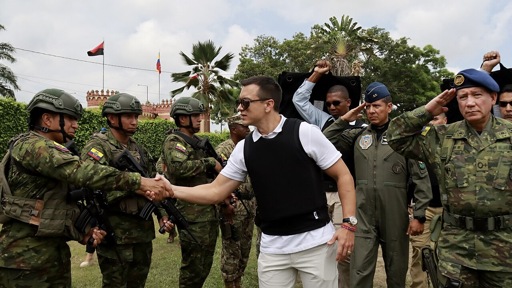
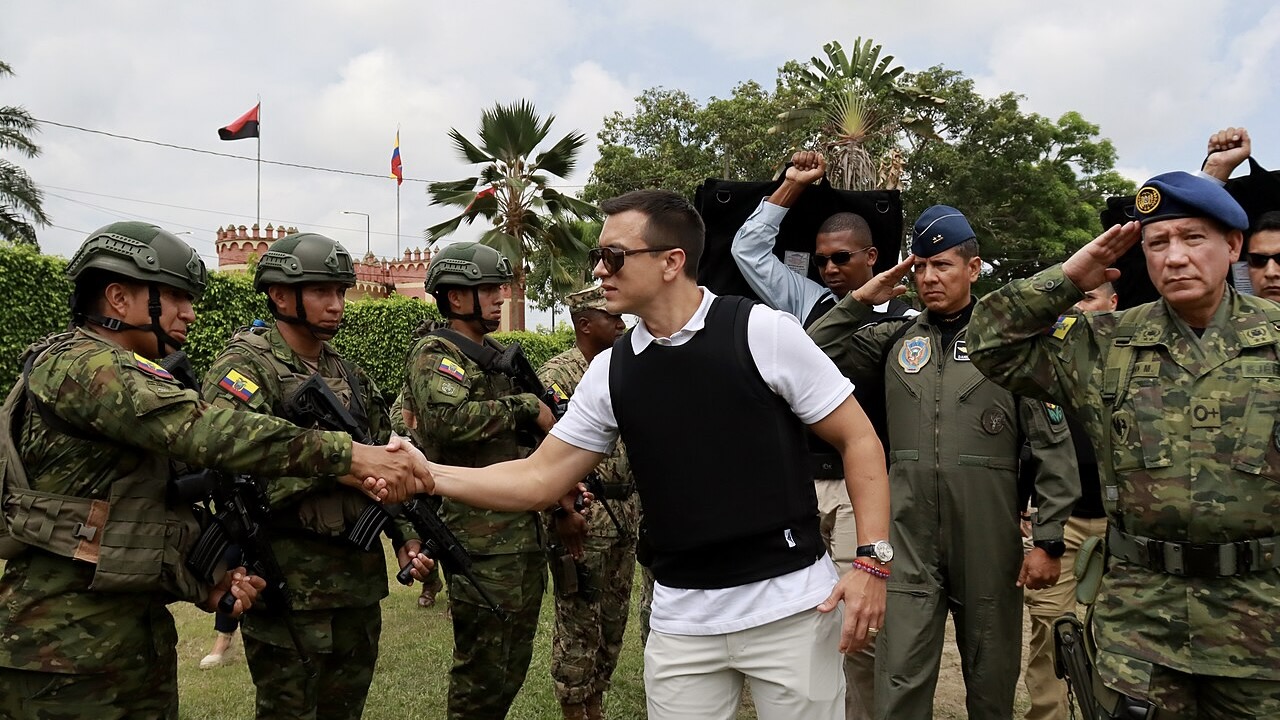
The government of Daniel Noboa, through a ministerial agreement, has allowed US soldiers and contractors to enter Ecuador without a visa, even if they are not working on security operations.
For several years now, Ecuador has been experiencing its worst security crisis in history due to a territorial dispute between drug trafficking gangs over control of drug trafficking routes and illegal mining operations. It is estimated that the largest amount of cocaine in the world passes through Ecuador, primarily bound for the United States and Europe.
Some experts conservatively estimate that more than 25,000 people have died from violence since the security crisis began in 2020. In response, Noboa has played the security card to consolidate his power and implement reforms that have not yielded the promised results, making his term the most violent in the country’s history.
The ministerial agreement thus seeks to present itself as part of a comprehensive strategy to reduce crime, although the government’s critics claim that it is, in reality, a surrender of the country’s sovereignty to the United States. The agreement also grants special immigration status that, among other things, affords these soldiers and contractors immunity from potential legal action for their activities on Ecuadorian territory and multiple entry visas.
The document states the following: “Members of the US Armed Forces, civilian employees of the US Department of Defense, and US contractors who have registered under the category of ‘Commercial Acts and Activities’ in connection with SOFA travel in Ecuador shall not be subject to any type of sanction or other administrative action of an immigration nature, provided they are legally present in Ecuadorian territory.”
It is not yet clear whether regulations allow US Department of Defense soldiers and contractors to use weapons on Ecuadorian territory or to participate in offensive operations; nor is it clear how the US personnel will operate. Will they be assigned a specific area? Will they need permission for each operation or will they have free rein to act?
One of the issues that has caused the most concern among the opposition is the announced immunity that US soldiers will enjoy on Ecuadorian territory, and what consequences this could have for the local population. “This becomes even more serious in light of reports of attacks on fishermen and the announcement that the US military campaign will be moved ashore.”
Read more: Noboa authorizes presence of the US military in Ecuador and promises total immunity
In this way, Noboa’s right-wing government is fulfilling the security agreements made with the Trump administration. Ecuador has been one of Washington’s most loyal allies in recent years, ranking among the countries most deeply involved in the Pentagon’s new hemispheric security policy for the region. This includes its participation in the Shield of the Americas and high-level meetings between Ecuadorian and US military officials.
The US military ground operation in Ecuador has already begun
According to several local media outlets, following the signing of the presidential agreement, US soldiers and contractors are already operating in the provinces of Esmeraldas (which borders Colombia) and Manabí. In the latter, the United States maintained a military base under its control for several years, until the administration of Rafael Correa (2007–2017) decided not to renew the agreement and US military personnel left the country.
Now, the Noboa administration has accelerated the return of foreign troops, who, according to Esmeraldas Governor Juan Jaramillo, are already conducting joint operations with the Ecuadorian armed forces. Jaramillo confirmed this at a press conference alongside US and Ecuadorian soldiers.
According to the senior official in the Noboa administration, operations in Esmeraldas will take place in San Lorenzo (a town on the border with Colombia), Río Verde, and Eloy Alfaro, although he did not explain what these operations would entail.
Likewise, Ecuadorian Minister of Defense Gian Carlo Loffredo, announced that joint operations will begin in Manta, in the province of Manabí, where three US Black Hawk helicopters are already stationed: “General Donovan came here with two US warships, as well as patrol boats and a helicopter. They will be stationed along the drug trafficking route.”
The story of an increasingly close military partnership
But the truth is that the Noboa administration has followed a course that had already been set several years ago. Although the Correa administration maintained diplomatic relations and even a spirit of mutual understanding with Washington, the reality is that those relations were not without friction and controversy.
In addition to not renewing the Manta Air Base lease, Correa went so far as to expel a senior official from the US Embassy (who was in charge of police cooperation) in 2009, and in 2011 declared US Ambassador Heather Hodges persona non grata; likewise, in 2014, a group of US military personnel was ordered to leave the country, thereby suspending a significant portion of military cooperation between the two nations.
But when Correa left office, his successor, Lenin Moreno, took a clear turn to the right and restarted the military rapprochement between the two countries, which has continued to this day through the administrations of Moreno, Guillermo Lasso, and the current president, Daniel Noboa.
In 2018, the Office of Security Cooperation in Quito was reopened during a visit by then-Vice President Mike Pence. In 2019, US aircraft were once again permitted to conduct anti-drug surveillance flights over Ecuadorian territory. This was followed by new training, assistance, and information-sharing programs between Ecuador and the Pentagon.
During Lasso’s administration, military ties between the two countries continued to strengthen. In 2022, the US Congress passed the United States-Ecuador Partnership Act, which authorized the United States to actively participate in the long term in strengthening certain Ecuadorian defense and security institutions, as well as in cybersecurity. This agreement was reached without the approval of the Ecuadorian Parliament, which drew widespread criticism.
In 2023, Ecuador and the United States signed the Status of Forces Agreement, which sets forth the legal conditions under which the US military presence in the Andean country will be established. In 2024, that agreement went into effect, the same year that Noboa accelerated the pace of this increasingly close relationship between the two governments, as exemplified by the agreement on Counter Illicit Transnational Maritime Activity Operations. In 2025, Washington designated several Ecuadorian organized crime groups as terrorist organizations, which, according to certain experts, allows the US to take action against these organizations because they pose threats to its security.
However, it appears that the agreements necessarily required the presence of foreign military bases in the country, which is, however, prohibited by the constitution. Noboa called for a referendum in 2025 to amend the constitution and, in addition, allow for the presence of foreign military bases. In fact, Kristi Noem, former secretary of homeland security, toured military facilities in Salinas and Manta with Noboa in November 2025, an action seen as an effort to establish a future foreign military presence through a military base.
However, the Ecuadorian people voted overwhelmingly against Noboa’s neoliberal reform agenda, which remains to this day the president’s greatest defeat since he took office.
Read more: Ecuadorian people deal a crushing blow to neoliberalism in Noboa’s referendum
Even so, the US military presence and cooperation were not going to stop. Thus, in December 2025, following the referendum, both governments announced a temporary US military operation in Manta, during which, according to the local press, military equipment was transported to the city in the province of Manabí.
In 2026, military operations against drug trafficking in the Pacific Ocean intensified. According to some human rights organizations, these operations included attacks on fishermen who remain missing, while others reported being tortured and sent to El Salvador by US soldiers.
Likewise, in March 2026, both armies reported that they had carried out a joint military operation near the border with Colombia, which was hailed as a success by Quito but criticized by human rights organizations, who claimed that the target was not a criminal base but an agricultural farm, where Ecuadorian soldiers allegedly beat farmers. This was followed by the opening of a permanent FBI office in Quito in March 2026.
Thus, Noboa hopes that military cooperation will help him address a security crisis he has been unable to overcome. During his campaign, he promised that a confidential “Plan Fénix” would reduce violence in the country, now at its worst level in history. For its part, Washington hopes to further strengthen its military presence in the region and secure its dominance over Latin America, as President Donald Trump himself has stated.
What short-, medium-, and long-term effects the US military operation in Ecuador will have remains a major unknown. Several government opponents claim that what Noboa and his predecessors have done amounts to nothing more than handing the country over to the United States, while the Ecuadorian government maintains that this is the right path to defeat, once and for all, the threat posed by criminal gangs.
From BT News via This RSS Feed.