

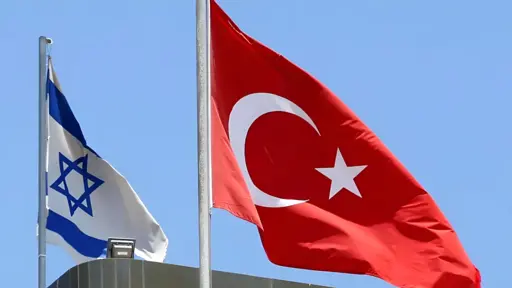
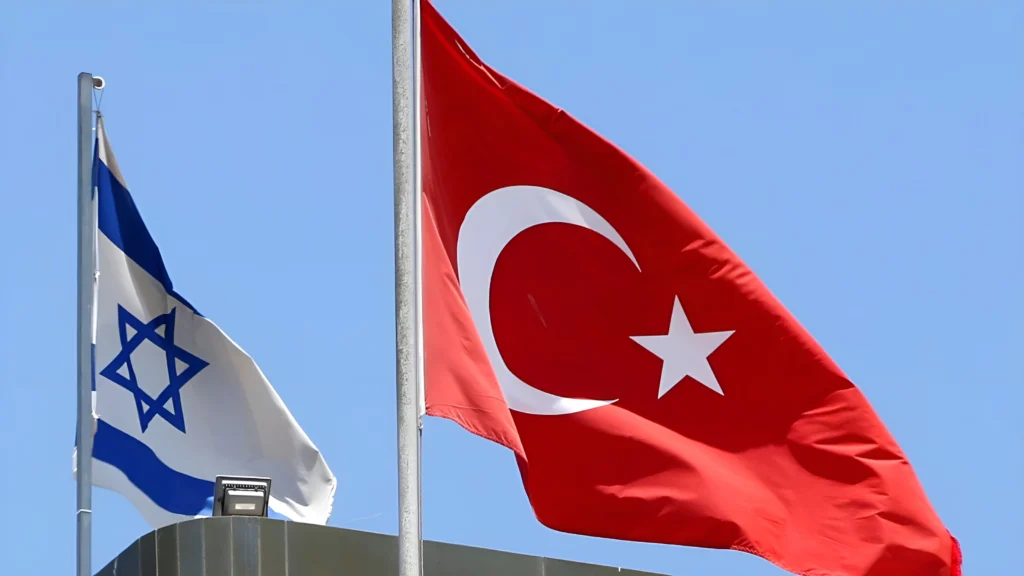
Secret pacts, Gaza flashpoints and collapsing commerce have repeatedly remade ties between Ankara and Tel Aviv.
Over the past seven decades, the relationship between Türkiye and Israel has oscillated between close security alignment and intense diplomatic friction. While public discourse often focuses on ideological disputes, broader regional security architectures, NATO commitments, and economic imperatives have consistently shaped the structural dynamic.
RELATED:
Türkiye Urges Prevention of Israeli Sabotage of U.S.-Iran Peace Agreement
In 1949, Türkiye became the first Muslim-majority nation to recognize the State of Israel. This decision set the stage for a relationship that would frequently diverge from the foreign policy stances of neighboring Arab nations.
The political Türkiye changed with the rise of the Justice and Development Party (AKP) in the early 2000s. Under the leadership of Recep Tayyip Erdoğan, Turkish foreign policy began prioritizing regional outreach, broader engagement with the Islamic world, and active support for Palestinian political movements.
These shifts brought longstanding structural cooperation into direct conflict with public sentiment and diplomatic positioning, leading to high-profile crises over Gaza and regional security.
Understanding the arc of Türkiye-Israel relations requires examining both visible political ruptures and the underlying institutional ties that have sustained bilateral interactions through periods of instability.
Recognition and Ben-Gurion’s “Periphery Doctrine”
The establishment of formal ties between Ankara and Tel Aviv in March 1949 occurred within the broader context of the emerging Cold War. Türkiye’s decision to recognize Israel was driven by its efforts to integrate into Western security structures, which culminated in its entry into the North Atlantic Treaty Organization (NATO) in 1952.
For Israel, securing diplomatic relations with a major non-Arab regional power was a primary foreign policy objective. During the 1950s, Israeli Prime Minister David Ben-Gurion developed the “Periphery Doctrine”.
The objective of this doctrine was to forge formal and tacit alliances with non-Arab nations and ethnic minorities on the periphery. Downplaying the collective political and military influence of pan-Arab nationalism led by figures such as Egyptian President Gamal Abdel Nasser.
The implementation of the Periphery Doctrine led to discreet operational ties between Türkiye and Israel. In December 1958, Ben-Gurion secretly met with Turkish Prime Minister Adnan Menderes in Ankara to finalize covert intelligence and security agreements, often referred to as the Trident Alliance.
This agreement, between the two countries, facilitated regular exchanges between Israel’s Mossad and Turkish intelligence agencies, focusing on monitoring regional political shifts and Soviet activities in the area.
Despite these covert security initiatives, Ankara maintained a calculated public stance. Following the 1956 Suez Crisis, Türkiye downgraded its diplomatic representation in Tel Aviv to the level of chargé d’affaires to manage relations with Arab states and address domestic public opinion.
The Israeli publication Israel Hayom reports that Israel has “studied” the principles of operation of Article 5 of the North Atlantic Treaty and claims that Israel could attack Turkish soldiers without triggering NATO intervention.
Meanwhile, Netanyahu is currently holding a… pic.twitter.com/hf0zb5nqgK
— 𝕊𝕡𝕣𝕚𝕟𝕥𝕖𝕣 𝕻𝕣𝕖𝕤𝕤 (@SprinterPress) August 21, 2026
The “Golden Age” of Military and Intelligence Cooperation (1990s)
The end of the Cold War and the opening of the Middle East peace process following the 1991 Madrid Conference allowed Türkiye and Israel to escalate their relationship.
During the 1990s, the bilateral partnership reached its historical peak, characterized by institutionalized military alignment, shared regional intelligence, and major industrial defense contracts.
This period of close alignment formally began with the signing of two key agreements in 1996: the Military Training and Cooperation Agreement in February and the Defense Industry Cooperation Agreement in August.
Negotiated by senior military leaders, including General Çevik Bir, the deputy chief of the Turkish General Staff, these frameworks enabled structural security operations.
Israeli Air Force pilots conducted long-range training missions in Turkish airspace over the Konya region, while the Turkish Armed Forces gained access to advanced Israeli defense technology.
Major economic contracts defined the defense partnership. In 1995 and 1996, state-owned Israel Aircraft Industries (IAI) secured a contract worth approximately $650 million to upgrade 54 Turkish Air Force F-4E Phantom jet fighters.
For both nations, the alliance served vital strategic interests. For Türkiye, partnering with Tel Aviv offered a way to secure high-tech weaponry and intelligence while bypassing arms restrictions imposed by Western European nations. For Israel, the partnership provided operational depth, access to key airspace, and a powerful non-Arab partner in the region.
The Rise of the AKP and the Gaza Paradigm
The election of the Justice and Development Party (AKP) in November 2002 marked a fundamental shift in Türkiye’s foreign policy framework.
Guided by a strategy of broader regional engagement across the Global South and the wider Islamic world, the government of Prime Minister Recep Tayyip Erdoğan gradually re-evaluated the country’s uncritical alignment with Israeli security priorities.
As Israel increased military operations in the Palestinian territories, political and diplomatic tensions began to escalate.
The first major public rupture occurred at the World Economic Forum in Davos, Switzerland, on January 29, 2009. Following Israel’s Operation Cast Lead in the Gaza Strip, Erdoğan engaged in a direct debate with Israeli President Shimon Peres.
Objecting to time limits imposed by the panel moderator and addressing Israeli military tactics, Erdoğan stated to Peres: “When it comes to killing, you know very well how to kill. I know very well how you hit and killed children on the beaches.”
Diplomatic relations deteriorated further on May 31, 2010, during the Mavi Marmara incident. The MV Mavi Marmara, a vessel organized by the Turkish humanitarian organization İHH, led an international flotilla attempting to breach the naval blockade of the Gaza Strip to deliver humanitarian aid.
Israeli naval commandos boarded the vessel in international waters, resulting in the deaths of nine Turkish citizens (and one Turkish-American student, Furkan Doğan) and injuring dozens more. A tenth activist, Uğur Süleyman Sönmez, succumbed to his injuries in 2014 after years in a coma.
The attack prompted Türkiye to recall its ambassador from Tel Aviv, expel the Israeli ambassador from Ankara, and suspend all bilateral military agreements.
Ankara conditioned any normalization of relations on three explicit demands: an official apology for the raid, financial compensation for the families of the victims, and the lifting of the blockade on the Gaza Strip.
Saudi General Mohammed Saleh Al-Harbi:
"Turkey is a reliable partner and ally. Saudi-Turkish relations are highly advanced. We have major Turkish projects and a military partnership with Bayraktar. The IMEC progress is futile propaganda. Israel should not be given added…
— Straturka (@straturka) August 20, 2026
Economic Interdependence Behind the Rhetoric
Despite recurring geopolitical rifts and intense public rhetoric, the economic framework between Türkiye and Israel demonstrated remarkable resilience throughout the 2010s and early 2020s.
Strategic cooperation between Ankara and Tel Aviv operated on a parallel track from commercial relations, allowing private-sector investments, bilateral trade, and supply chains to expand even during periods of diplomatic freeze.
Bilateral trade statistics highlight this dynamic. Following the Mavi Marmara incident in 2010, annual trade between the two nations stood at approximately $3.4 billion.
Rather than contracting, total trade volume surged over the subsequent decade, reaching $4.4 billion by 2014 and surpassing $8 billion by 2021.
Türkiye became a primary supplier of raw materials and industrial goods to the Israeli economy, exporting high volumes of construction steel, cement, vehicles, textiles, and agricultural produce. Conversely, Israel exported high-tech goods, chemicals, and refined petroleum products to Türkiye.
Energy logistics formed another critical pillar of this structural interdependence. Azerbaijani crude oil, transported via the Baku-Tbilisi-Ceyhan (BTC) pipeline to Türkiye’s Mediterranean port of Ceyhan, was consistently shipped via tankers to Israeli ports such as Haifa and Ashkelon, supplying a significant portion of Israel’s energy needs.
This economic reality facilitated the formal restoration of ties in June 2016. Under the reconciliation agreement signed by both governments, Israel paid $20 million into a compensation fund for the families of the Mavi Marmara victims and stated regret.
In exchange, Türkiye passed legislation dismissing legal claims against Israeli military personnel involved in the raid. While full ambassadorial relations were re-established, the underlying arrangement underscored a policy of pragmatic duplicity: maintaining lucrative economic integration while managing political opposition to Israeli regional policies.
The Post-October 7 Horizon and the Limits of Reconciliation
The systemic tension between Ankara’s strategic priorities and its regional diplomatic commitments reached a major turning point following the escalation of the Israeli-Palestinian conflict in October 2023.
Israel’s military campaigns in Gaza, combined with widespread regional destabilization, generated unprecedented domestic and international pressure that rendered the traditional dual-track model, maintaining diplomatic condemnation alongside commercial trade, untenable for Turkish leadership.
In response to the humanitarian crisis, Ankara systematically dismantled its commercial engagement with Israel. The Turkish Ministry of Commerce announced a total suspension of all export and import transactions with Tel Aviv.
While formal state-on-state military conflict between Türkiye and Israel remains structurally constrained by Türkiye’s NATO membership and Israel’s status as a non-NATO security partner with advanced defense capabilities, security analysts identify several critical theatres where indirect friction or inadvertent armed escalation could occur.
Following political shifts and ongoing conflict in Syria, both nations have maintained overlapping security operations in the Levant. Israeli airstrikes targeting defense infrastructure near the Turkish border have repeatedly drawn sharp condemnations from Ankara, highlighting the constant risk of operational miscalculations or direct encounters in northern Syrian airspace.
Simultaneously, competing maritime boundary claims and offshore energy access in the Eastern Mediterranean continue to generate friction. Israeli defense alignment with Greece and the Republic of Cyprus directly challenges Turkish maritime jurisdiction claims and offshore gas exploration initiatives, creating persistent naval standoffs.
The evolution of Türkiye-Israel relations over seven decades illustrates an ongoing struggle between Western strategic alignment and regional geopolitical rivalries.
While the 1949 recognition and the security partnerships of the 1990s were anchored in cold-war defense frameworks, the current era demonstrates the hard limits of uncoupling commercial trade from human rights and regional sovereignty.
Sources: teleSUR – Al Jazeera – Al Mayadeen – Xinhua – CGTN – Swiss Info – Press TV – Agency Anadolu – TRT World – Hispan Tv
From teleSUR English via This RSS Feed.