

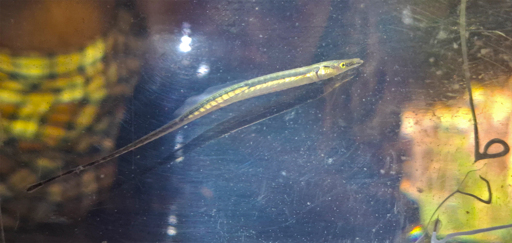
By mid-June, Jerrica Agebido was staring at disappointment. His nearly two-week-long, exhausting search for a mysterious fish that hasn’t been seen by scientists for nearly four decades was drawing to a close. His team of researchers had braved Papua New Guinea’s hot, humid summer days, meandering along the Sepik River’s course by boat and canoe — but the spinach pipefish still eluded them. “We had spent days travelling through the Lower Sepik, talking with communities and looking for information about the pipefish,” Agebido, a researcher at the Papua New Guinea University of Technology and the New Guinea Binatang Research Centre, wrote in an email. “We had almost given up hope.” The spinach pipefish (Microphis spinachioides) is a small, slender pipefish with an elongated snout it uses to capture small prey, reaching maybe 15 centimeters (6 inches) in length. This greenish-brown freshwater creature, a close relative of seahorses and seadragons, is well camouflaged in its only known home here in the Sepik River — the country’s longest waterway — hiding among water lilies and other plants near riverbanks. Just like seahorses, pipefish males carry their embryos in a brood pouch for weeks until the young are born. Much about the spinach pipefish has remained an enigma, because scientists haven’t seen it since 1985. It was last assessed for the IUCN Red List in 2016, and at the time, was classified as data deficient by IUCN, the global conservation authority. The only known museum specimen, on which the taxonomy of the species…This article was originally published on Mongabay
From Conservation news via This RSS Feed.