


Kevin Abourezk
ICT
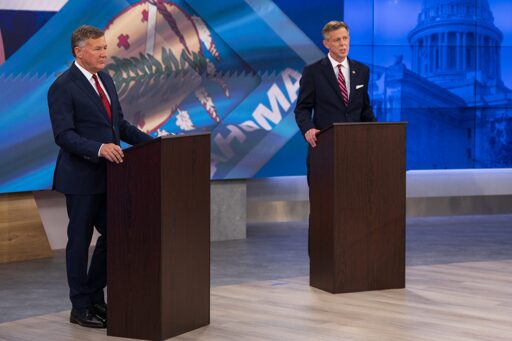
Two Republican candidates for Oklahoma governor will face each other Tuesday in a runoff election after neither succeeded in winning more than 50 percent of the vote during the state’s June 16 GOP primary election.
The stakes are high in Indian Country as the winner will most likely be the next governor in the heavily Republican state — replacing outgoing Gov. Kevin Stitt, Cherokee. He is considered by many tribal leaders in the state to be the worst in Oklahoma’s history in terms of his relationship with the state’s 38 tribes.
“Indian Country in Oklahoma is going to breathe a huge sigh of relief when Gov. Stitt walks out of the governor’s mansion for the last time knowing that it’s going to be better for us,” said Kayln Free, who serves as the Cherokee Nation’s legal counsel**.** “It’s gonna be a better day in Oklahoma.”
Oklahoma Attorney General Gentner Drummond will face Stitt’s former budget secretary Mike Mazzei on Tuesday. The winner of the Republican runoff will face Oklahoma House Minority leader Cyndi Munson, Democrat, in the Nov. 3 general election.
Both Drummond and Mazzei have promised to work with tribal nations and negotiate tribal compacts if elected. Additionally, both have expressed support for the Supreme Court’s decision in McGirt v. Oklahoma that effectively recognized eastern Oklahoma as a federally recognized Native reservation.
Stitt has been outspoken against tribal compacts for tobacco and car license tags, and tribal gaming compacts. He vetoed several compacts, despite overwhelming support by the state’s legislature, slowing the process for establishing the tobacco, car tag and gaming compacts between Oklahoma and tribal nations.

Cherokee Nation Principal Chief Chuck Hoskin Jr. speaks during a news conference with tribal leaders from 32 tribes to speak out against Gov. Kevin Stitt’s request to extend gaming compact negotiations Thursday, Dec. 19, 2019 in Tulsa, Okla. Leaders from nearly every Oklahoma-based Indian tribe that has a gambling compact with the state on Thursday rejected Gov. Kevin Stitt’s offer to extend the compacts for an additional eight months. (Mike Simons/Tulsa World via AP)
Tribal-state compacts are legal agreements between federally recognized tribes and state governments. It is most commonly used for class III gaming – slot machines and table games.
Stitt was quoted as saying that the McGirt decision has torn Oklahoma apart and has created two justice systems based on race.
Neither he nor his office responded to multiple ICT requests for comment for this article.
Stitt is ineligible to run for reelection as he is serving his final year and last term as governor.

Gov. Kevin Stitt, pictured Tuesday, vetoed a bill this week that otherwise would have extended the existence of the Oklahoma Advisory Council on Indian Education. Stitt said the council is redundant, lacks transparency and meets too rarely. (Photo by Nuria Martinez-Keel/Oklahoma Voice)
Oklahoma has a lifetime limit of two four-year terms for governor of the state that nearly 330,00 American Indian and Alaska Natives – about 8.4 percent of the state’s population, according to the 2020 Census – call home.
Cherokee Nation Principal Chief Chuck Hoskin told ICT that Stitt has worked against tribes at every turn and lost every legal battle he’s had with them.
“It’s a tall order to say that Kevin Stitt’s term has been the low watermark, but without any exaggeration or hyperbole it absolutely has, both because of his staunch opposition to tribal sovereignty and because of the contrast that his style and substance of leadership has been compared to his predecessors, who on a bipartisan basis were working to actually improve state-tribal relations,” Hoskin said. “He is an absolute firm believer that in the 21st century a tribe should not be exercising sovereignty, and he said that in so many ways that the only reasonable conclusion is that he would like us to essentially be terminated.”
Hoskin said Stitt has missed an opportunity to work with tribes to improve the lives of his constituents and said tribal-state compacts have served Oklahoma well by injecting revenue earned by tribal enterprises into state coffers and into tribal communities, which have used those funds to build roads, schools and healthcare facilities that also serve non-Native people.
He said tribal programs and infrastructure have especially benefitted rural communities that have often been ignored by state lawmakers and leaders.
Hoskin said Stitt viewed state-tribal relationships as a zero sum game, meaning that anything that one gained, the other lost. He said the governor views anything that benefits tribes as detrimental to the state of Oklahoma.
But Hoskin said tribes, including the Cherokee Nation, use much of the revenue they generate from tribal enterprises, including casinos, to improve public infrastructure, like roads and schools.
“The governments that often provide the solutions are actually tribal governments, and so they see us as great partners and so his view that everything we do that’s any sort of exercise of authority comes at the expense of his state is an absolute fiction that he has created,” Hoskin said.
Shawnee Chief Ben Barnes echoed Hoskin’s sentiments, saying that he spent the past six years trying to work with Stitt but was rebuffed each time.
“The next governor needs to reach out to tribal nations directly and to not just assume that they know best what’s best for tribal nations, to come to tribal nations and ask where are those natural collaborations,” he told ICT.
Free, the Cherokee Nation’s legal counsel, said Stitt’s constant legal attacks against tribes cost the state and those tribes millions of dollars.
“He ultimately lost to me (in court) and he lost at every turn, and these political disputes consume valuable time and physical resources that could have been spent addressing real shared priorities whether it be making public schools better, more healthcare access, job creation,” she said.
She said Stitt views Native American identity as a racial distinction rather than a legal one, despite the fact that tribal citizens can be members of any race, and predicated many of his assaults on tribal sovereignty as based on the notion that Native people shouldn’t receive benefits that members of other races don’t receive.
Tuesday’s runoff will feature several other races of interest to tribes, including two Democratic candidates for U.S. Senate seeking to face Kevin Hern, Republican, who currently holds the state’s U.S. House of Representatives District 1 seat and easily won his party’s nomination for the Senate seat being vacated by Markwayne Mullin, Cherokee.
Mullin left office to serve as U.S. secretary of homeland security under President Donald Trump.
N’Kiyla “Jasmine” Thomas, Chickasaw, will face fellow Democrat Jim Priest, an attorney, in the runoff election for their party’s nomination.
John Pfeiffer, Cherokee, will face fellow Republican candidate Kevin West in the runoff election for the GOP nomination for state labor commissioner.
The post Oklahoma GOP runoff features race to replace controversial governor appeared first on ICT.
From ICT via This RSS Feed.