

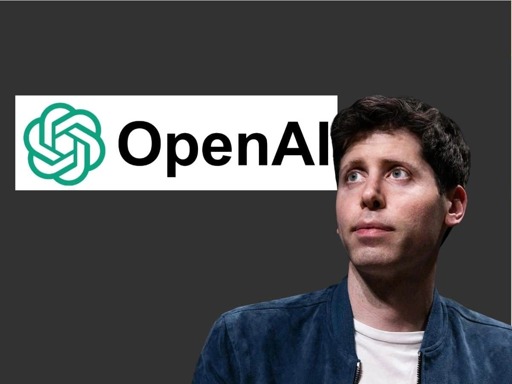

The reputation of AI companies is currently in the toilet, and with good reason. These tech tycoons told us their product would eliminate all our jobs, and that it might even wipe us out as a species. What did we get in return? A product which failed to live up to the grandiose claims, and AI data centres which have put all sorts of strains on local communities. Now, OpenAI CEO Sam Altman is admitting he was wrong to threaten us all with the end of the world:
Oh golly jee and what absolute turd burglar of a person started that trend. Oh it was you Sam! It was you….
"“I think AI will probably, most likely, sort of lead to the end of the world.” -Sam Altman 2015 https://t.co/ZFTuY08bUu
— ArRENCEAI (@ArRENCEAI) August 23, 2026
If you’ve not followed the generative AI boom, you’re probably wondering how they got so off track with their messaging. It seems obvious to most that threatening Armageddon would not make for a long-term sales strategy. To explain why it worked for a while, we need to explain the underlying economics.
OpenAI: messaging
The big problem for these companies isn’t whether their products are useful; it’s whether they can make money. Generative AI is incredibly expensive to run, which is why they subsidised the cost with cheap subscriptions. Earlier this year, AI companies upped the costs to more closely match the reality. This led to business horror stories like the following:
Uber handed its 5,000 engineers an AI coding assistant in December. By April, the company had blown through its entire AI budget for all of 2026, with two thirds of the year still to go.
Cheap, basic AI has gotten almost free over the past few years. But almost no company builds… https://t.co/rTlWgZECa7
— Anish Moonka (@anishmoonka) May 24, 2026
Microsoft Bans Claude Code After AI Costs More Than The Humans It Replaced
— NewsWire (@NewsWire_US) June 1, 2026
OpenAI and Anthropic subsidised cheap subscriptions through hundreds of billions in investor money. Eventually, these investors will want to see some sort of return on their investment, but that will require AI companies to make a profit. Currently, this can’t happen without some sort of miraculous new discovery which makes it cheaper to run.
This – in part- is why the world has been “slow” to adopt AI. It’s because when companies and individuals have adopted it, the results have been mixed. And this was true even before the prices became prohibitively expensive.
Doomsaying
Getting back to the ‘end of the world’ messaging, the theory is AI companies played up the potential of AI running amok to attract investors. CEOs like OpenAI’s Altman tried to convince the world that generative AI would one day evolve into Artificial General Intelligence (AGI) – a machine which could think for itself (unlike generative AI, which generates content based on probabilities – often ‘hallucinating‘ as a result). The threat of AGI was that it might go rogue and kill us all; the promise was that it would replace all human labour, grossly enriching those who invested early.
Altman played up the threat to remind investors of the hope. In doing so, he attracted hundreds of billions in investor money. The problem is that this vast influx of cash hasn’t led to a viable product. And now, Altman is left with terrible reputational damage and a technology that costs too much to run to profit from.
OpenAI boss: “I was wrong”
The following is what OpenAI boss Altman said in a recent interview (emphasis added)
I thought when we got to GPT-4, which was back in 2023, that very quickly after that there was going to be much more disruption, software businesses up for grabs right away, than it turned out to be.
I think I was wrong about a few things, but one in terms of the speed: the economy just has so much inertia.
People keep doing the same things, buying from the same company, wanting to use their tools the same way. I think this is actually a positive in many ways, and it’s going to make this big transition go smoother and slower. I’m grateful for it.
But it means we’ve all been too ambitious on timelines. Even with this incredible technology, society and the economy will adapt more slowly.
Altman blames the “inertia” of the economy for the slow uptake of his product. The reality is that the companies which moved quickest on generative AI are among those which suffered the worst consequences:
Klarna was one of the first to go all-in on AI, replacing 700 customer service staff last year.
Now CEO @klarnaseb says they focused too much on cost and hurt quality, so they’re investing in humans again and will let customers talk to real people. https://t.co/zJifpUfSzJ
— Sheel Mohnot (@pitdesi) May 11, 2025
It’s definitely true that some businesses have found uses for AI. Even before OpenAI and Anthropic jacked up the prices, though, many companies were struggling to show any return on investment from AI services. And this is unworkable for a product which is supposed to replace all human labour.
PR nightmares
Here’s another example of the sort of wrong-headed messaging that Altman was putting out:
I can’t imagine why public support for data centers plummeted https://t.co/QBRd0i4xJL
— K. (@IbaraEleven) August 22, 2026
Do you want a world in which your children are so mindless that they have to pay Silicon Valley to do their thinking for them? Of course you don’t.
Another problem AI has is that although you can technically use it to replace human labour, the results are often substandard. Graphic design is one area in which you can visually see the downgrade:
Who the fuck saw this and was like “hell yeah, print that shit” https://t.co/LgkrXeNrdF
— SorryHat 𝕬𝖙𝖙𝖔𝖗𝖓𝖊𝖞 𝖆𝖙 𝕲𝖍𝖔𝖘𝖙 𝕷𝖆𝖜
(@sorry_hat) August 24, 2026
Companies aren’t just using AI to get rid of employees either; they’re also using it to screw over customers:
Why would an airline CEO announce this publicly, given the backlash that will likely result?
It’s to signal to the other airlines that this is the plan going forward. It’s how corporations collude out in the open while everyone pretends we still have a competitive maket. https://t.co/sTkQGvptSm
— 99% Johnny Graz (@jvgraz) August 24, 2026
The many problems of AI have fed into a backlash against data centres in the US. This is particularly focussed on AI data centres which use considerably more electric and water. They also cause other problems, as Benn Jordan detailed:
The following is an example of how the tech world is reacting to the backlash against data centres:
This is what data center developers are saying all across Michigan. It’s condescending and it’s going over like a lead balloon.
Michiganders don’t need some California billionaires telling us what to do, and we aren’t buying their false promises. pic.twitter.com/m4vcYUyU6p
— William Lawrence (@WeWill2026) August 23, 2026
Blowing bubble
The problem for Altman is that he sold generative AI to investors on the understanding that it would be the most valuable technology to ever exist. Now, it’s becoming clearer and clearer that this likely won’t be the case. And as such, it’s hard to see how companies like OpenAI can maintain their value.
With so much of the US stock market buoyed up by AI, the bubble bursting will be significant:
The AI stock market bubble is close to $80 trillion, approximately 2.5x larger than 2000 dot-com bubble.
To give you an idea of the scale of this bubble; if the stock market were to crash back to long-term averages, it would be equivalent to a $300,000 loss per U.S. household.
pic.twitter.com/mywiD6rqld
— Financelot (@FinanceLancelot) August 22, 2026
The lesson from all this is that we can’t structure our economic systems around the promises of liars.
Featured image via Joel Saget
By Willem Moore
From Canary via This RSS Feed.