

Ankara has opted for caution after Israel described its attack on a Syrian base as a ‘warning to Türkiye.’
The Israeli attack on a base located about 50 kilometers from the Turkish border has further strained the already troubled relations between Israel and Türkiye, an escalation that Ankara views as a provocation but in response to which it has so far opted for caution.
RELATED:
Türkiye Seeks Interpol Arrest Warrant for Israeli PM Netanyahu
Israel, known for neither confirming nor denying its cross-border military operations, declared on this occasion, that the attack was intended as a “warning to Türkiye.”
Turkish analysts and security experts agree that the response from the government of the country’s president, Islamist Recep Tayyip Erdogan, has been “prudent” to avoid falling into what it considers a calculated provocation.
“Ankara’s response is extremely measured. The attack is interpreted as an attempt by Israeli Prime Minister Benjamin Netanyahu” to gain popular support ahead of elections scheduled for late October, analyst Murat Yetkin said.
The widespread view is that the Israeli leader is trying to stoke fears of a possible conflict with Türkiye and, above all, that the Turkish opposition accuses him in this regard of “playing with fire,” he added.
In his view, Netanyahu “is also seeking to turn his growing international isolation into a narrative of victimhood, but Türkiye has no intention of falling into the trap.”
In this situation, Ankara is trying to contain its anger and “grit its teeth” until the Israeli elections are held, he stressed.
Turkiye is a peaceful country and sends diplomatic messages to its neighbor regarding acting in accordance with international agreements and underlines the need to avoid illegal/unilateral practices. At the same time, it states that it has no intention of ever comprimise its… https://t.co/kpWLr5LpMP
— TR_tech (@T_Nblty) August 24, 2026
Diplomatic journalist Deniz Zeyrek argues that the Turkish government prefers to remain cautious while discreetly strengthening its military cooperation with Syria, avoiding responding symmetrically to Tel Aviv’s maneuvers.
However, “Syria, unfortunately, is demonstrating its fear of Israel by repeatedly leaking information that benefits Israeli interests,” Zeyrek wrote in an analysis published by the Nefes newspaper.
“Although the United States appears to be criticizing Israel, it is actually pressuring Türkiye and Syria to establish a military de-escalation mechanism with Israel that ‘will make Israel feel more comfortable,’” he said.
However, other critical sectors warn about the risk of failing to display military strength because, regardless of whether Turkish troops were present at the base bombed by Israel, they have no doubt that an Israeli airstrike at a location immediately adjacent to the Turkish border creates a serious risk of direct confrontation.
On Monday, former lawmaker Nesrin Nas said that Türkiye “should have deployed its aircraft, not to bomb, but as a show of determination,” a position shared by diplomat and geopolitics expert Mehmet Ögütçü, who warns that the credibility of Türkiye’s deterrent capability is at stake.
“There is a dangerous perception in Israel that Türkiye formally protests but does not alter the reality on the ground. Red lines lose their meaning if violating them does not generate real costs,” Ögütçü argues.
TÜRKIYE
-ISRAEL
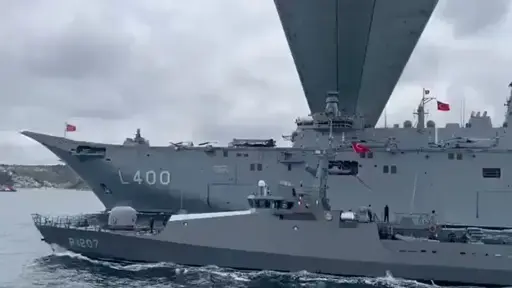
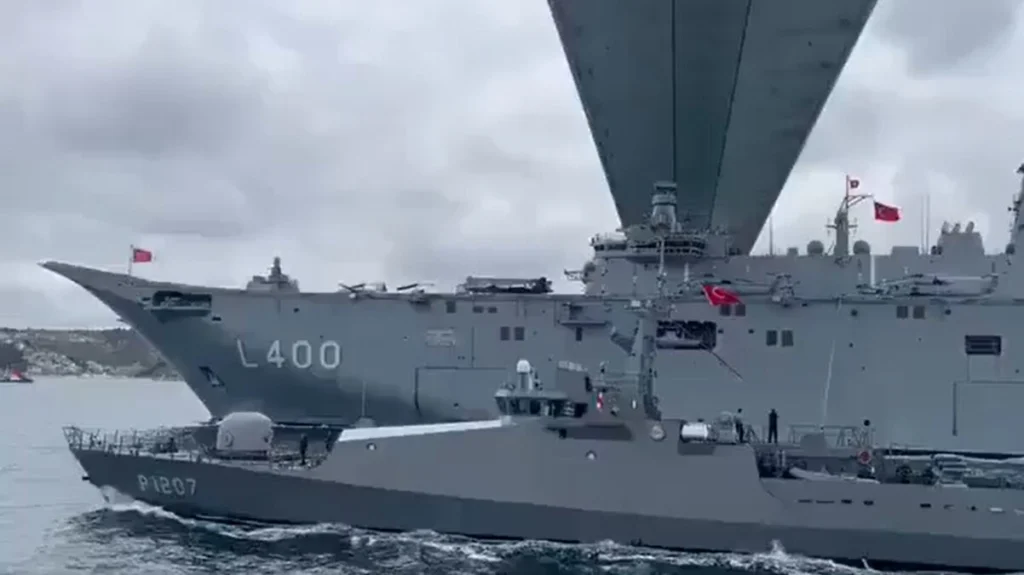
| Türkiye stands firm against Israel’s. Turkish troop movements continue in an unprecedented land and sea deployment as Ankara prepares for a direct confrontation with Israel. Both states are vying for alleged gas fields beneath the Eastern Mediterranean. pic.twitter.com/XI7le8UVWy
— Nanana365 (@nanana365media) August 22, 2026
The Aug. 18 bombing of the Abu Zuhur base took place amid closer relations between Ankara and Damascus, following the signing in August 2025 of a military cooperation agreement under which Türkiye committed to supplying weapons, logistics and support for the rehabilitation of Syrian army facilities.
Although Syria’s Foreign Ministry denied that a permanent base had been granted to Turkish troops, it did confirm the recent presence of a military delegation from Ankara in the area that was bombed.
The incident has put on hold the de-escalation protocol that Türkiye and Israel reached in 2025 under the mediation of Azerbaijan, which established a demarcation line in Syria at the level of Hama and required both nations to notify each other of their operations to prevent direct clashes.
With this channel having collapsed, U.S. special envoy for Syria and Iraq Tom Barrack has called for the urgent reactivation of military communication channels to prevent “unnecessary tensions” from developing into an open armed confrontation in the region.
Over the past decade, relations between Türkiye and Israel have been marked by diplomatic ruptures and growing geopolitical rivalry, shifting from historic cooperation to hostility driven primarily by the Palestinian issue. Following the outbreak of the war between Israel and the Palestinian Islamist group Hamas in October 2023, Türkiye suspended all trade relations with Israel.
Tensions took on a new dimension after Syrian President Bashar al-Assad was overthrown in late 2024, as Ankara consolidated its influence in the neighboring Arab country, something perceived in Israel as a threat to its security.
teleSUR/ JF
Source: EFE
From teleSUR English via This RSS Feed.