

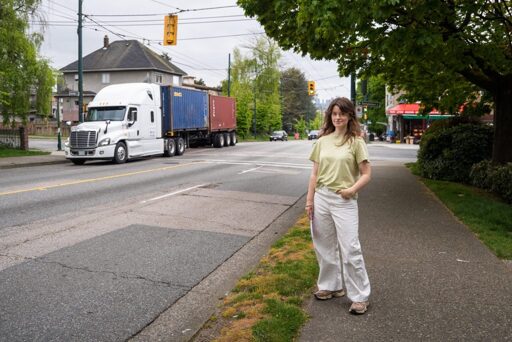
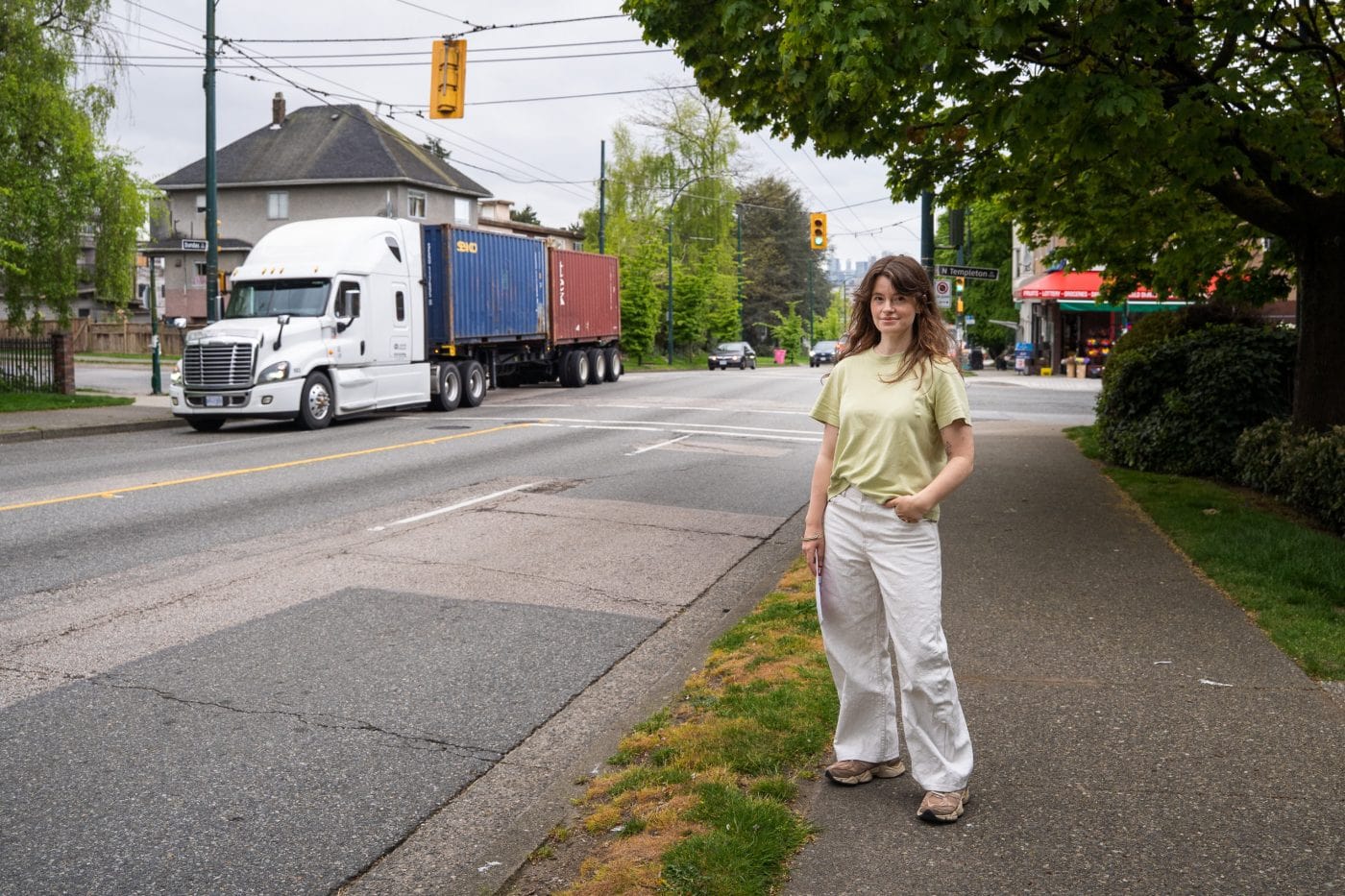
When Michelle Brown-Colistro became pregnant with her second child in 2024, she and her husband decided to find a two-bedroom place to house their growing family. They managed to find a home in Vancouver’s notoriously expensive housing market that they could afford: a 1970s-era wooden-sided walk-up in Hastings-Sunrise, a historically working-class residential neighbourhood on the city’s east side. She knew her apartment-lined street was a designated truck route, and that container trucks had begun using it to reach the Port of Vancouver after the port’s Clark Drive entrance was closed to container trucks in 2011. But weeks after moving in, surrounded by unpacked boxes in her toddler’s bedroom, she became aware of the non-stop assault to her senses from the heavy-duty truck traffic outside.
“Just the smell of the diesel through our window was so extreme,” she recalls. “It’s like a train of trucks. You barely get a break between them.”
Brown-Colistro wasn’t the only resident concerned about the impacts of truck traffic. In the following months, she and her neighbours learned that the Port of Vancouver had decided to make the temporary detour permanent; changing its status as a truck route would also require approvals from Translink, the regional transit authority and the City of Vancouver.
That summer, the fumes from truck exhaust on Brown-Colistro’s street were so cloying she had to keep their windows shut even on the hottest days rather than subject her toddler’s little lungs to the pollution. She bought air purifiers and ran them constantly, concerned about the risk of inhaled pollutants to her developing fetus. After her second child was born, Brown-Colistro rallied a city councillor, Lisa Dominato, and her MLA, Nikki Sharma, to her cause, but their efforts were futile. She was informed that the city’s engineers were concerned that re-routing traffic from her street would merely shift the burden onto other streets, equally unequipped to handle increases in heavy-duty traffic.
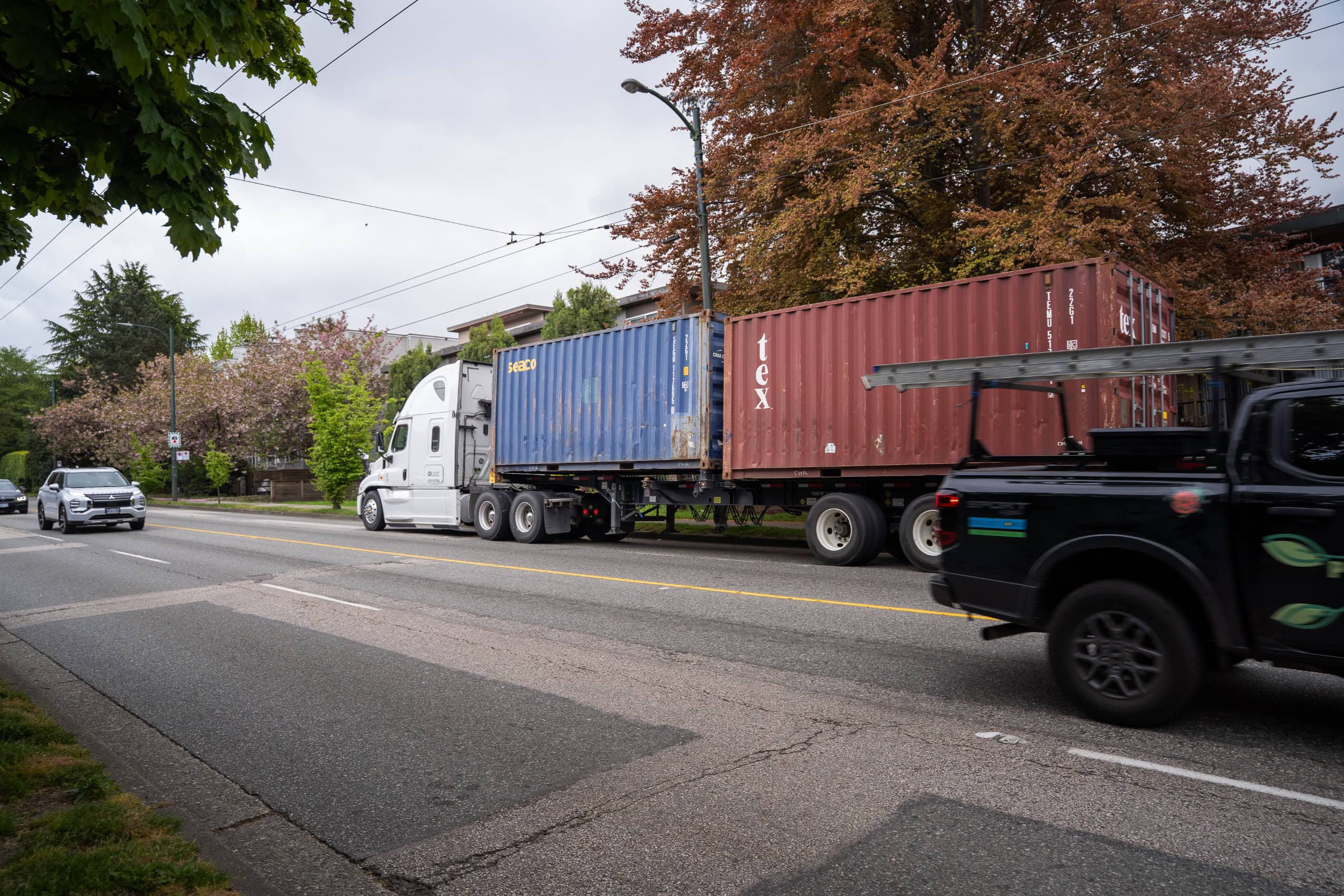
Heavy-duty diesel trucks release exhaust fumes that present a health hazard for humans. While other countries are implementing measures to limit their damage, experts say Canada is falling behind, with residents in cities like Vancouver paying the cost.
In Vancouver, the heaviest burden of that traffic lands in the city’s east side, which encompasses heavily used truck routes, including the one outside Brown-Colistro’s apartment. The eight-kilometre-long Clark-Knight corridor, which runs north from the Fraser River toward the port’s newly expanded container terminal on Burrard Inlet, brings an average of 33,000 vehicles through the Clark and Broadway intersection each day and is the most heavily used truck route in the city. Of 25 air quality monitoring stations Metro Vancouver operates, the one adjacent to that intersection consistently records the worst nitrogen dioxide levels.
A 2018 study found that the air quality at this location was as poor — and at times poorer — than that along Ontario’s 401 highway, the busiest highway in all of North America, despite having one-twelfth as much traffic. The researchers’ conclusion? It wasn’t the number of vehicles so much as the higher proportion of heavy-duty diesel-burning trucks that spiked airborne pollutants. Though large trucks account for only six per cent of traffic at this intersection, they contribute a disproportionate amount of pollutants; compared to Sundays, when few trucks are on the road, on weekdays the levels of concerning pollutants are up to 2.8 times higher.
“The air quality objectives across Metro Vancouver, as they report to us, are met except for the monitors near our downtown area and also the Vancouver Clark Drive station,” Michael Schwandt, a medical health officer with Vancouver Coastal Health, explains. “It’s also a major problem because as we see increasing population density and all of the amenities that people need to live healthy lives — whether that’s schools, childcare, workplaces — often cluster in these areas.”
“The port is such an important economic engine for the country,” Christine Davis, a neighbourhood parent, whose child attends elementary school right on the truck route says. “But where does that leave the immediate neighbours that have to deal with the pollution and the traffic?”
A more toxic beast
Not only has diesel exhaust been linked to cardiovascular impacts and compromised lung function, increasing incidences of asthma and chronic obstructive pulmonary disease, but it is also made up of a cocktail of nitrogen oxides, sulfur oxides, ozone, formaldehyde, benzene and smaller organic molecules that the World Health Organization classifies as a known carcinogen.
“Diesel exhaust is different from gasoline exhaust, and diesel exhaust does generate compounds with higher levels of toxicity,” Marianne Hatzopoulou says. Hatzopoulou is an engineering professor at the University of Toronto who studies transportation systems and air pollution generated by traffic. “There’s definitely non-questionable evidence out there right now that the major contributors of traffic-related air pollution are the diesel vehicles — so, primarily the heavy-duty and the medium-duty trucks.”
One in five childhood asthma cases in Canada are linked to traffic-related pollution, according to Vancouver Coastal Health research scientist Michael Brauer, who co-authored a 2019 study examining the global burden of NO2-caused pediatric asthma, which was published in the medical journal Lancet Planetary Health.
There are documented links to cancer, too. One study of French children reported the risk of childhood leukemia rises with exposure to nitrogen dioxide, black carbon and fine particulates — hallmarks of diesel exhaust. Health Canada states “there is sufficient evidence that the relationship between [traffic-related air pollution] exposure and childhood leukemia is likely to be causal.” It also notes links between adult lung cancer and breast cancer. Researchers have also found infants and children exposed to traffic air pollution are more likely to develop allergies and ADHD, while living near busy roadways is linked with a greater incidence of dementia, Parkinson’s, Alzheimer’s and multiple sclerosis in adults.

Brown-Colistro wipes down her patio table weekly, and is concerned that the grime she cleans up is from the exhaust of the diesel container trucks that pass by daily. She is advocating for the city to reopen an entrance on Clark Drive to redirect the trucks from the Port of Vancouver off of her street, which is primarily residential.

There are shorter-term impacts on brain functioning from traffic-related air pollution too. Chris Carlsten, Director of the Centre for Lung Health at the University of British Columbia, has found that two-hour-long exposures to diesel exhaust temporarily dull the brain’s ability to concentrate and do basic tasks. In one experiment, he and his colleagues found that those exposed to diesel exhaust showed impairment comparable to someone with a blood alcohol level of 0.05 per cent, the equivalent of two or three drinks for an average-sized man.
The Port of Vancouver did not make anyone available for an interview. By email, they wrote, “We recognize community concerns about impacts associated with commercial vehicle traffic and continue to engage with residents, government and industry partners to gain a clearer understanding of traffic impacts, both related to the port and otherwise. We remain committed to minimizing the impacts of trade-related activity on surrounding communities while supporting the safe and efficient movement of goods that Canadians rely on.”
I think it’s fair to say that schools in general just should not be within 300 metres of high traffic routes.
What’s equally concerning for Carlsten is the invisible toll that traffic exhaust exacts on the lungs of young children, which can impact them decades later. “Suddenly all these early life insults become much, much more significant,” he says, describing how someone in their 50s or 60s might experience deteriorating lung capacity that actually originated from their exposure to traffic-related exhaust in childhood and adolescence. “I think it’s fair to say that schools in general just should not be within 300 metres of high traffic routes. I mean, it makes no sense; it’s where the kids are spending most of their days,” Carlsten says. “Given the level of evidence of adverse effects of traffic-related air pollution on children, it’s hard for me to understand how that can be possibly justified.”
And yet, 10 of Vancouver’s 89 public elementary schools are located within 300 metres — the distance from major roadways in which pollution levels are most concentrated — of the Clark-Knight corridor route to the port. Based on 2024 enrolment data, that means around six per cent of all public elementary school students in the city are breathing air that health experts believe is dangerously compromised. Across Canada, a 2022 analysis by Health Canada found that almost half of schools were located within 200 metres of major roads. (In Vancouver, it’s more than half.)
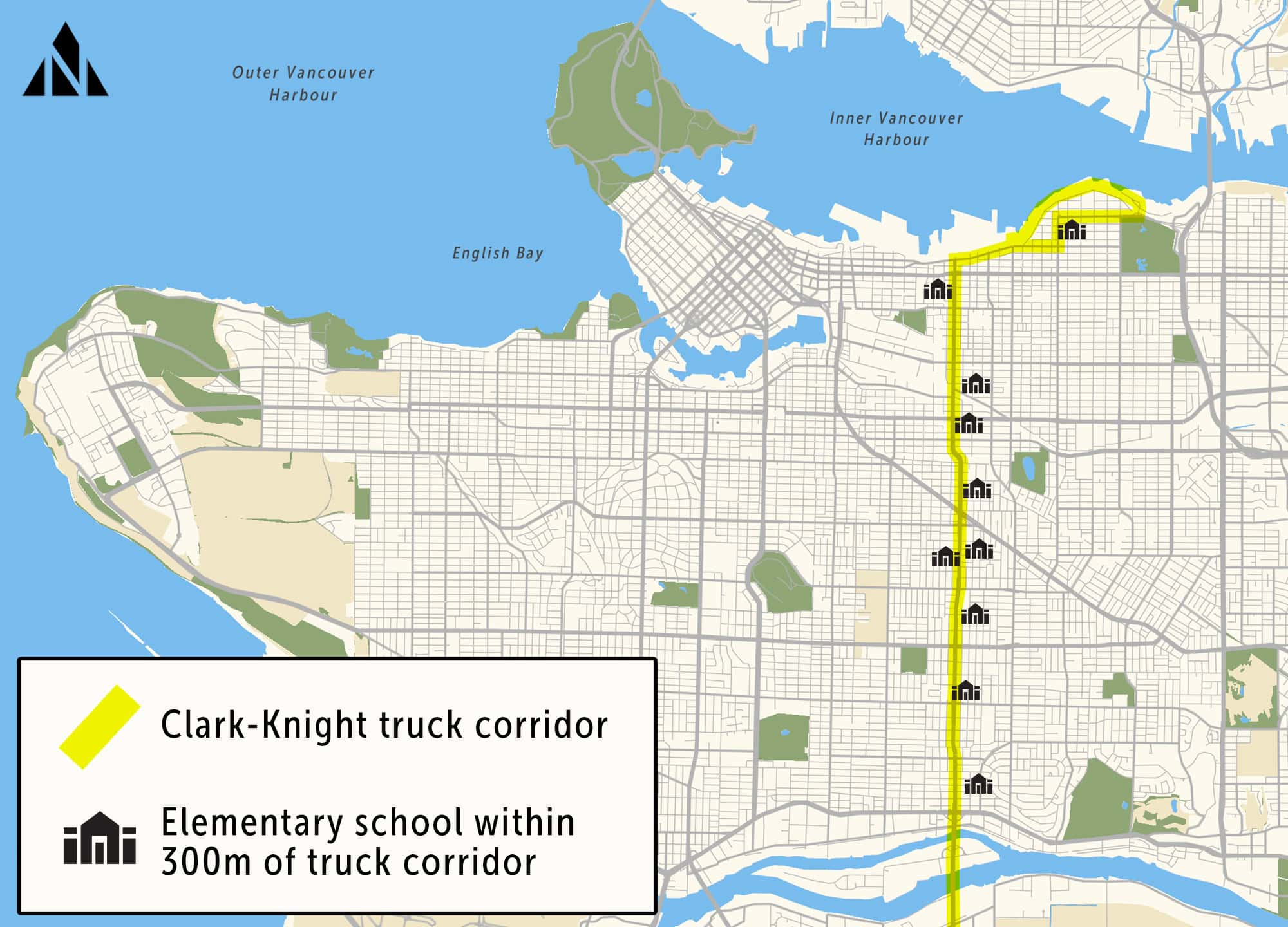
Ten elementary schools are located within 300 metres of the Clark-Knight corridor to the Port of Vancouver. Based on enrolment data, that’s around six per cent of all children enrolled in Vancouver public elementary schools. Map: Shawn Parkinson / The Narwhal
“We are promised as citizens of Vancouver that we will have access to this beautiful clean air that’s heavily marketed to us. I constantly feel like: Who is that accessible to?” Brown-Colistro says. “It’s certainly not low-income people. It’s certainly not a lot of young families who, due to the housing crisis, are forced to live along these busy corridors. It’s certainly not school kids.”
A tangled web of regulations presents challenges for decreasing vehicle emissions
In 1992, an emissions reduction program for light-duty vehicles was implemented in B.C. AirCare required vehicles to pass regular emissions testing before it was ended in 2014. Coupled with improved vehicle technology and cleaner fuels, vehicle emissions were reduced by 89 per cent between 1992 and 2014, according to the B.C. Ministry of Environment. Overall, the air quality in the region has improved in recent decades, thanks to these policies and regulations, despite significant population growth. However, the equivalent of mandatory AirCare for heavy-duty diesel vehicles was never instated, despite a 2013 MetroVancouver report showing it could have cut their emissions by more than 76 per cent.
“Heavy-duty vehicles, especially trucks, don’t have as stringent emission standards as we’ve historically done for light-duty vehicles,” Hatzopoulou explains.
But the gap with regulations for on-road heavy-duty diesel trucks remains significant in British Columbia, and nationally too, since many of these vehicles drive across the country, crossing provincial borders. Interestingly, Metro Vancouver has managed to move the dials to clean up non-road diesel engine emissions, from construction or industrial work, significantly. The regional authority introduced regulations around the emissions of non-road diesel engines in 2012, which cut pollution from construction, industrial and commercial sites.
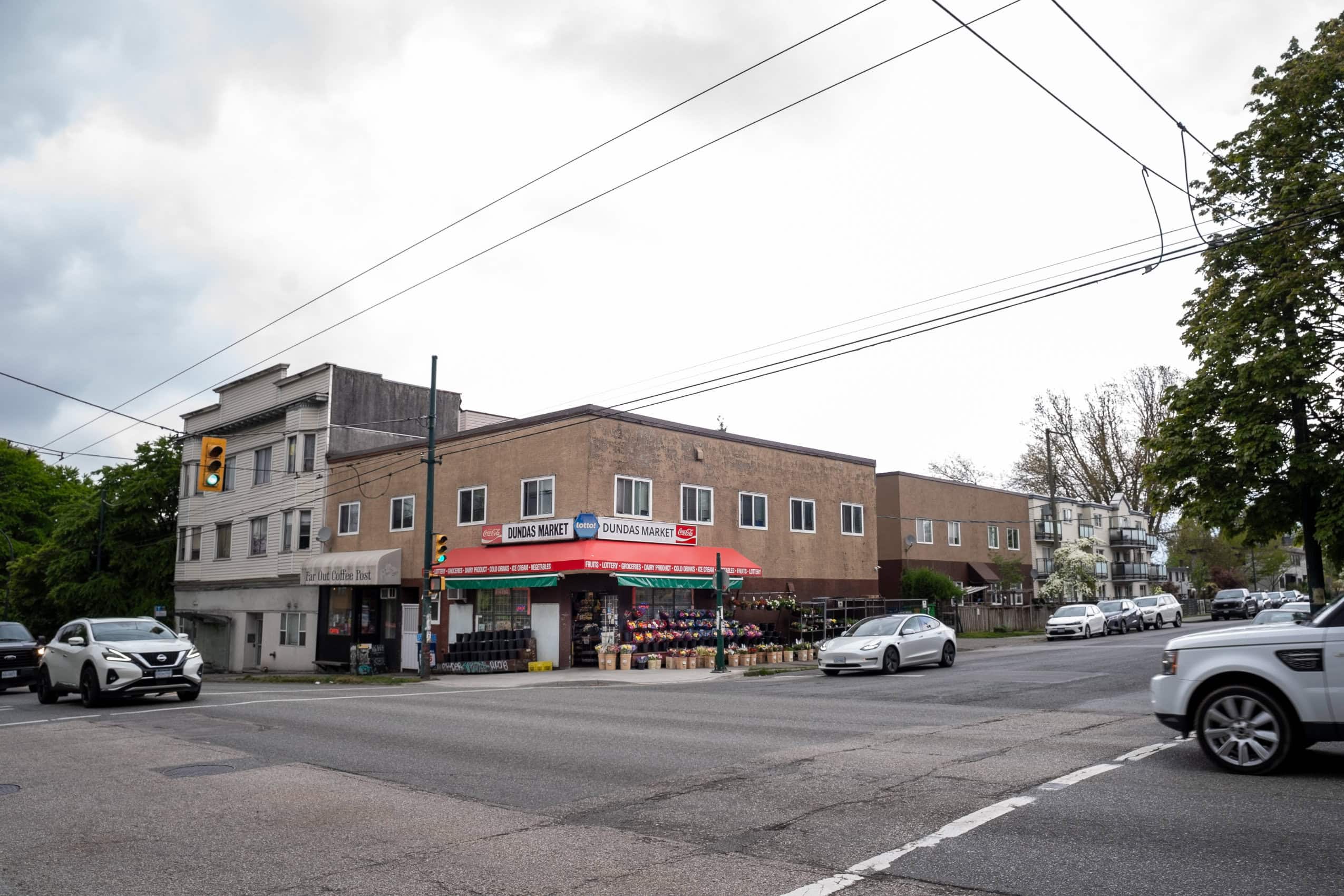
Traffic exhaust takes an invisible toll on the developing lungs of young children, with researchers worried the impact can lead to deteriorating lung capacity later in life. A 2022 analysis by Health Canada found that almost half of the country’s schools were located within 200 metres of major roads.
In 2021, the regional district further strengthened the regulations, banning older diesel engines with zero emission controls (as well as older engines that have slightly reduced emissions) from operating within 100 meters of hospitals, elementary schools, day cares or community care facilities. In explicit recognition of the public health costs of the status quo, Metro Vancouver is now phasing in higher fees for those operating more polluting engines to offset their higher health costs to the region.
Though B.C. and Metro Vancouver have tried to run mandatory emissions testing programs for heavy-duty diesel trucks, some of which are older, poorly maintained or whose emissions control systems have been tampered with after-market to burn dirtier, these efforts were abandoned after lobbying efforts from trucking industry groups.
Trucking in B.C. doesn’t have to be this dirty
Since 2006, the Port of Los Angeles, the largest and busiest port on the continent, has implemented policies to reduce emissions and pollutants. Their investments and policies include a US$10 tariff per 20-foot container, excepting zero-emissions trucks, which is used to fund clean truck deployment. As of May 2025, 546 zero-emissions trucks operate at the Port of Los Angeles and the Port of Long Beach, most of which were bought with vouchers collected through the tariff or similar incentives. Since 2005, the Los Angeles port’s diesel particulate matter and nitrogen oxides emissions have been cut by 92 and 77 per cent, respectively.
In fact, all over the world, federal jurisdictions are actively tackling the problem of heavy-duty diesel truck emissions. Germany has built a one-kilometre section of its Bavarian Autobahn to wirelessly charge e-trucks as they transit the inductive roadway. Sweden now requires older vehicles to be retrofitted for pollution reduction before they can drive in the country’s designated low emission zones. The health benefits of these “clean air zones,” which restrict access for for vehicles that do not meet emissions standards, are significant. One study tracking several thousand elementary school-aged children in London, England documented improvements in children’s lung growth and health following the introduction of London’s “ultra low emission zone,” which led to 22 per cent reduction of nitrogen dioxide exposure in children over five years years. “That complacency … I would say it’s just in Canada,” Hatzopoulou says.
In Vancouver, that complacency is hard to change. The Port of Vancouver was going to implement a Rolling Truck Age program that banned the oldest, most polluting trucks from accessing the port, however the program was postponed three times before being abandoned altogether, following opposition from truckers. By email, the Port of Vancouver said any new trucks applying for port access are required to be 2018 models or newer. However, drivers with trucks older than 2018 models who have already been approved can renew their access.
As a result, of the fleet of 1,700 container trucks that are licensed to access the port, more than half are older than 2018 models (and just under 10 per cent are 2007 models or older, the worst polluters), according to the port. By email, the port told The Narwhal it “does not have enforcement authority or capability for container truck inspections.” And as the port points out, its container trucks are not the only heavy-duty diesel engines on Vancouver’s roads. Any regulation or enforcement has to come from the federal or provincial level to meaningfully transform the roads.
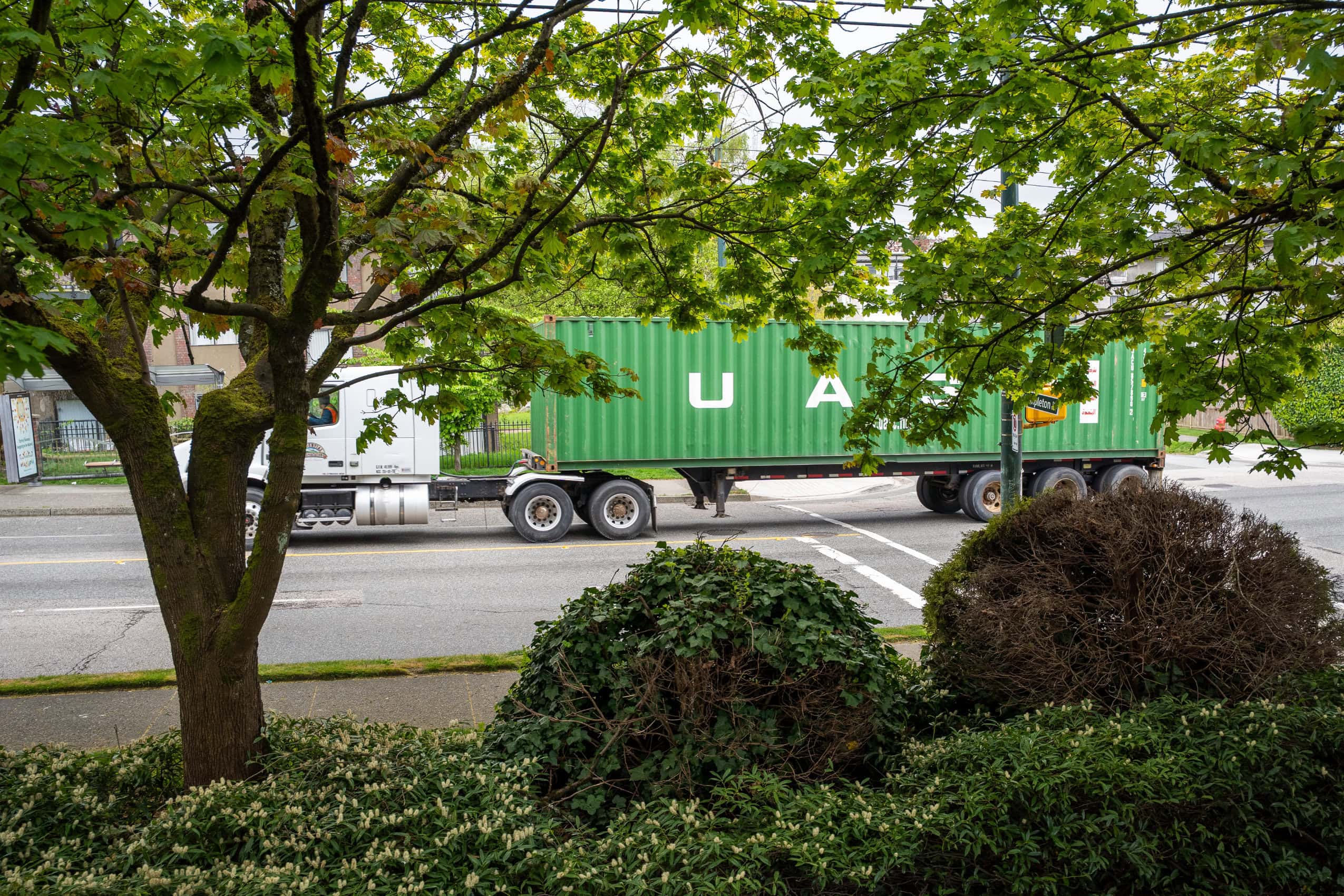
Across the world, federal jurisdictions are tackling the problem of heavy-duty diesel truck emissions, but Canada is falling behind. Older, more polluting trucks are still allowed on the road: of the 1,700 container trucks that are licensed to access Vancouver’s port, more than half are older models.
On one hand, getting the oldest, most polluting trucks off the Clark-Knight corridor should be low-hanging fruit for public health and transportation policy. But Dave Earle, president and CEO of the BC Trucking Association, says, “It is white hot politically.” Despite the dirtiest-running trucks — from 2007 and earlier — comprising a small minority of the port’s truck fleet, they are “driven by a couple of hundred extremely vocal, very, very politically active and well-connected folks,” Earle says. Yet the public health burden posed by this small minority of older trucks is outsized. A study led by McGill researchers and published this July concluded that removing pre-2007 heavy duty vehicles in Toronto and Montreal would prevent more than 3,300 premature deaths a year.
The current costs of electric heavy-duty trucks, after government rebates, is still around twice as much as a diesel truck. In June 2026, HTEC opened Canada’s first high-pressure hydrogen refuelling station for heavy-duty trucks on Tsawwassen First Nation industrial lands, 45 minutes south of the Port of Vancouver, but hydrogen-powered vehicles currently cost two to four times as much as a diesel model. Smaller but more accessible improvements could be made by replacing pre-2007 trucks with newer diesel models that run 10 to 20 per cent more efficiently, says Earle: “The quicker we can get the old stuff off the road and the new stuff on, the better off we’re going to be.” Running container trucks on natural gas, which reduces greenhouse gas emissions by upwards of 30 per cent and nearly eliminates particulates in exhaust, should also be explored, he adds. There are other changes he thinks the industry could make: tires that improve fuel efficiency, or retrofitting auxiliary power units so to reduce emissions while trucks are idling. (The province did offer rebates for trucks to retrofit their auxiliary power units, but the program’s funding was cut in 2024).
But absent any changes to regulations and policy incentives, the problem is only going to get worse as trade disruptions with the U.S. hike the number of overseas trade coming in and out of Vancouver’s port. Last year, the equivalent of 3.7 million 20-foot-long shipping containers moved through the port’s four container terminals, two of which are located in Vancouver — a nine per cent increase from the previous year. Though the port is now running six all-electric trucks — part of a $3-million pilot project with Transport Canada and the province — this is just a drop in the bucket for Brown-Colistro and her neighbours, who see more than 2,000 container trucks and 6,000 heavy-duty vehicles pass by their homes each week.
In the absence of leadership from government or jurisdictional authorities, there are signs of progress in the transportation industry. R.R. Plett in Langley, for example, operates eight electric trucks in their drayage fleet, one of few operators in Western Canada to have zero-emission heavy-duty trucks on the roads. Edison Motors has just received approval to manufacture class-8 diesel-electric hybrid trucks at its manufacturing facility in Donald, B.C., and is securing funding to do so. The Vancouver International Airport is exploring how it can use zero-emission electric barges to reduce congestion on Vancouver’s roads, innovating an air-to-marine model of cargo movement that circumvents the dirty heavy-duty vehicles altogether in favour of short-sea shipping over local waterways.
“I just see a real desperation amongst my neighbors and the people I talk to,” says Brown-Colistro. “We’ve been knocking on proverbial doors and we get promises, but we don’t get solutions that are enacted.”
In 1971 a group of 25 mothers in East Vancouver blockaded the railroad cutting through their neighbourhood to protest the danger to children who had to cross the tracks on their way to and from school. Their efforts were successful in spurring the city to finally build a pedestrian overpass. While the truckers’ threats of job action have moved the needle among decision makers to protect the status quo, despite the disproportionate health costs to children, a modern echo of the ‘70s Militant Mothers of Raymur looks more necessary all the time. “Everybody is dragging their feet so much about it,” Davis, the fellow neighbourhood mother, says. “At a certain point … do we have to do civil unrest or something? Do we have to block traffic to get noticed?”
The Narwhal’s reporters are telling environment stories you won’t read about anywhere else. Stay in the loop by signing up for our free weekly dose of independent journalism.
From The Narwhal | News on Climate Change, Environmental Issues in Canada via This RSS Feed.