

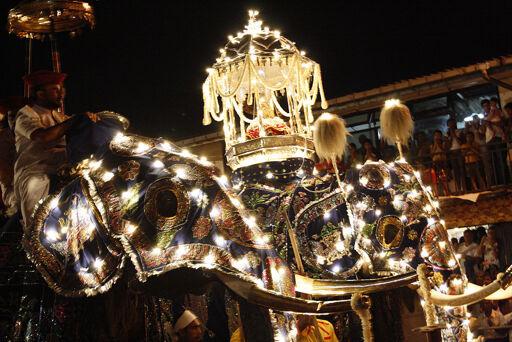
KANDY, Sri Lanka – The famous Kandy Esala Perahera procession is one of Sri Lanka’s most vibrant religious-cultural celebrations, which transforms the hill capital into a spectacle of color, music, dance and caparisoned elephants to honor the tooth relic of the Buddha. But as the country prepared for this year’s Esala Perahera, which started on Aug. 18, politicians, Buddhist monks, veterinarians, lawyers and animal welfare advocates are busy debating the future of the country’s captive elephants. At the center of the controversy is Sri Lanka’s long-awaited Animal Welfare Bill, a draft law that has spent nearly two decades in legal limbo before finally getting the green light from the government in July. Opponents to the bill argue that if it becomes law, it could effectively prohibit the chaining of elephants, making their use in religious processions difficult and threatening the continuation of centuries-old Buddhist ceremonial traditions. Animal welfare groups counter that the bill has been misunderstood: It does not explicitly ban chains but seeks to prevent cruelty to animals and improve standards of care. Opposition to the bill “The animal welfare bill has a lot of ambiguities, and we fear that it could negatively restrict the use of elephants in major cultural events,” said Ashoka Dangolla, a veterinarian at the University of Peradeniya who has been involved in caring for the elephants of the Kandy Perahera for more than two decades. As elephants are wild animals, owners often justify chaining as necessary to restrain the elephants. Image by Dominik Stahl…This article was originally published on Mongabay
From Conservation news via This RSS Feed.