

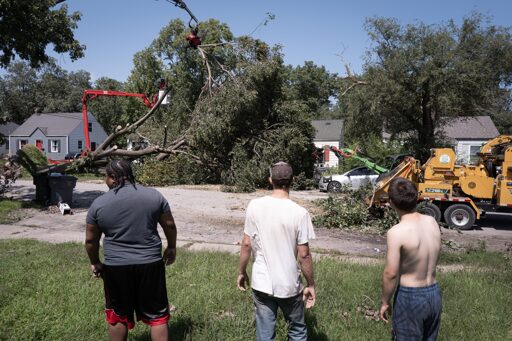
After a deadly “derecho” storm and flash floods slammed the midwest in early August, downing trees and power lines, tens of thousands of residents in and around Gary, Indiana have been surviving without power for 12 days and counting. According to the Associated Press, “Northern Indiana Public Service Co. said 68,000 customers were still without power as of Thursday morning, the majority of them in Lake County beside the Illinois border. The utility said it has restored power to 306,500 others since Aug. 11. But power is not expected to be fully restored until Tuesday [Aug. 25] in some places, including Gary.” In this urgent episode of Working People, we speak with a panel of residents and community leaders about the ongoing blackout in Gary and the conditions that led to this avoidable national tragedy. Panelists include: GlenEva Dunham, president of the Gary Teachers Union, AFT Local 4; Freida Graves, Project Director at the faith-based nonprofit Families Anchored in Total Harmony (FAITH) CDC; and Reverend John Jackson, Pastor of Trinity United Church of Christ.
Additional links/info:
- FAITH CDC website and Facebook page
- Gary Advocates for Responsible Development (GARD) Facebook page
- Tilly Robinson, Indianapolis Star, “Braun tells NIPSCO to move faster in Gary, while clergy says state must do more”
- Javonte Anderson, Capital B Gary, “I grew up in Gary. I’ve never seen a power outage like this”
- Belly of the Beast, “US policy causes Cuba’s blackouts. US citizens bring solar panels for pregnant women”
Featured Music:
- Jules Taylor, Working People Theme Song
Credits:
- Audio Post-Production: Jules Taylor
Transcript
The following is a rushed transcript and may contain errors. It will be updated.
Maximillian Alvarez:
Alright. Welcome everyone to Working People, a podcast about the lives, jobs, dreams, and struggles of the working class today. My name is Maximillian Alvarez, and today we are in Gary, Indiana with an urgent update on the ongoing nightmare tens of thousands of residents are living through after having to survive 10 days without power as of this recording. And we’re recording on Saturday, August 22nd. So yesterday, the Associated Press reported this. “In Gary, Indiana, schools remain closed after the deadly August 11th storm down trees and power lines. Residents turned to social media to find open laundromats and working wifi while others sought food, diapers, and cleaning wipes for low income neighbors. Meanwhile, heavy rains in central Ohio brought flash flooding that covered roadways Thursday morning in Columbus, the state capitol, where emergency crews rescued motorists from stranded cars and saved a 12-year-old boy who was swept off a bridge.
Northern Indiana public service companies said that 68,000 customers were still without power as of Thursday morning, the majority of them in Lake County besides the Illinois border. The utility said it has restored power to 306,500 others since August 11th, but power is not expected to be fully restored until Tuesday in some places, including Gary. Like Baltimore, Gary is a majority Black town that has been through and is going through a lot. And it is frankly a national disgrace and a moral outrage that it isn’t a bigger news story and a national emergency that an entire chunk of the country and tens of thousands of our neighbors have just been living in darkness for 10 days and counting. And the stories that I’ve been seeing and hearing from working people in Gary are so strikingly and unbearably similar to the stories that I’ve been seeing and hearing from working people in Cuba who are being strangled by the oil blockade imposed by our own government.
It is all just devastating and horrifying and it’s unacceptable. And working people are being crushed and abandoned and they need help. And people in and around Gary, Indiana need help right now. And I’m really grateful to be joined today by three guests who are going to help us understand what is happening, what is and isn’t being done, and what you can do to help. Please introduce yourselves to our listeners and tell them what is happening, what you are seeing around you, what you and your community need, and what they can do to help.
Freida Graves:
Hi, good afternoon. My name is Freida Graves. I’m a lifelong resident of Gary, Indiana. I am director of Food as Medicine for Faith CDC and a member of Progressive Community Church. What I see going on and what I feel went on, this is unprecedented. We’ve never had this kind of damage from the derecho tornado that hit, the land-based tornado that hit. For my prospect, there are certainly things that could have been done to prepare ourselves for this kind of weather event that we felt was coming. For our part, our church is solar. So at our point, we knew that at some point, and we have a solar backup battery. We’ve been fearing that for 10 years because we knew at some point as the weather changed, the weather events were going to get worse and worse. And we’d been speaking about this for years, probably to deaf ears, but some people pay attention to the environmental people pay attention, but the people that need to pay attention and make some changes could have previously done so had they listened.
But right now, I’m not saying we’re the end all be all, but I am saying that there’s some things that we could have done to prepare ourselves a little bit better. Now, as for the second part with the trees down and the poles down, I definitely think NIPSCO could have did a better job over the years of maintaining some of that. Some of this could have been avoided with some maintenance and paying attention. Gary was named Tree City several times. So to let you know how many trees we have and how many old trees and how many trees that are native and not native. I do think that some of this could have been possibly avoided had NYPSCO over the years, maintained it and kept up with what was going on, cutting down the trees that need to be cut down and maintaining the wires and the base.
So I’m not going to say total blame is with NIPSCO because it’s a lot of things that Gary sometimes gets ignored on certain things. But I do think with my mindset, they could have absolutely done a better job and we probably would not be in a position. We might’ve had some outages, but not to the point we have now. My power’s not on after 11 or 12 days. And everybody can afford generators. And we have senior buildings where today our church for two days has been passing out water and household supplies and all these kind of things like that for people that are coming down. Yesterday we did over a thousand people. Today I sent $500 worth of stuff to senior buildings. That’s just one senior building that has no air conditioning, no power, and the people are suffering. So from my point, I think things could have been done better on NIPSCO.
And I think for the mayor and administration, yes, they’re trying to get out there and work, but he can’t do it alone. It has to be NIPSCO. It has to be downstate. It has to be all these things that are regulated and made to be better. So I’ve been trying to keep positive. That’s why we’re doing the giveaways. That’s why we’re doing everything we did. Yesterday was 12 hours today. I’ve been out here 10 hours doing giveaways and sending them to seniors apartments. So because all of us are coming together here, churches, faith-based organizations, people are coming together. That’s what’s made everything better. That’s why we kept maintaining our positive spirit because people are coming together and moving together and working together. Thank you pastor for letting me go. And thank you, Ms. GlenEva, for letting me go. I’m going to have to go back outside, but things definitely could have been done better if they had maintained these trees and poles and all these things.
And I thank you for that. Let me be on the show and everyone have a blessed
GlenEva Dunham:
Day. All right, I’m GlenEva Dunham, president of Gary Teachers Union, AFT Local Number four, also president of State Federation of AFT in Indiana. When the tornado or the storm came on the August 11th, we were in school. And so our whole focus was trying to get the children out safely, and we were successful in that, and that was great. All of our schools, we have 10 buildings. They have been down with power. Right now, six of our schools do have power. So we plan on going back into the buildings on Monday, but no students. Four of our buildings will go into our career center and they will just do some professional development and just getting ourselves together before we bring the students in. So what I’m finding about the whole situation, so School City has been feeding the children. We’ve been having drive through lunches every day since school has been out, and that’s been a great thing to make sure they’re fed.
The city opened up the YWCA where a lot of our children have been going, and that has been a 24-hour service. And a lot of our teachers have been to the YWCA and have found some of their students and able to give them work as well. And so that’s been the focal point. Mayor Melton, we’re good friends. We worked together when he was a senator, getting our schools back. Our schools were taken over by the state. And so he’s been working really, really hard. Social media has really been hard on him, but he’s really been working really, really hard. And so I’m proud of the administration. I’m proud of our city. I’ve been driving around. I’ve been here at Gary all my life. I’ve worked all over because I’ve worked in many schools. I’ve been teaching 48 years, and I’ve really seen the devastation. I’ve never seen anything like it.
As far as the comparison with the neighboring communities, are they getting their service sooner than us? It looks like they are, but I know that Gary has more square footage than any of our regional cities, East Chicago, Hammond. Matter of fact, I’m the state fair president. I have 27 locals and 10 of my locals are right here. Lake Station, Porter County, East Chicago, Hammond, Whiting, Griffin, all of those are my locals. So I’ve been in touch with all of them. And also, there was devastation on the south end of our state, which is not really included, but me being a State Fair president, they had a lot of flooding down there. So they didn’t get it like we got it, but they got it pretty bad. But I’m proud of the city. I’m proud of, like Frida said, people coming together. Now that the folks have got a word about it, people are coming from all over the country and helping us.
And so sometimes bad things happen, but in bad things, good things can come out of that. And that’s what I’m seeing, and that’s what I’m hoping. And I’m praying that we all get our power on. I mean, 10 days for us was hard. We did have a generator, but still when the lights came on, Reverend Jackson, I though I was in heaven. It was so bright. I was so happy. So I’m saying I’m a positive person. And so it’s been a lot of back and forth about on social media, should you be positive? Can you express your feelings? Can you say what you think about the administration or whatever? But at the end of the day, we’re going to get through this because I lean on big shoulders. I always go back to my ancestry. Our ancestors, they went through a lot of stuff. And so we have to go back and think about how did they get over?
And we also have to put God in the picture. We can’t just leave God out and think that he’s forgot all about Gary Indiana because I’ll never believe that. So I believe that we’re going to get through this. I’m praying that it won’t be Tuesday because if it’s Tuesday, a lot of people will lose all hope because that’s just too, too long. The mayor was kind of a positive this morning saying that he hope he got the message through on the front page of the Post Tribune, our daily paper. Bron, the governor was on the headlines pushing NIPSCO to do better. And so like I say, I’m seeing a lot of trucks, so I’m just hoping that we’ll get our power before Tuesday.
Rev. John Jackson:
I’m John Jackson and I pastor the Trinity UCC congregation in the great city of Gary, Indiana. I also write a column in the Gary Crusader spiritual column that connects spirituality. I try to show the merging of the secular and the sacred in those columns. And I’m framing this this way as kind of a Katrina 2.0. Gary and Northwest Indiana, from my vantage point, are experiencing a Katrina moment. And as we know, the hurricane that hit in 2005, it did massive destruction. But what it really did in addition to that was pull the covers off, as I think Gleneva was saying, pull the covers off of the lack of maintenance in New Orleans for the levees. As the levees broke, it showed that in the working people’s area of Black, brown and poor whites, what they had been dealing with all along. And so it pulled the covers off of the same thing I see happening here in Gary, Indiana and Northwest Indiana.
Bulgaria, Indiana in particular because it is an older city, if not the oldest city. And as Friday said, it’s a lot of space, a lot of area. And as Gleneba pointed out, there’s a lot of trees. And what it showed is that the maintenance on the trees really had not been done. And so NPSCO has not been faithful in doing the maintenance, which it would have lessened the effect of trees falling on wires and then power outages. And so that’s one issue. But then it opens up the other issue of the rate hike. NPSCO just got a rate hike. And so when you look at that, and now you’ll hear some of the executives talking about how much money it costs for this, how much money it costs for that, well, those things don’t line up together. Then you put in, and I’m staying on the area of rates right now, because there is this legislation called Construction Work in Progress.
And what that legislation allows NIPSCO to do is bill customers for work they plan to do in the future. So that’s part of our bill. And I don’t understand how you bill somebody for something that you’re not doing right now. I don’t understand how that goes. The other part is that if a tree falls on the wire and the wire connected to your house pulls your meter out, my understanding is that the resident has to hire an electrician to affix and get that meter back. Then NPSCO comes out, connects to power.
There’s some disconnect here, there’s some problem here. And with that, in this time, there are not all electricians, but there are some that see the opportunity to gouge people. So there’s a need for electrical engineers and electricians who are honest and who will take care of that. And in fact, it’s really NPSCO’s responsibility, in my humble opinion. I was in a meeting that Good Mayor Melton had called on Thursday with a couple of NIPSCO executives, the president of NIPSCO, and I think the vice president or something of night source. And so he had leaders in the community, political leaders, religious leaders, grassroots persons, civic organizations were in the room. And so one of the things that was said by the NIPSCO executives is that they’re not coming on your property to trim the tree. And my thought was, “Well, if I give you permission to do that, you should be doing that ahead of time.
But when the tree falls on the wire, you got to come in there anyway.” So these things have exacerbated this moment where you have people who have been sitting. My church is still without power. People have been sitting in hot homes and apartments for 11 days now. And when the first estimates of restoration came out, Gary wasn’t on the list. Now, this is in conjunction with a tornado that came through in June that did massive destruction and a lot of the same things were happening that we’re experiencing now. So there are people that have been recovering from that. And then you have this now and this extended delay in restoring power. I know that ComEd in Illinois has more people, but still, I don’t understand why Gary is always last on the list to get restored. So after the meeting Thursday that Mayor Melton had called with the executive, then they said that very night we’re going to put a new list of days and times for power to get back on.
Once again, Gary last on the list with the prospect of being restored on Tuesday. Why does Gary always have to take the backseat for other areas? And knowing that it’s an older city and the infrastructure needs restored, how come the infrastructure was not taken care of five years ago? Three years ago? How come they haven’t been working all day? These are questions that I’m just relating questions that persons in my own congregation are raising. And then again, people have lost food. And so we do a lot of food giveaways. So as best we can without power, we’ll get food and we have to give it away right away. But people without food and without just the ability to have decency and hygiene, everybody’s not able to have generators. And those that have generators has spent close to a fortune in getting gas for it in 11 days.
And so what compensation will NIPSCO offer? Here’s another question I’m getting from a congregation. So for 11 days, there’s been no power. Why do we got to pay a bill? Why isn’t a moratorium on paying a bill for the next month or two? Because the objective in a transaction is that if I pay my money, then I’m going to get the goods or the service in return. Now, if I pay my money and I don’t get those goods and services, then I’m expecting that there’s going to be some compensation that will help reduce the difficulty that I’ve been placed in because you don’t have the ability to provide what I’m paying for. So these are questions that I’m just fueling for my congregation with what happened in June and then now and this extended thing and all of the excuses that we have now. It was a massive storm.
It was unprecedented. But as I think GlenEva pointed out, we’ve known for years now that the tornado alley has been shifting because of climate change. That means I know the executive of NIPSCO have been apprised of that too. So therefore there is been opportunity to beef up the infrastructure that can help reduce the level of challenge that people are facing.
Maximillian Alvarez:
And I appreciate y’all so much for laying that out for me and our listeners, all of us. It’s really helpful information, even if it’s hard to hear. You’re right. It’s like the echoes of Katrina are just so loud and like Katrina and not just Katrina. I mean, I’ve been going around to places all over this country where working people are experiencing toxic explosions, constant pollution, or huge blackouts like this, or they’re being locked out of their jobs at poisonous facilities. I was just interviewing the BP workers over in Whiting who have been locked out of their jobs for five months. And for listeners, we’re talking about the same area that’s all right around the same area. And so I wanted to hook that into a question. Pastor Jackson, you were laying out the conditions that set Gary up for failure. The conditions that weren’t addressed by the company to mitigate the vulnerabilities that were there in case a major storm hit and certainly prepared for an emergency if this many people are without power.
How the hell are they going to get help? How are we going to reimburse them for the costs and how are we going to make this right? That’s a question that I think is on everyone’s mind right now. But I wanted to hook that into the conditions of Gary itself and life for working people in Gary as well. I wanted to ask if you guys could say, because Gleneva, you’re president of the teacher’s union, and we interview working people in education and all over the place, including BP oil workers in Whiting, Indiana, because we just talk to people about their lives, their jobs. And what we hear from folks is life’s getting harder. We’re working longer for less. Schools are more packed or they’re under-resourced. So that also makes our communities vulnerable to these kinds of catastrophes. I mean that also amplifies the burden that poor and working people have to bear in an economy that’s already asking them to bear too much.
And so I wanted to ask if you could just also help listeners understand what working people in and around Gary have been going through up until this as well. Are they making enough money? Is the air safe to breathe? How are people doing before a catastrophe like this hits?
GlenEva Dunham:
We have to remember, we go back about maybe about two months ago, NISCO was on strike. And I don’t know if you know that, Mr. Alvarez, that they were on strike. I was on the picket line with them and it was for working conditions. And I believe some years ago they did lay off 200 linemen. And so they’re working short-staffed. I sit on the board of the AFL CIO and one of my brothers, he just retired 35 years with NISCO. So he came on Facebook and did a diagram of how the process goes, how the trees and all of this. And then I want to say a couple of things about what Reverend Jackson said. So Mayor Milton did say that the governor, I did get a copy of his declaration because my whole thing was getting my teachers and my paraprofessionals paid. Although we didn’t work, we have in our contract, if it’s anything beyond our control, we get paid.
So that’s part of our working conditions. But there’s a $5,000 per household from the government if you can produce receipts, which is going to be hard because my husband’s been getting gas every night, but the gas stations haven’t had receipts. So that’s going to be hard from your food, if you have receipts from food that you threw away also. And we also have a foundation called the Legacy Foundation where they’re going to help with those monitors or meters that Reverend Jackson is talking about too. So I’m just trying to say there aren’t things working in our favor as far as things that’s not working in our favor. So working conditions, I mean schools, Gary schools were taking over for five years. We just got our schools back last year. This is the second year we’ve been out of state takeover. Then Mayor Melton was Senator Melton, and he was very instrumental in getting our school corporations back.
And it was all about money, but then that’s all about the state. I’m a State Federation president as well. The formula for funding, public education is like trash. Indiana has a, what, $4 billion surplus. And so always people talk about Indiana, I always just say, “Hey, Mike Pitce was our governor.” So it’s always about them being conservative, fiscal, so they can get on Trump’s bandwagon. Bron is, I call him baby Trump. So we’re not getting services. He just passed a law where his children won’t get fed next summer in summer programs, didn’t get fed this summer. When churches have their programs, they usually can rely on the government to bring in lunches. So all of that has been snatched away from us. So yeah, all of that. Big government, NPSCO, people talk about the monopoly. People have said we need another company. NPSCO has been around since I’ve been born, so I don’t even know how that works.
I know it’s all about big money, money talks. But working conditions, like I said, NPSCO was on the picket line. They went back in, their clericals stayed out because they didn’t get. But from my understanding, they really didn’t get what they were out there about, but they just came on back in. Well, BP Amico, theirs was much different. They’re trying to take insurance, everything. They’re trying to strip them and still, still trying to. So they had a bigger fight. So that’s a picture of economics and education. And Gary is always just, people look down on us. I thought Richard Hatcher was the greatest mayor ever, but if you listen to people talk, the detriment to our city started with him. But then it was about the black and white thing. We had the big convention here, the Black convention in West Side, and that’s when we gave the platform for Black America to go forth.
And a lot of people got elected after that. And so that’s on Gary. And then we had the great white flight. I was part of the integration movement. I lived in the projects, was bused to Glen Park, which is our white part of town back in the day where they thought that was better for us. So I mean, it’s a lot of history in Gary about why we are where we are. But I like to think about in the moment. In the moment, I sit on the Redevelopment Commission now appointed by the mayor. I finished one term. We have a lot going on. I hate this happened, but I just see it as a bigger picture. We have Glenn Robinson, one of our NBA players, he just donated $100,000. He did not cancel the Jackson weekend. So I’m sure they’re coming in town. I mean, we had the premier of that movie here.
So that second generation of Jacksons are friends with our mayor. So I can’t, being a union leader, I have to look at it on a positive because I deal with kids. I taught kindergarten for 31 years, so you have to be positive. And so that’s where I am. And I get it. I know the history of Gary. I know Hurricane Katrina. I saw all of that. But still where I sit, I have to think that better days are coming. We’re going to get through this because I’ve never seen what I’ve seen. I’ve never seen all these people coming together. A 18-wheeler truck out of Tree of Life. My husband just left from over there and people on Facebook saying what they got, Pampers and all that. I mean, lay people, a lot of my teachers who got little organizations, nonprofits, they’re meeting on corners, giving out supplies.
I just think it’s going to get better. I see in my own neighborhood, my husband is 80. I see the young man, they helped him pull his choke on his generator. They helped him get his generator fixed. So I’m seeing that in our communities and our communities have always come together in hard times. And I’ve seen it year after year after year. And so that’s what I’m relying on. Yeah, we got to get to the core of what happened. I believe Eddie, he reached across the aisles. He knows how to work with the people across the aisles. That’s how we got things that we’re getting now. That’s how we got all this money for demolition of the blight. Things are going down, things are coming up. So he’s a smart man. And so I put my money on him any day. No matter what anybody says, I know his heart, I know his spirit.
I know like attracts like people coming to our city because tomorrow Jamal Bryant will be here from Atlanta. My son is talking about the Keith B or whoever his name is. I don’t know him, but my son is 33 and that’s exciting. The young folks, the other young folks want to come and do stuff for us. And so I’m looking at it like that. I’m passionate about all of this, but I was out with power for 11 days too. And so I had no ideas. And I got senior citizens, I got retired teachers who I’m looking at. I’m like, how much more can they take? And so I’m glad Reverend Jackson was in on that meeting. I know my superintendent was there, and I know they put a word down in ISCO. And I’m just, like I said, 20 new trucks in our neighborhood. So I don’t know if I answered the question, but there you go.
Rev. John Jackson:
Yeah. GlenEva really set the stage when she went over the challenges Gary has had. Another framing point I tend to use is historically, Gary is similar to what happened in Haiti. When Haiti in 1804 was the first nation to liberate itself from oppression and servitude to France, it sent shock waves throughout the hemisphere. And after that, France, America, Britain has been punishing Haiti ever since, to the point of even forcing Haiti to pay restitution and reparations to have the unmitigated gall to declare that they’re human beings and would not be subjugated. But the people in Haiti are resilient people. They are a positive people. They are hopeful people, which is why they have been able to endure some horrific conditions that have been forced upon them. Like you mentioned And Cuba and how Cuba’s being strangled by this country as we speak. And so Gary has been under attack ever since.
It had the unmitigated gall to declare that Black folk know how to run stuff too and elected Mayor Richard Gordon Hatcher. And so that is when the vicious attack came from downstate in Indiana and then from after the Carter administration, then from the national government. And so the resilient and prideful and strong people of Gary have been enduring this for all of these years. So that’s part of the backdrop of it.
The federal dollars and all of the corporate dollars have not flowed in over the years. So people have had to use gum and duck and everything to put things together and have done a pretty admirable job. But the fact of the matter is we pay taxes and those taxes are supposed to go to making sure that working class people, poor people can have life with dignity. And so one of the other challenges that has been already lifted up is there has been not enough attention to Gary in this moment. This is an incredible moment in the sense that an unprecedented storm comes through and does massive damage and you don’t have national news. Now, Gleneva mentioned that Pastor Jamal Bryant is coming and then there are a lot of social media folk that are moving and using their resources. I’m getting calls from all over Chicago and whatnot because I work with an organization that’s a social justice organization, the Samuel DeWitt Proctor Conference.
And so there’s mobilization among people, grassroots organizations, everyday people, residents, helping their neighbors get through, cutting down trees so that they can get it off of people’s cars and help folk get the trees off their houses as much as possible, getting the streets clear as much as possible. Of course, folk do this in crisis because of their resiliency and their strength and their love for living and humanity. But the fact of the matter is we shouldn’t have to bear this burden like this. We shouldn’t have to bear the neglect that has happened. It’s not just NIPSCO. It is broader than that. And the line workers for NYPSCO, the people that are going out, getting on the poles and all of that, these people are working hard. They’re working. So it’s not about them. It’s about the institution itself. Because what we’re talking about is institutional.
You were talking about predatory capitalism, these things. So that’s why from this spiritual as a pastor vantage point, I see my faith and as a follower of Jesus Christ who also was a community organizer against the empire of Rome so that he could create an alternative community against the predatory nature of the Roman Empire, which had created society of oppression for people extracting from them profit and not caring about people. And so this is where the vantage point that I come from and therein is the hope because people are going to resist. People are going to build. People are going to help each other get together. But my focus is, okay, the lights are going to come back on. We can’t go back to business as usual. And a lot of people, all of us, you get happy when the light comes on. And again, that’s another metaphor for the light of our faith.
We get joy when the light comes back on, but the light also brings heat. And that heat then has to be applied so that we don’t get to this point again so that we can have a utility company that works better for the people. Now, I really hope that the executives have been listening and hearing the people so that they can take back the changes that need to be made. We’ll see. But we have to not allow the moment to just die down.
We got to keep pushing so that Gary can get the attention and the resources and the work that needs to be done so that again, there’s going to be another storm. It could be another storm in another few days. We are in this season of storms. Now, if things go the way they have been going, we’re going to do this again. And this is something we can’t do. It shows again, it covers all that there’s some stuff that needs to be done to strengthen. One of the executives, because the question was ask, well, how come the wires, the lines are not underground? There are places in Northwest Indiana where the lines are underground. They experience less outages than other places where the wires are on top of the ground. Well, the executive said it costs 10 times more to do that than to do what they’re doing right now.
I understand that, but NIPSCO is recording record profits. I’m going to leave it at that.
Maximillian Alvarez:
And I’m not because I’m like, they’re recording record profits and they’re saying it’s costing more to put the lines underground. And what they’re also saying is that that cost is less tolerable to us than the cost of tens of thousands of people going two weeks without power. That is what they’re saying is that costs, they could pay that cost, but they would rather working people, poor people, regular people bear that cost ourselves of their negligence. We are bearing the costs not just of their negligence, but of their profits. Those profits come in our expense. I don’t know if you could get a more clear cut example than this. Record profits for the same company while people that pay for their service are left without power for 10, 11 days and counting. So sorry, I’m just so fired up and frustrated about all of this. I was even going to say, well, we got to wrap up, but no way we can wrap up on that because I wanted to give y’all just one more chance to hop in because I appreciate you so much for your time.
I know I got to let you go, but I wanted to ask if you could just finish with any final messages you have for listeners about what they can do to help folks in Gary now and what advice you have to them about how they can put that lesson into practice Reverend Jackson spoke of, that there’s a lot of work that needs to be done to make sure that this kind of catastrophe doesn’t happen again or keep happening or keep getting worse every time the news cycle resets.
GlenEva Dunham:
I just want to say, if this is going to our Gary residents, first and foremost, we have to vote. We have to vote. Our voting record is dismal. So we have to get involved. We can’t just wait until crisis and things like that to want to come out. We have to get involved. We have to go to the meetings. We have activists like Carolyn McCrady herself who they have meetings all the time and they call the NPSCO execs to the meetings. And those meetings are not attended by the people who are in line right now. And I know sometimes it’s hard to get to meetings and stuff, but we have to become aware of what’s going on to us. So we just got to put our voice out there. That’s number one. Number two, I know the city has on their website, they have all kind of paid.
They have set up a fund. So there’s people because a lot of people are talking, a lot of people have platforms, and we are suffering. Some people are suffering and need help. And so if you can’t get to Gary, there are places where you can do donations and make sure that the donations get where they need to be. One of them is a legacy foundation that is a not-for-profit in our community.
Just continue to pray for us because I believe in the power of prayer. Tomorrow is Sunday. If you are gathering and worshiping, make sure Gary is spoken out loud, that you pray for us, that we get our power on, and that also we pray for folk like CEOs. We can’t forget them. We need to pray that their hearts are touched, that they would do a better job of the people who keep them living. Like Reverend Jackson said, we pay their salaries. And that’s where we fight all the time as a union leader. We have to tell the people we are taxpayers. These schools, that’s a whole nother thing, they belong to us. So we have to let people know that we are taxpayers and we do know how to protest. And Reverend Jackson again is good at that. His church is Afrocentric and they are a cornerstone in our community.
So we just want you to keep us in your prayers financially if you can, because it’s going to take a lot. I have a neighbor across the street who’s waiting, he has a tree in his yard, and he said that he’s in the queue. We have a 311 that you put your name in there, but I don’t think that they’re going to get his tree out his yard. I don’t think that he’s going to have to get somebody to do that. And I know financially he probably can’t. And so come to the community, get online, see some of the people who are talking, DM them, see what they need, the schools, all of us. So just offer us the assistance that you can.
Rev. John Jackson:
Frida and Gleniva, they are examples of ordinary people who just love God and who love our people and who love to be of service to people, just ordinary people who take on these roles because they want to help people’s lives be better. They are replicated by hundreds of thousands in Gary, Indiana. And so that just gives you an idea of the quality of people that we have. I forgot to mention when you asked about what has the residential Gary had to put up with. I work with a group called GUARD, Gary Advocates for Responsible Development. And just a couple of months ago, we had a town hall meeting dealing with the steel mill, US Steel that has been purchased by Nippon Steel, Japanese company. The town hall was about challenging Nippon Steel who pledged something like $4 billion when they purchased Gary as investments and challenging them to use funds to update the blast furnaces from the toxic furnaces they have to the clean steel.
Because that’s another issue in Gary because of the steel mill, because of a lot of factories and things like that, which there’s a high rate of health problems from breathing problems to cancer. It is a high rate because of this. So you’ve got this going on and now you got this going on. It is a heavyweight to carry. So one of the things that going forward, there is no Citizens Action Coalition for Gary, CAC, which help monitor to help put some accountability to NPSCO. So that’s one thing that needs to happen, that the Citizen Action Coalition would get established. And as Gleneba pointed out, prayer is always necessary because that’s the engine that drives us, that’s the connection that gives us strength because we are a believing people. But also going forward, the right attention and not always trying to find a negative and magnifying it.
Every community has negatives in it, but there has been campaigns to try to magnify a few negatives and not look at the great work and the great citizens of this great city. And so we need more persons like yourself, Brother Alvarez and others and the national attention to point out what actually is missing here. What is not being provided in this city of 60,000 plus people and the needs that they have from the schools to. And we can, as Laniba said, these are other areas that we could have a whole show on. Because again, it comes down to we are taxpayers and our taxes should be used to make sure that life is better. It should not be profit over people. It should not be price over principle. It should not be money over meeting. It should not be those things. And so from the federal government to corporations on down, we need more of the attention to point out that people are enduring and they’ve got joy, but they shouldn’t have to bear the burden alone.
That’s why we pay taxes. And voting, yes, voting is connected to these things. Voting is connected and we have to exercise. It’s one tool in the toolbox, but like a good carpenter, you use all the tools in the toolbox. So voting is important.
Maximillian Alvarez:
All right, gang, that’s going to wrap things up for us today. I want to thank all of our guests from Gary, Indiana. GlenEva Dunham, president of the Gary Teachers Union, Freida Graves, Project Director at Faith Farms, and Reverend John Jackson, Pastor of Trinity United Church of Christ. And of course, I want to thank you all for listening, and I want to thank you for caring about this. We do this work for you and we cannot do it without you. Working People is brought to you in partnership with In These Times Magazine and The Real News Network. This show is produced by the great Jules Taylor and is a proud member of the Labor Radio Podcast Network. We’ll see y’all back here next time for another episode of Working People. And in the meantime, go explore all the great work that we’re doing at the Real News Network because we do grassroots reporting that lifts up the voices and stories from the front lines of working people’s struggles around the US and across the world.
Subscribe to our YouTube channel. Check out our great podcasts like Under the Shadow and the Marc Steiner Show, and connect with us on social media and get updates on our reporting there. And please help us do more work like this by going to therealnews.com/donate and becoming a supporter now. It really, really does make a difference. I’m Maximillian Alvarez. Take care of yourselves. Take care of each other. Solidarity forever.
From The Real News Network via This RSS Feed.