

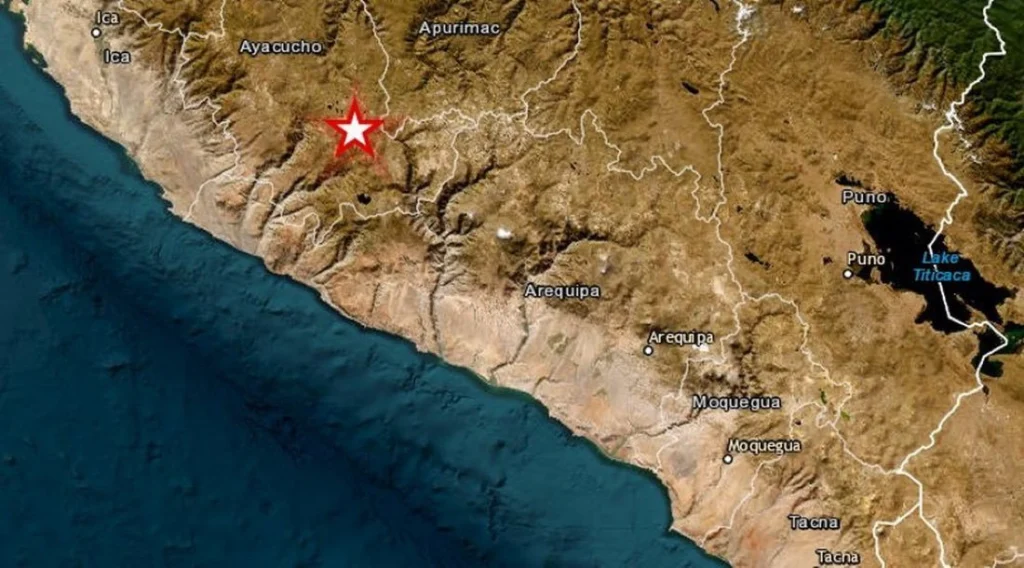
The Peruvian government declared a state of emergency this Sunday in four districts of the province of Parinacochas and one in the province of Huanca Sancos, in the southern Ayacucho region, due to the impact of last Thursday’s 7.2 magnitude earthquake that has left nearly 500 people affected and three injured.
[Recent Peru Earthquake Reopens Debate Over Disaster Response Capabilities: Peru Declares Emergency in Five Districts Affected by 7.2 Earthquake](https://www.telesurenglish.net/peru-declares-emergency-in-five-districts-affected-by-7-2-earthquake/)
The measure will be in effect for 60 days in the districts of Chumpi, Coracora, Pullo, and Upahuacho in the province of Parinacochas and the district of Carapo, in the province of Huanca Sancos, for the execution of exceptional, immediate, and necessary response and rehabilitation measures and actions, according to the supreme decree published in the official gazette El Peruano.
Last Thursday’s earthquake in Ayacucho caused damage to 83 homes, as well as to about twenty schools, health centers, public buildings, and transportation routes.
In this regard, emergency actions will be carried out by the Regional Government of Ayacucho and the local governments involved, with technical coordination and monitoring by the National Institute of Civil Defense (Indeci) and the participation of the Ministries of Health, Agrarian Development and Irrigation, Education, Housing, Construction and Sanitation, Transport and Communications, Interior, Defense, Energy and Mines, Labor and Employment Promotion, Women and Vulnerable Populations, and Development and Social Inclusion.
The norm detailed that goods considered for donation in natural disaster situations include, among others, medical material, medicines, sunscreens, vaccines, medical equipment and/or related items, insect repellents, food, beverages, clothing and warm textiles.
Also, machinery and equipment, electric generators, liquid fuels, diesel fuel, construction articles and materials, water purification treatment plants, transistor radios and batteries, UHF and VHF communication radios, plastic materials and articles, tents, awnings, and sleeping bags.
Likewise, the norm indicated that services provided free of charge include catering, medical, transportation, dispatch logistics, transfer and storage, operators, and any other service necessary to meet the needs of the affected population.
The implementation of the actions provided for in the supreme decree will be financed from the institutional budget of the entities involved, without requiring additional resources from the Public Treasury.
From teleSUR English via This RSS Feed.