

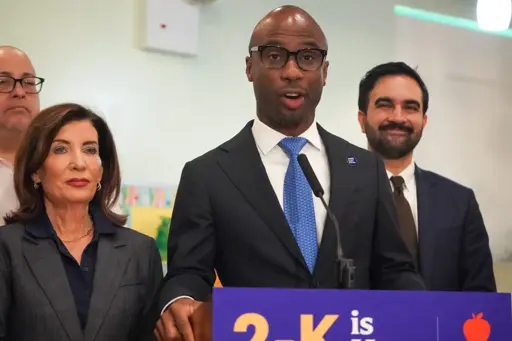
The recently released reading scores for New York City students have prompted a new round of discussion about the state of literacy in the city’s public schools just a month before the start of the new school year.
According to the results, reading proficiency fell six points citywide, with third-grade proficiency dropping by nearly 14 percentage points, even as local assessments suggest a less dramatic decline. There are many questions about the reliability of the exams themselves, sparking calls for independent audits, given that last year’s results showed big gains, and that this year was many third graders’ first time taking the state test virtually.
But beyond this particular measure, many educators, families, and students themselves are justifiably angry about a school system that leaves students struggling — from literacy and numeracy to critical thinking and emotional regulation. While these abilities are always framed in terms of “being ready for the job market,” the problem goes beyond meeting the needs of a worsening capitalist labor market. Educators know the potential that schools can have to transform students’ lives, ignite curiosity, and inspire students to not only critically interpret the world, but to change it.
Beneath the debate over testing data is a much bigger question: what does it actually mean to talk about students “falling behind” when their learning conditions are becoming increasingly dire? Schools are increasingly asked to resolve crises that extend far beyond the classroom.
Many use cultural deficiency arguments and blame parents for not reading to their children or students for not prioritizing education, or chastize public schools, teachers unions, and individual teachers themselves. Capitalists use these arguments to throw money into lobbying for charter and private schools, where non-unionized teachers are treated like education machines and students experience heavy-handed discipline and heightened levels of surveillance. Capitalist governments continue to defund public schools, and the cycle continues.
Let’s be clear: declining literacy rates is neither the fault of teachers, students, nor families. It’s the product of a neoliberal education system embedded in a society in which workers, oppressed, and young people bear the brunt of the social and economic crises produced by capitalism. And the solutions to these problems won’t be found in more neoliberal reforms or technocratic solutions offered by either capitalist party — it will be found from rank-and-file educators uniting struggles with students and families to fight for an education system the youth deserve.
Literacy Doesn’t Happen in a Vacuum
What’s much more alarming than the scores themselves are the conditions in which students are growing up.
Educators know that literacy does not occur in a vacuum. Vygotsky, a widely celebrated Bolshevik child psychologist, observed that learning is socially and historically situated. Education as a whole, and especially language acquisition, is therefore not an individual activity, but a social one. That context is consequential for youth in New York City.
The child and youth poverty rate in New York City is 27 percent, representing roughly 450,000 children living below the poverty line. Including low-income families, roughly 69 percent of all children in New York City live in households struggling to make ends meet. Roughly 1 out of every 7 public school students in New York City experienced homelessness during the 2024–25 school year.
Nationwide, youth face deep mental health issues, with approximately 20 percent of high school students reporting seriously considering attempting suicide in the prior year. There are significant disparities within these rates; girls and LGBTQ+ youth report higher levels of depression and hopelessness. Youth social isolation is a growing public health crisis, with over 20 percent of teenagers and young adults experiencing frequent loneliness, pointing to the long-lasting impacts of the pandemic and the effects of addictive technology. In this context, many youth turn to AI to fill a social void, with over 70 percent of youth having interacted with AI companions, and around 15 percent having sought emotional support from AI.
In a deeply segregated school system like New York City, we know low-income students of color deal most acutely with these struggles, as they are more likely to be in underfunded public schools with less access to resources, robust academic and extracurricular programs, and more likely to face higher teacher turnover. Not to mention the attacks on immigrant families and students, many of whom have been terrified to go to school or drop off their kids. This played out most dramatically in Minneapolis, but is happening all over the country, especially given the most recent attacks on Haitian and Syrian immigrants with the end of Temporary Protected Status for those groups.
The literacy scores also fit into a much larger story about disinvestment in public education that has been happening over the last nearly half a century of neoliberal attacks, exacerbated under Trump, who has demolished the Department of Education and advanced an “anti-woke” agenda aimed at teachers and curriculum that teach the truth about U.S. history and Palestine, that recognize and affirm LGBTQ+ students, and that encourage students to critically think about the challenges that humanity faces, like the climate crisis.
While the attacks on curriculum and libraries are uneven across the countries, with educators and students in red-states bearing the brunt of these right-wing attacks, New York City is not outside of the context of this story. For example, fewer than 15 percent of the city’s public schools have a school librarian, meaning hundreds of school libraries sit dusty and empty, used as storage spaces rather than a space for developing a culture of literacy.
Also, NYCPS, the city’s department of education, has faced budget cuts under Mamdani as part of the cuts from the mayor’s Commission on Government Efficiency. While the cuts apparently won’t impact vital services, they are part of a growing string of disappointments for educators, including his backtracking on campaign pledges to undo mayoral control, support a boost in pay for paraprofessionals, and swiftly reduce class sizes.
So, debates and policy solutions about literacy that reduce reading and writing instruction to a set of techniques and methods, as if learning were entirely individual, obscure a much deeper debate concerning the context in which learning takes place. We cannot separate literacy scores from the profound crises that young people are walking into school dealing with every day — and as educators, we are the front lines dealing with the effects of these crises.
Mandated Curriculum Is Not the Answer
Yet despite having to support students through more and more social crises, educators find ourselves increasingly deprofessionalized and in worse working conditions. A huge part of that story is around mandated curriculum.
A major part of the reading score conversation has been centered around New York City Reads, which, along with its numeracy counterpart New York City Solves, was rolled out in 2023 and expanded last year as a citywide public school initiative to improve literacy instruction by using the “science of reading,” standardizing phonics-based foundational skills and other curricula across elementary and middle school. Unfurled by former Mayor Eric Adams and continued by Mayor Zohran Mamadani and Chancellor Kamar Samuels, it replaces the decentralized model, where literacy curriculum was left to the discretion of the principal, with many schools opting for the now widely discredited Lucy Calkins’s curriculum, which de-emphasized phonics in favor of a “whole-language” approach.
But mandated curriculum doesn’t just impede New York City teachers’ academic freedom and curricular autonomy, it also doesn’t meet the needs of the city’s diverse student body whose learning cannot fit into a one-size-fits-all approach. For years, educators have been pushing back on these types of curriculums and how their uniform, standardized approach does not allow them to respond to students’ cultures and contexts. Many ask students to learn by reading isolated, out-of-context excerpts rather than sit down and understand a whole book. Plus, districts’ strict demands on “fidelity” and pacing does not allow educators to meet the learning needs of the students in front of them. These scripted curriculums go against everything we know to be solid pedagogical practices — and even contradicts the NYCPS’s so-called commitment to culturally responsive and sustaining education.
Moreover, mandated curriculum and standardized testing encourages teachers to tailor their teaching to nationally administered tests rather than engage students in the individualized, messy process of deep, holistic learning that actually results in students caring about what they learn. This is evidenced by the fact that elite, racially-segregated “specialized” schools are allowed to sidestep the mandates, showing how these curriculums do not apply to schools with better resources, higher-qualified staff, and students from wealthier socioeconomic backgrounds.
Shamefully, the United Federation of Teachers (UFT) supported this mandated curriculum initiative without the genuine input of the educators who would be responsible for executing it. Now, in light of these results, the UFT has threatened to withdraw its support for New York City Reads. In spite of this, Chancellor Samuels has indicated that NYCPS plans to stay the course on the mandated curriculum.
Moreover, the union supported the expansion of AI in schools, which is integrated into much of the New York City Reads curriculum. Last year, the American Federation of Teachers launched a $23 million initiative with major tech companies — OpenAI, Microsoft, and Anthropic — to create the National Academy for AI Instruction based out of UFT headquarters in Manhattan.
However, this excitement for AI by the UFT leadership is not necessarily shared by its base. The NYCPS’s new preliminary guidance on AI has been met with resistance from families, students, and educators who are demanding an AI moratorium because of extensive concerns about the use of the technology in schools — from its impacts on students’ cognitive development to surveillance and data privacy to environmental damage and water waste.
While apparently an attempt to solve the literacy crisis in a vacuum, mandated curriculum is part and parcel of the neoliberalization of education that both the Democratic and Republicans have advanced. Mandated curriculums, along with the obsession with standardized testing, are about deprofessionalizing the teaching profession to make us replaceable, to attack our labor conditions and ability to collectively organize, and to corporatize education for the benefit of edtech and AI companies. It’s rank-and-file educators and students who are bearing the brunt.
Rather than investmenting in hiring and training educators — from classroom teachers, paraprofessionals, and school aides to librarians, social workers, counselors — schools instead throw multimillion dollar contracts with for-profit companies to take the aspects out of the job that require skill, design, and creativity. The fight for curricular autonomy can’t be divorced from the need for more planning time, fewer and smaller classes, and intensive training before entering the classroom as a full-time teacher.
This is not an argument for abandoning all assessment or not giving teachers any support with curriculum development. Of course, student learning should be measured, and tests can have a place in that. But the U.S. education system has increasingly fetishized standardized testing as the only way of measuring student “achievement” — from Bush’s No Child Left Behind to Obama’s Race To The Top — reforms that have punished individual teachers and public schools as a whole, opening the flood gates to school privatization, charter schools, and high rates of teacher turnover.
Under these conditions, it’s no wonder that teachers face anxiety, exhaustion, and distress when expected to fix systemic issues without decision-making power.
How Do We Fight Back?
The recent New York City literacy scores will eventually become one more in a long line of reports about student learning. There will be new diagnoses, new initiatives, and new technocratic solutions offered in response as Trump’s attacks continue. But for educators, students, and families to break out of this cycle, we have to understand the literacy crisis as part of the social conditions in which students are trying to learn.
This means recognizing that the fight for better education cannot stop at the classroom or school building walls. Since the 2012 Chicago Teachers Union strike, educators have helped advance the idea of “bargaining for the common good” — fighting not only for wages and working conditions, but for the needs of students, families, and communities. More recent educator struggles, from San Francisco to Massachusetts, have shown that this idea continues to resonate. The struggles of educators and communities in Minneapolis and St. Paul have demonstrated just how deeply these fights are connected. We cannot separate the fight for high-quality instruction from the fight for the safety of immigrant students and their families, the rights of LGBTQ+ students, or the broader conditions that shape young people’s lives.
Teachers unions are an irreplaceable tool in this fight. But for unions to play that role, they have to be democratic organizations where educators themselves have a meaningful say in what they fight for and how they fight. Michael Mulgrew and the UFT leadership’s reliance on closed-door negotiations with the city and corporate partners, while leaving out rank-and-file educators, undermines that potential. We need working-class methods that bring educators together in open, democratic spaces like assemblies where we — along with students and families — can debate and decide on the issues affecting our working conditions and students’ learning conditions. That also means building solidarity across school staff and across unions — bringing teachers together with paraprofessionals, school aides, custodial workers, and other workers whose labor keeps schools running.
There are already examples of educators, students, and families organizing around these issues, from opposition to the expansion of AI in schools to demands for greater protections for immigrant students and their families. These struggles point toward a different approach to education — one that starts with the people who actually live and work in our schools rather than the politicians, corporations, and consultants who so often make decisions for us.
That means immediately increasing education funding, hiring more teachers and school staff, investing in meaningful teacher preparation and professional development, and reducing class sizes. It means fighting the expansion of corporate education models and charter schools rather than treating privatization as a solution to problems created by decades of disinvestment.
It also means breaking with the obsession with standardized testing as the primary measure of student learning. Tests cannot capture the curiosity, creativity, critical thinking, and growth that make education meaningful. Students, educators, families, academics, and researchers should have a meaningful role in developing more holistic ways of understanding student learning, that could include portfolios, projects, and other forms of assessment. They should also have a voice in determining curriculum that connects to students’ lives, interests, cultures, and the social issues they are already grappling with.
But none of this will happen without a struggle, particularly within a school system where so much power remains concentrated in the mayor’s office. The UFT should call for and organize assemblies where educators can openly discuss and debate the issues that shape our working and learning conditions, from curriculum to student discipline to dress codes. With contract negotiations approaching, we should reject closed bargaining and NDAs that leave the vast majority of educators without a meaningful say in the contract that will determine their working conditions for the next five years. And we should directly confront the anti-worker Taylor Law, which strips public sector workers across the state of the fundamental right to strike.
The literacy crisis cannot be solved by another program handed down from above. If we want schools where students can actually learn, think, question, and understand the world around them, then educators, students, and communities have to have the power to shape those schools. The question is whether we are willing to fight for an education system built around the needs of the people who learn and work in it.
The post Mandated Curriculum Won’t Help New York City Students Learn to Read appeared first on Left Voice.
From Left Voice via This RSS Feed.